Before the Board Trusts the Advice
The Verification Standard for AI-Assisted advisory
I was having coffee with a GC named "Katie" last month. We were talking about a strategy paper her board had commissioned in Q1, around $140,000 for a market entry assessment. I asked whether AI was used to produce any of it. She laughed: "Isn't everything these days?"
She's right about that, and I don't care whether AI was involved in producing the work. AI doesn't make work bad, and lazy process doesn't suddenly become acceptable because the analyst used a different tool. A tired analyst cutting corners on a Friday produces the same garbage whether they use ChatGPT or a calculator, and the output only gets dangerous when nobody checks it afterwards.
Three weeks later, EY retracted a published research study with fabricated citations. AI-generated references that don't exist, in a piece of work from one of the largest advisory firms in the world (AFR, 17 May 2026).
The verification gap is the problem. The tool is irrelevant.
1. Understand why confident-sounding AI output keeps passing through unchecked
Large language models predict the next word that best fits the pattern in their training data. They are not built to verify whether the text is true. The better a model gets at sounding right, the harder it gets to spot when it's wrong.
I spoke to a client 2 weeks ago who'd just signed off on a risk assessment from an external firm. 40 pages, well-formatted, 6 regulatory citations in the appendix. I asked if anyone had checked the citations against the original sources.
He said, "Why would we? That's what we're paying them for."
You're paying for expertise. If the expert used AI to draft the appendix and didn't verify the output, you're paying for confidence, but not accuracy.
Confidence is what these models are designed to produce.
2. Ask three questions on every deliverable that crosses the board table
I've started asking these in every governance review I do. The reactions tell me everything about how prepared the organisation is for what's coming.
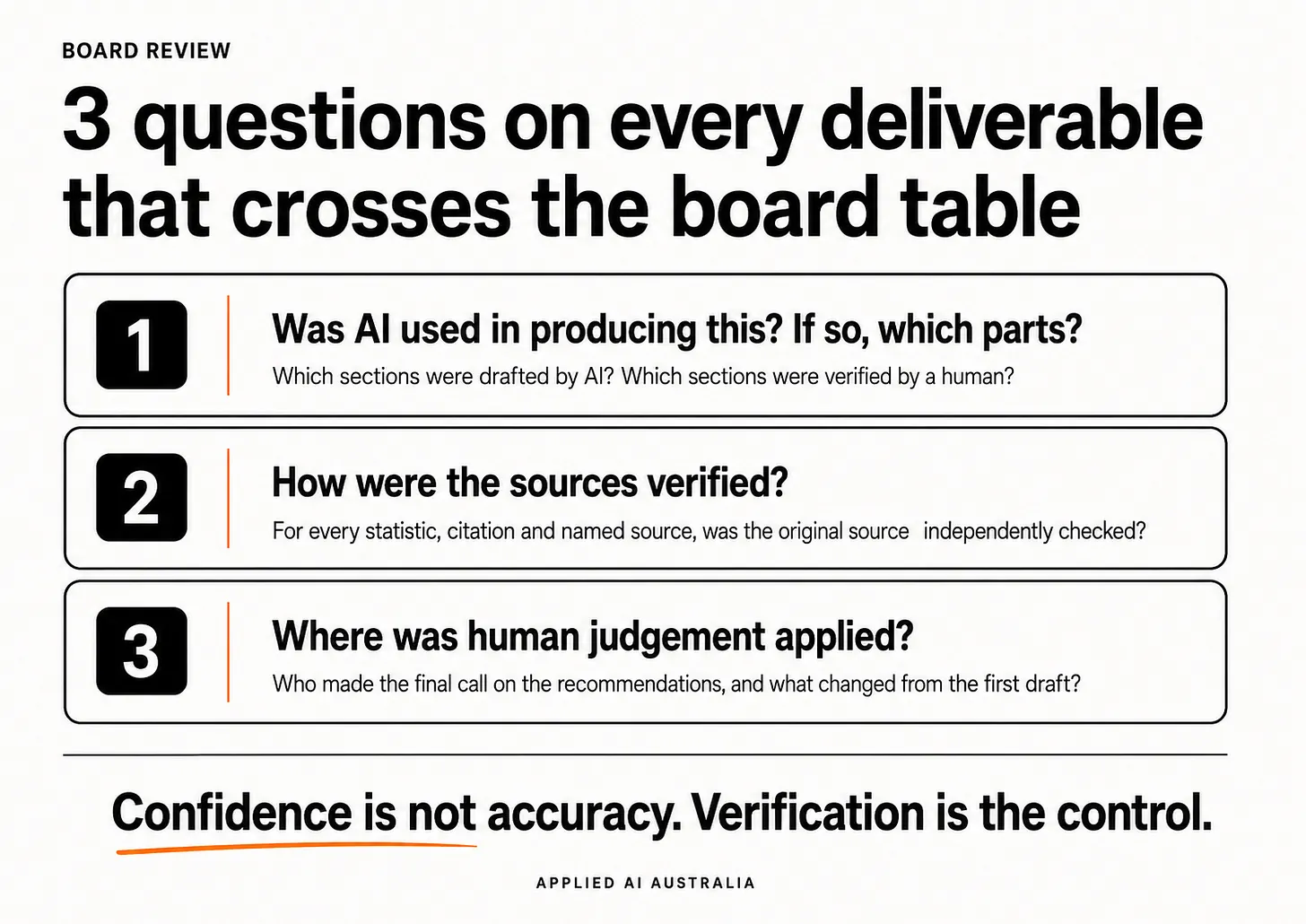
Question 1: "Was AI used in producing this? If so, which parts?"
What I actually say in the room: "Can you confirm whether AI tools were used at any stage of this work? If yes, which sections?"
Nobody is asking this yet, a year ago the question wasn't always necessary. The worst case used to be a tired analyst cutting corners on a Friday afternoon. The worst case now is fabricated evidence in a board paper that informs a capital allocation decision...
Why it matters commercially: if your board approves a $5m investment based on a strategy paper with fabricated market data, that quickly becomes a serious fiduciary issue. The liability sits with the directors who approved the paper.
Question 2: "How were the sources verified?"
What I say: "For every statistic, citation and named source in this document, what was the verification process? Were sources independently checked against original material, or carried forward from the AI output?"
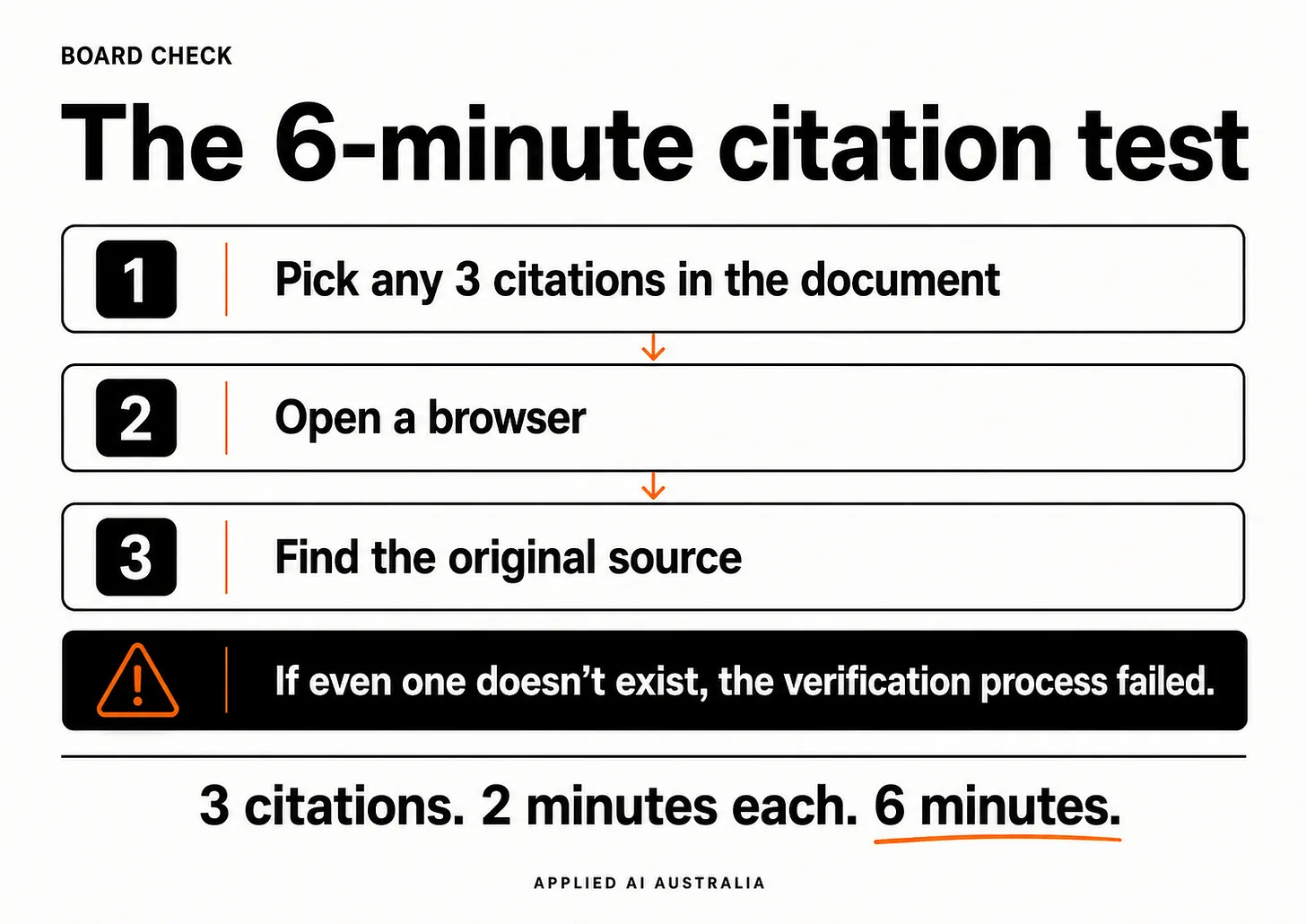
This is the question that would've caught the EY retraction before it went public. I run a simple test with clients:
- Pick any 3 citations in the document
- Open a browser
- Try to find the original source
If even one doesn't exist, the verification process failed.
3 citations, 2 minutes each, 6 minutes.
I ran this test on a risk assessment a client received from an external advisor earlier this year. 2 of the 3 citations I checked were real. The third referenced a report from a consulting firm that doesn't publish reports. The title sounded right, the date was plausible.......BUT the report didn't exist. Nobody in the approval chain had verified it, and the document had been tabled at a board meeting and used to inform a $2m procurement decision.
Add one line to your vendor contracts:
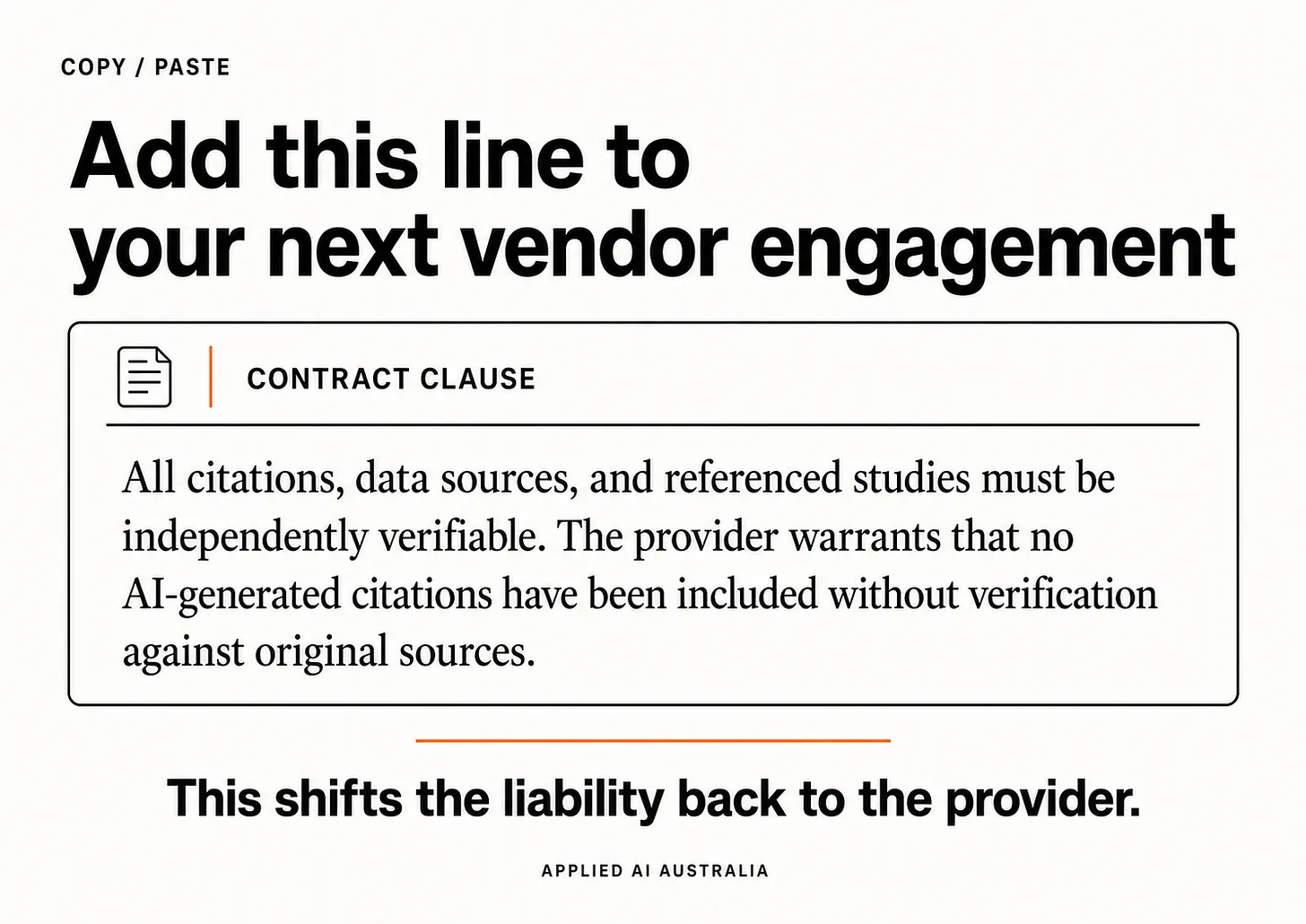
Your GC can draft that in 10 minutes, this shifts the liability back to the firm that produced the work.
Question 3: "Where was human judgement applied?"
What I say: "Who made the final call on the recommendations, and what did they change from the first draft?"
Good AI-assisted work has a clear human judgement layer. Someone reviewed the output, challenged the reasoning, and adjusted the recommendations based on context the model doesn't have. That's how you use AI-assisted work: sources get checked against originals, recommendations get stress-tested against client context, and if we use AI to draft a section, we flag which section and what we changed.
The tell is in the recommendations. Here's the test: open the recommendations section. If it says "implement a robust governance framework and invest in AI literacy across the organisation," that could apply to any company in any sector. If it says "your Q3 claims triage is running 3 automated decisions through a vendor model with no human override, and your October D&O renewal will price that in," someone with knowledge of your business wrote it. If the recommendations could apply to your competitor without changing a word, ask who actually wrote them.
3. Ask "how was this produced?" the same way you'd ask about a financial model
You want to know the assumptions, the data sources, and who signed off when you look at any business case right?
AI-assisted work deserves the same scrutiny:
The OAIC's submission to the Productivity Commission this month argued for stronger privacy protections around AI adoption, not looser safeguards (OAIC submission, 22 May 2026). APRA flagged AI-related governance and controls as a growing supervision focus the day before (APRA System Risk Outlook, 21 May 2026).
If you're thinking "our advisors wouldn't do that," consider this: they might not know they're doing it. Junior staff use AI to draft sections. Managers review the output without checking the citations. Partners read the executive summary. The 60-page deck lands on your board table looking polished and thorough, and the process failed 3 levels down.
Nobody above caught it because nobody asked
4. Do these three things before Friday
If you're a Chair: pick the last advisory deliverable your board received. Use the 3 questions. If you can't get clear answers to all 3, you've likely found the gap. Request a verification protocol from your GC by 30 June.
If you're a CFO: run the 6-minute citation test on any document your board received this quarter. Pick 3 citations, open a browser, check them. The whole thing takes 6 minutes.
If you're a General Counsel: add the verification warranty clause to your next vendor engagement. Draft the contract language this week. Add "AI disclosure and verification" as a standing item on the board risk register.
If you're a CEO: ask your executive team one question: "On the last piece of external advisory work we received, did anyone check whether the citations were real?"
Before Friday: run the 6-minute citation test on one document your board received this quarter.
Forward this to your General Counsel or Board Chair.
Until next time, Ramon.
If your AI investment is not hitting the P&L
I'm now taking executive briefings with Australian Boards and executive teams between $100 million and $1 billion in revenue. We surface where AI matters in your business, what risks need control, and what the right next step looks like before any budget is committed.
What we'll cover
- Where AI is already affecting growth, margins, time and risk in your business (including governance on APP 1.7.
- Which business problems are worth investigating
- The right next step. Audit, workshop, roadmap, or pilot
About Applied AI Australia
I am an executive who advises, not a career consultant.
After carrying the P&L at News Corp, I built Applied AI Australia because I kept seeing smart executives sold vague AI strategies that never changed the bottom line.
CEOs and CFOs do not need more AI "hype". They need to know which decisions AI should change, what risk it creates, and how to get value without creating chaos.
Staying up to date with AI is hard, so we publish a regular podcast and weekly newsletter to give busy executives the judgment they need in less than an hour a week.
Listen on Spotify or Apple Podcasts.
**Disclaimer:**Nothing in this newsletter is legal, financial, or professional advice. It is research, pattern‑recognition, and practical operating observations for Australian boards and executives. Before acting on any of it, speak with your own adviser, or get in touch if you want to discuss an engagement.
Ready to deploy AI with confidence?
Get board-ready frameworks and strategic guidance for Australian executives navigating AI transformation.
Discuss your AI problem