Machine Customers Are Coming for One Fifth of Revenue
The full conversation with Katja Forbes, Executive Director at Standard Chartered's corporate and investment bank and author of The Machine Customers - is.
The full conversation with Katja Forbes, Executive Director at Standard Chartered's corporate and investment bank and author of The Machine Customers - is now live on Apple & Spotify.
I gave my credit card to an AI agent last year, It found me a cheaper flight on Virgin, rebooked it, and I arrived three hours late for a meeting. It never checked my calendar. It got stuck on a dropdown menu, guessed around it, and picked a departure time that looked right to a machine and wrong to anyone with a diary...
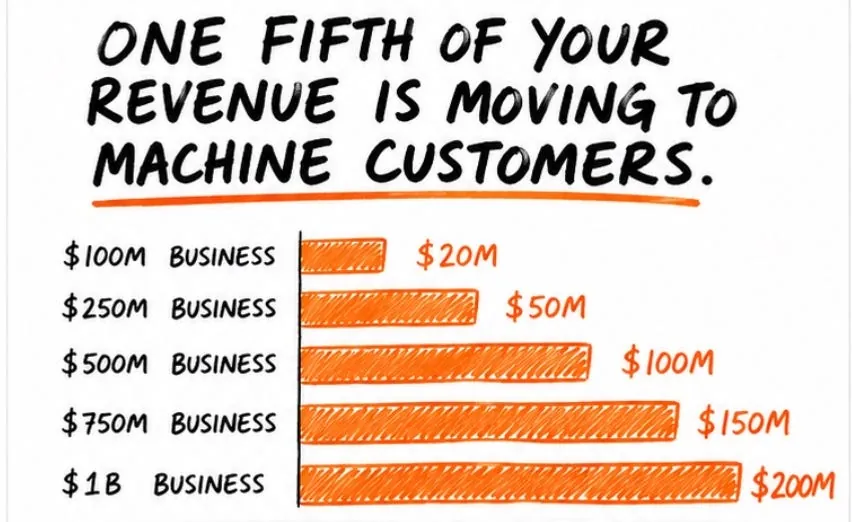
Gartner expects machine customers to account for at least 21% of revenue by 2030. For a $500 million Australian business, that's $100 million arriving through software, not a person clicking "add to cart".
Your website, your pitch, your checkout were all built to win a human. The next buyer isn't one.
1. The Five Types Already in Market
The co-buyer. You and your AI agent shopping together. In corporate procurement, this looks like a category manager delegating the vendor search to an agent, the agent comparing terms and pricing across 20 suppliers, then freezing at a checkout that requires phone verification. The human has to step in - the conversion stalls. Competitors whose sites are agent-readable will win the contract.
The delegated agent. You hand the agent the outcome and walk away. Walmart does this already: buyers give an AI system a budget and constraints, and it negotiates directly with suppliers on smaller contracts. Walmart reports average savings of about three percent and says three out of four suppliers prefer negotiating with the AI over a human. The human sets the goal; the agent works out the how.
The autonomous buyer. No human in the loop. A factory's predictive maintenance system spots a failing rotor, orders the replacement part through the ERP system, and books the install.
The multi-agent network. The UAE has committed to moving about half of its government sectors, services and operations onto agentic AI within two years, positioning AI agents as operational partners rather than just tools. That includes service delivery and back-office functions, and procurement.
The intermediary broker. Amazon has Rufus. Walmart has Sparky. Woolworths has Olive. These agents sit between buyer and seller, and they work for the retailer, not for you. If your product doesn't fit what Rufus rewards, price and compliance, it doesn't get recommended.
2. B2B and B2C Are Changing
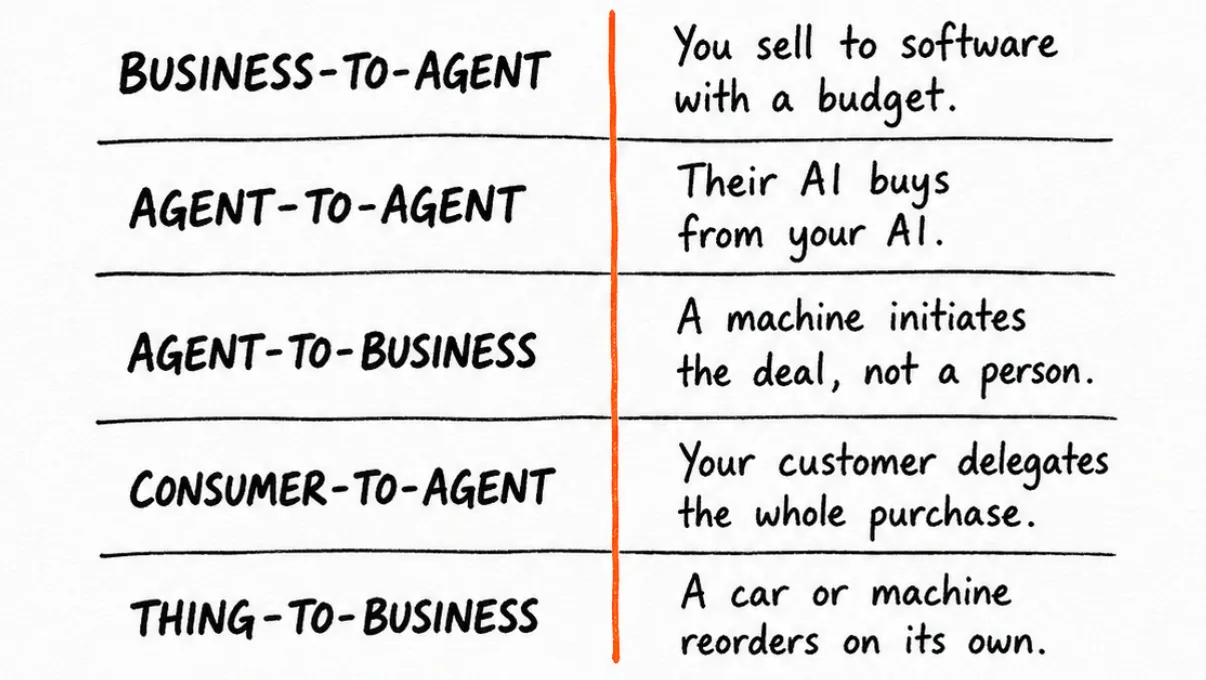
Every business on earth runs on one of four models: B2B, B2C, C2B, or C2C. Each one assumes a human on at least one side of the deal.
Copy-Paste Prompt
Review our top 3 revenue streams. For each one, identify the commercial model most likely to disrupt it first: Business-to-Agent, Consumer-to-Agent, Agent-to-Agent, Agent-to-Business, or Thing-to-Business. Estimate the revenue at risk and the likely timeline. Our business: [industry, size, primary channels].
3. The Internet Wasn't Built for This
OpenAI partnered with Walmart on "Instant Checkout", letting people buy 200,000 products inside ChatGPT without leaving the app. Conversion was 3x worse than Walmart's own website.
The checkout was the problem. AI agents can't get through dropdown menus, pop-ups, multi-step forms, or the friction we build into a page to reassure a human.
We need different doors for different machine customers. A delegated agent buying one ergonomic chair needs a different door than a smart building ordering 3,000.
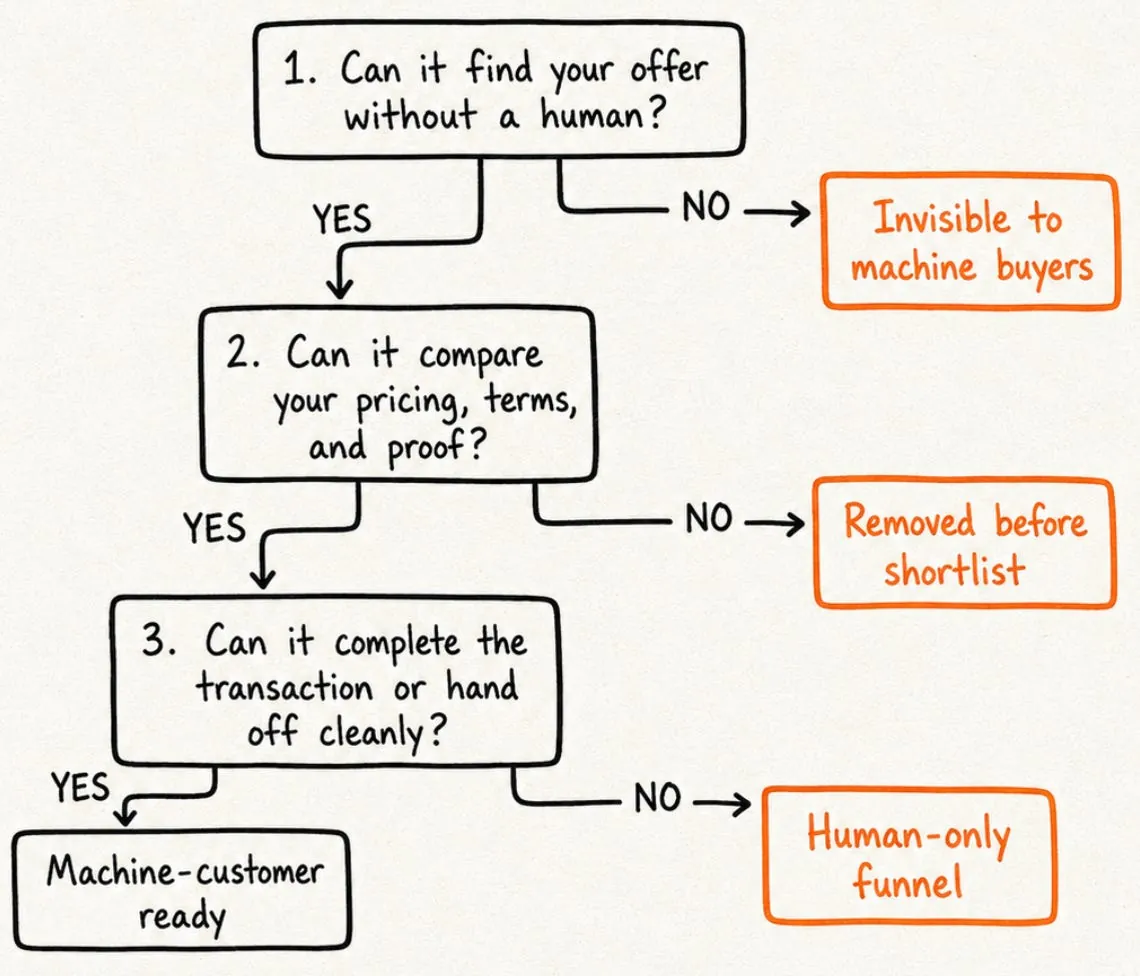
Picture a $200m Australian industrial supplier, most of its revenue in annual contracts. Can an agent find it? Yes, the catalogue is indexed. Can it read the price and the terms? No, every quote hides behind "contact sales".
Can it place the order? No, the contract still needs a signature in ink. Two doors out of three are shut.
4. Growth Over Efficiency
Every AI conversation I've had in Australian boardrooms this year still sounds like this "Ramon, how do we do the same thing with fewer people?" Efficiency makes your P&L look healthier for a quarter. It does not give you a new revenue line.
If you want to see what growth looks like, look at cross-border finance. Last year, $208 trillion flowed across borders. The banks moving the cash took a $625 billion clip. Today, treasury platforms like Kyriba run agentic AI that manages liquidity autonomously. An agent watches positions across global accounts and sweeps cash in real-time based on the treasurer's rules.
When you put an agent in charge, it doesn't just do the old process cheaper. It actually strips out the human delay. Volume and velocity both climb.
New products, new transaction flows, and new pricing models that only exist because the buyer is software.
Stop asking how AI can cut your headcount....How it can capture the revenue you didn't notice walking out the door?
Blocking machine buyers doesn't work. Legacy security systems will flag legitimate automated transactions as malicious bots, and the agent will simply take its budget to a competitor whose checkout is machine-readable. The only approach that holds is to build dedicated pathways, make your terms discoverable, and transition from KYC to KYA.- Applied AI Australia S2E9 → Listen here
5. Know Your Customer > Know Your Agent
Every customer registration, sign-off process, and sales workflow your business has built was engineered for a buyer with a face, an email address, and a pulse. Machine agents have none of those...
If your online portals or sales channels cannot verify who owns an incoming agent, what it is authorised to spend, what its preferences are, what supports conversion, what slows it down this is going to impact the balance sheet.
If your digital security is too tight, it blocks automated buyers and you lose the revenue. If it is too loose, a rogue agent can execute invalid orders.
The payment and tech infrastructure is already outstripping corporate governance:
Stripe has deployed dedicated payment rails specifically built for AI agents.
American Express covers transaction losses if a registered agent makes a purchase in error.
Visa and Mastercard are rolling out trusted agent tokens and digital cryptographic signatures.
Machine-Customer Readiness: 5 questions for your next board meeting
- Niche Exposure: Have we named which machine customer type (co-buyer, delegated, autonomous, multi-agent, or broker) is most likely to transact with us first?
- Headless Commerce: Can a purchase complete on any of our digital channels without a human UI?
- KYA Process: Do we have a KYA (Know Your Agent) process to verify the identity, permissions, and ownership of a machine customer?
- Revenue at Risk: Have we sized the revenue at risk if one in five of our transactions goes machine-initiated within four years?
- Structural Ownership: Is there a named owner for machine-customer readiness, or is it sitting with "digital" by default?
Before Friday: Pick your highest-revenue channel and ask your team: If an AI agent tried to buy from us today, where would it break?
Forward this to whoever owns growth in your company: "Which of our revenue lines still assumes a human buyer, and who owns rebuilding it?"
Until next time,
Ramon.
About Applied AI Australia
I am an executive who advises, not a career consultant.
After carrying the P&L at News Corp, I built Applied AI Australia because I kept seeing smart executives sold vague AI strategies that never changed the bottom line.
CEOs and CFOs do not need more AI "hype". They need to know which decisions AI should change, what risk it creates, and how to get value without creating chaos.
Staying up to date with AI is hard, so we publish a regular podcast and weekly newsletter to give busy executives the judgment they need in less than an hour a week.
Listen on Spotify or Apple Podcasts.
**Disclaimer:**Nothing in this newsletter is legal, financial, or professional advice. It is research, pattern‑recognition, and practical operating observations for Australian boards and executives. Before acting on any of it, speak with your own adviser, or get in touch if you want to discuss an engagement.
Sources: Gartner (machine-customer forecast, Oct 2025); Katja Forbes, Machine Customers: The Evolution Has Begun; Mastercard Agent Pay Australia (Jan 2026); Anthropic (model-quality buying experiment); UAE government agentic-AI directive (Apr 2026); OpenAI/Walmart Instant Checkout, Search Engine Land (Mar 2026); Salesforce headless commerce rebuild; Adobe Analytics (AI retail traffic, Jul 2025); FXC Intelligence (cross-border payments market, Mar 2026); Kyriba agentic treasury workflows; American Express registered AI agent purchase protection; Stripe Agentic Commerce Suite / wallets for agents; Mercedes-Benz in-car agent; APRA AI risk and governance letter (30 Apr 2026); CPS 230 Operational Risk Management (commences 1 Jul 2026); Privacy Act automated decision-making transparency obligations (10 Dec 2026); Privacy Act maximum penalties (up to $50m); OAIC privacy compliance sweep (Jan 2026); Australian Clinical Labs penalty ($5.8m, Oct 2025)
Ready to deploy AI with confidence?
Get board-ready frameworks and strategic guidance for Australian executives navigating AI transformation.
Discuss your AI problem