One Backfill. $160K. Nobody Checked the Workflow.
VentureCrowd cut their team by 60%. The reason isn't what you think. (they are also AFSL regulated)
Listen now and subscribe: Available on Apple and Spotify
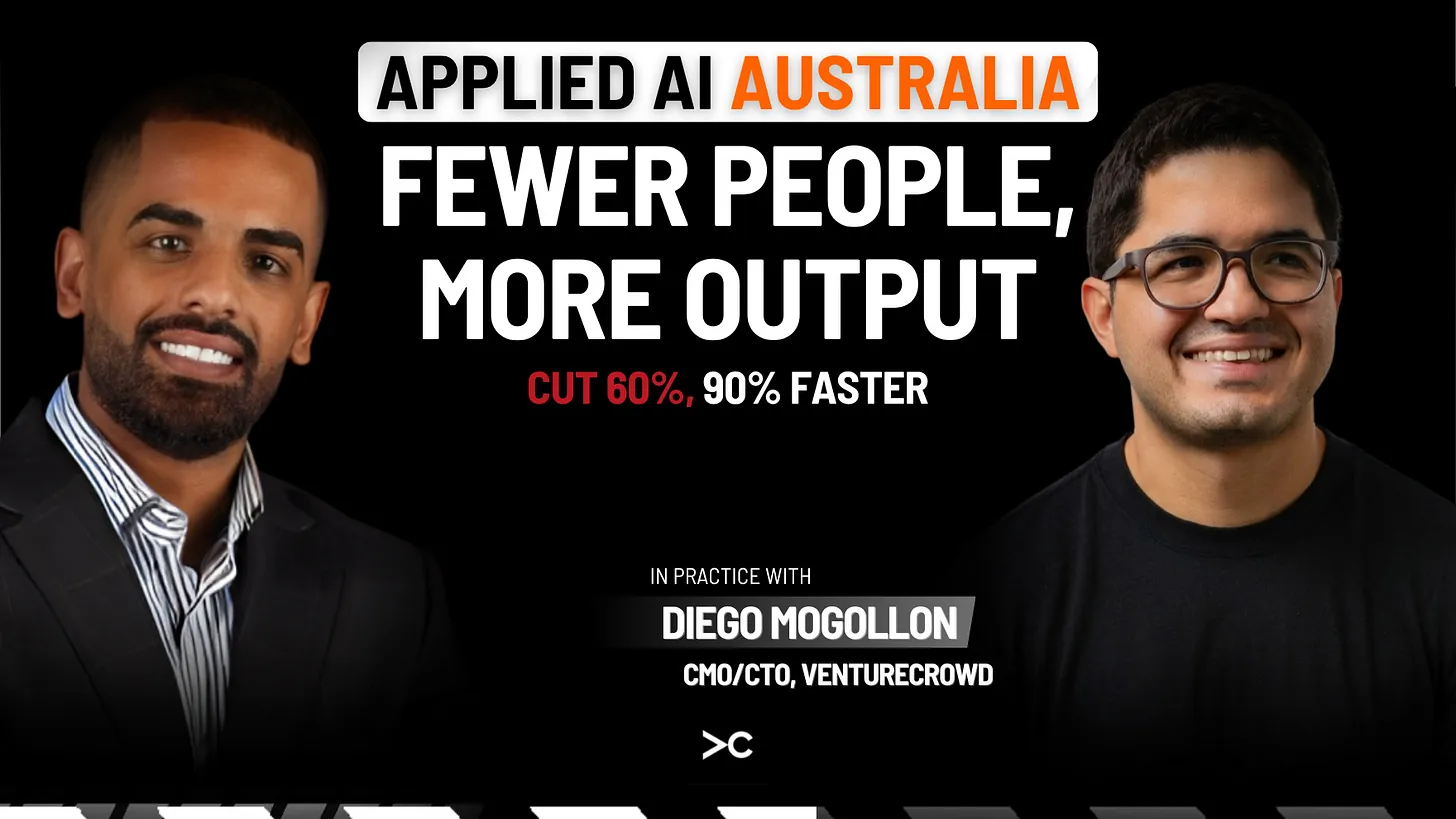
I sat with Diego Mogollon from VentureCrowd recently, his marketing team went from six people to one. His tech team is 60% smaller than two years ago. Development is 90% faster. He did this inside an AFSL-regulated business with $440 million raised and 79,000 registered members.
I approved a backfill last year without reviewing the workflow. Took six weeks to fill, three months to ramp, and by month four the person was doing work that a scoped agent now handles. That hire cost more than $150K in year one. The redesign would have cost a half-day and a $30/month subscription.
That was one role. I've since run the same review across three client portfolios. The pattern compounds.
Roles are collapsing. Job titles haven't caught up.
Diego's marketing team didn't shrink from six to one because he fired five and kept the best marketer. One person with the right agent setup now covers the workflow that used to need six. A designer who'd never written code is pushing to production through Slack.
I'm seeing the same pattern across clients. A sales rep at one org built their own pipeline dashboard last month instead of waiting three weeks for BI to queue it. A marketing coordinator at another is running competitive analysis that used to sit with the strategy team. Finance analysts developing investor decks without a designer or copywriter in the loop. It's not just ICs. I sat with a COO in Jan who built his own workforce planning model in Claude instead of briefing it to his Head of FP&A. Took him 40 minutes.
When the ELT starts doing work that used to belong to the layer below them, the layer below them needs a different job description.
Each of those examples used to be a two-role or three-role workflow. Now it's one person with agent support. You're not filling a job title any more. You're filling a workflow, and the workflow might need a completely different skillset than the job ad you posted last time. Diego found volunteers inside his existing team who could absorb broader scope once the tools changed. He would have missed every one of them if he'd gone straight to a job board.
ABS data released this month shows 337,900 jobs sitting vacant across Australia in February 2026, the highest level in over a year. AHRI tracking shows one in three Australian businesses operating with staff turnover above 20%. That's a lot of vacancy decisions being made on autopilot, while the economics of the work underneath are shifting.
McKinsey estimates disengagement and attrition cost a median S&P 500 company US$228 million to US$355 million a year. Quiet quitting alone costs nearly as much as actual turnover. Yes this is US large-cap data, but the pattern holds here: bad workflows get expensive before anyone resigns, because you pay for the inefficiency first and the replacement second.
What's inside:
- Why one unchecked $160K backfill is never just one
- VentureCrowd's three-question vacancy framework
- A calculator and checklist you can drop into your next req approval
- The retrospective prompt that will make your last three backfills uncomfortable
Diego's operating blueprint
When someone leaves, Diego doesn't automatically replace the role. He runs a redesign review first, using three questions in an order that forces clarity:
- What can an agent handle?
- Who can upskill into this?
- What can we redesign entirely?
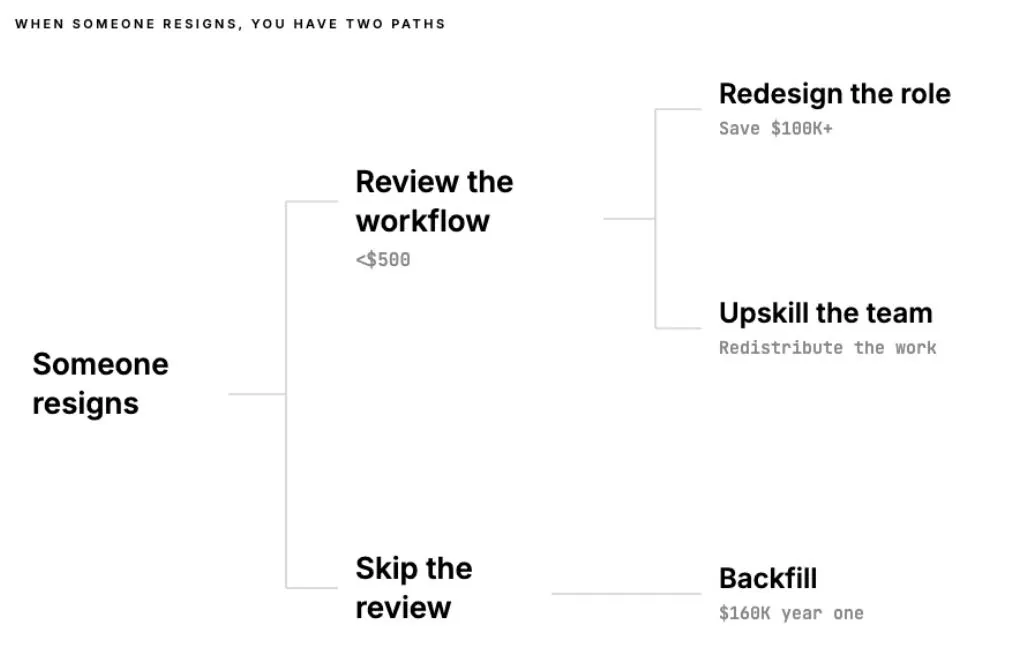
Vacancies are now a capital allocation decision. Diego walks through how he runs this, including how he onboards each agent, on the episode.
1. The backfill reflex is more expensive than it looks
The old reflex feels safe because it preserves the structure. Someone leaves, the team feels the gap, finance approves the replacement, and the org chart survives another year. A $90K role doesn't cost $90K. AHRI data puts the true replacement cost at about 1.5x annual salary once recruiting, onboarding, and lost productivity are counted. That puts a $90K role closer to $135K to $160K in year one. If the workflow genuinely needs a person, hire the person and do it fast. If the workflow should have been redesigned, the backfill becomes cost carry that gets mistaken for capacity.
☐ SAVE THIS CALCULATOR
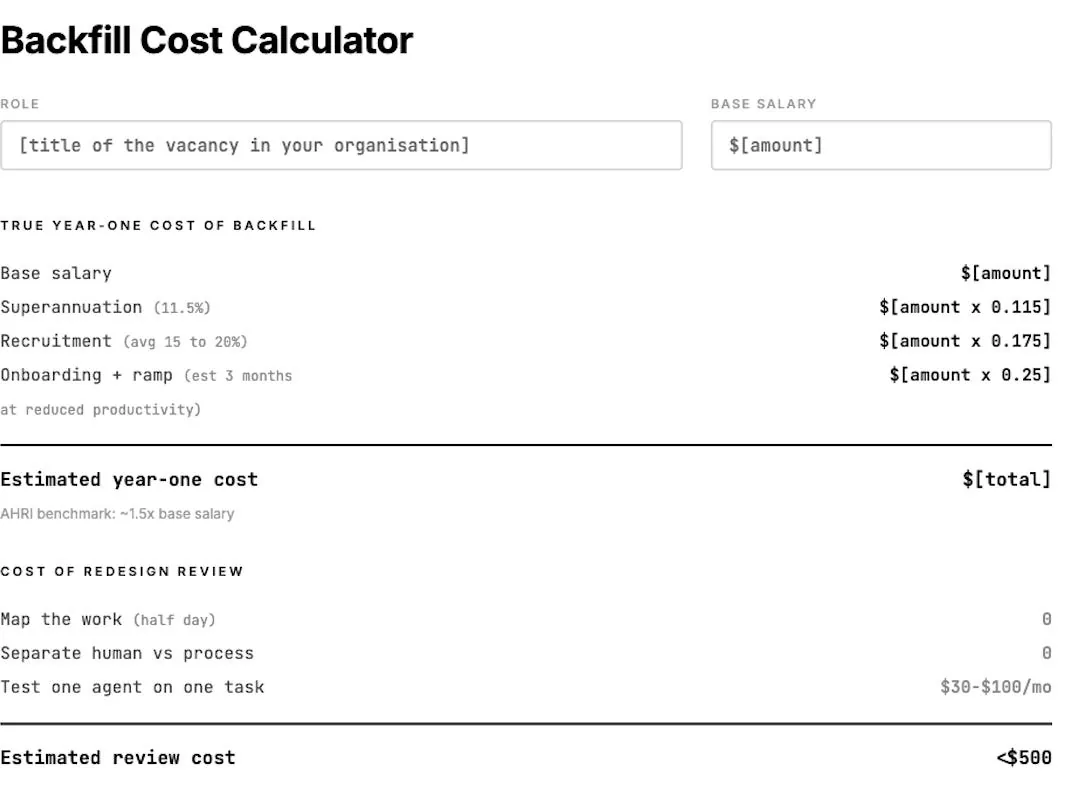
Is the gap between these two numbers big enough to justify 2 days of redesign before approving the req? If the answer is yes for even one role this year, this review pays for itself.
Drop this into your next vacancy decision. Fill in the numbers. Show the comparison to your CFO before the req gets signed. Now multiply that by every backfill your team approved this year without reviewing the workflow. A 200-person org at 20% turnover makes 40 vacancy decisions a year. If half should have been redesigns, that's 20 roles you waved through as backfills. If each one carries roughly $150K in year-one cost, that's a $3M decision set nobody audited.
2. Hiring is often the slowest way to recover capacity
The hidden cost in the old model isn't just salary. It's time. SHRM's median time-to-fill is 44 days, and that's before notice periods, onboarding, and ramp. The traditional recovery path is slow by design. Start by mapping the work. Separate the parts that need judgement from the parts that need process, then work out what can be automated, what can be absorbed, and what should be rebuilt entirely. In **VentureCrowd**s case, projects that used to take months are getting done in two weeks. In most businesses, cycle time is where margin disappears, slow decisions and slow execution compound in ways payroll never shows you....
If hiring is your default answer to every capacity problem, you pay twice. Once in salary, and again in speed...
3. This only works if risk stays controlled
VentureCrowd operates under AFSL regulation. The cost of getting customer or investor communication wrong cannot be overlooked. Diego's view: guardrails come first, before agents go anywhere near customers or investors. They automate inside defined boundaries, with named owners and hard limits on what touches customers without review.
Diego breaks down each phase of this, including his favourite agent and the one that cut his own debugging time by 90%, on the full episode.
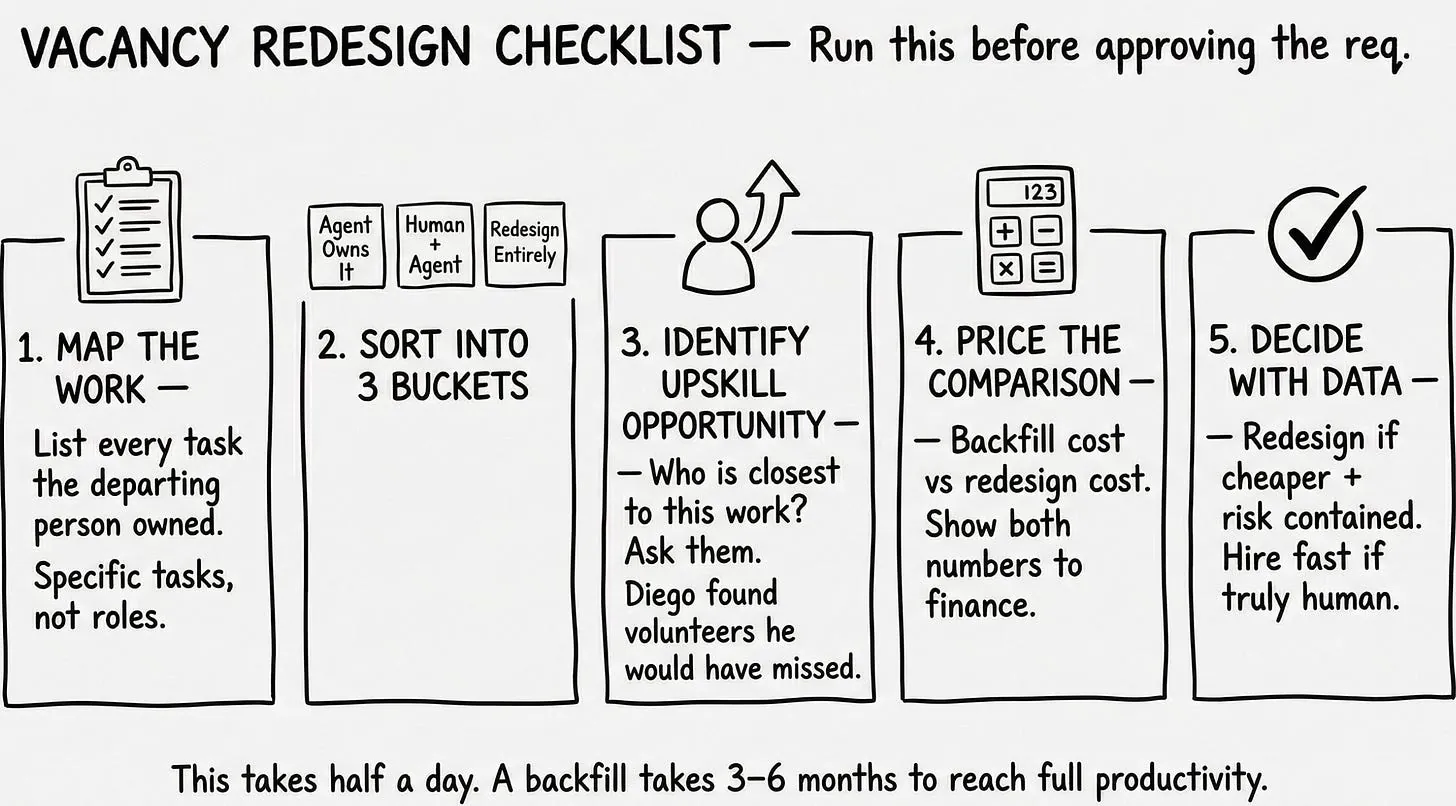
Pin this to your wall. Run it the next time a resignation lands on your desk.
How to use this newsletter as an AI input
Upload this entire newsletter into Claude or ChatGPT Enterprise. Then paste:
"Based on this newsletter, review my organisation's last 3 backfills
against the vacancy redesign framework described.
My organisation: [your industry and size].
The roles: [list titles, salaries, and key tasks].
Flag any role where more than 40% of tasks could have been
handled by a scoped agent or process redesign.
Show the cost comparison for each."
Use the output as your first-pass case before the next req gets signed.
⚠ Governance note
This only works if control stays intact. VentureCrowd operates under ASIC regulation with AFSL licences, which means speed is being built with guardrails. If your organisation is deploying agents without clear data boundaries, you're carrying a compliance exposure. Under the Privacy Act and the OAIC's Australian Privacy Principles, you're responsible for how personal data enters AI systems, whether you approved the tool or not. ASIC's regulatory technology guidance applies to any financial services licensee using AI in customer-facing or decision-support contexts. A safe internal sandbox with guardrails costs less to build than one ASIC inquiry to manage.
My recommendation: keep a human in the loop. Worst case, you're approving work that needs coaching. The 2026 version of continuous improvement.
Before Friday:
- Pull up the last role your team backfilled.
- Run the Backfill Cost Calculator on it retrospectively.
- Compare the year-one cost against what a redesign review would have taken. Takes 15 minutes. If the gap is more than $50K, you've already found the business case.
- Then multiply by every backfill your team approved this year.
Stop treating every vacancy like a hiring decision. Some of them are redesign decisions now. Some will be next quarter. The number is higher than most leaders think, and it grows every day. To be clear, you can't automate every role to an agent. Nowhere close, but there's more that's possible today than most organisations have tested.
Next week I'll cover the actual agent workflows that are proven for mainstream roles, what they can do, and what they can't. I've built and tested every one of them. I'll also show you how to build your own, if you're feeling adventurous.
Forward this to your CFO: are we funding capacity, OR preserving a workflow that should already have been redesigned?
Listen to the full conversation, it covers the debugging agent that cut his team workload by 90%, the full vacancy strategy behind a 60% team reduction, and why his designers are now pushing code to production. Worth the full 40 minutes.
Listen now and subscribe: Available on Apple and Spotify
Need an executive workshop? DM or email me - Workshop, and I will be in touch.
Ramon.
Sources:
ABS Job Vacancies (February 2026 release): https://www.abs.gov.au/statistics/labour/jobs/job-vacancies-australia/latest-release
AHRI turnover data cited by Scale Suite: https://www.scalesuite.com.au/resources/australian-employee-turnover-statistics-2026
AHRI replacement cost benchmark cited by HumanX HR: https://www.humanxhr.com.au/blog/the-real-cost-of-high-employee-turnover-2
AHRI replacement cost benchmark cited by Accurate Australia: https://www.accurate.com/au/blog/the-hidden-costs-of-employee-turnover/
SHRM median time-to-fill cited by Amtec: https://www.amtec.us.com/tools/cost-of-vacancy-calculator
McKinsey on disengagement and attrition value destruction: https://www.mckinsey.com/uk/our-insights/the-mckinsey-uk-blog/the-hidden-costs-of-quiet-quitting-quantified
VentureCrowd company-stated data: https://www.venturecrowd.com.au/s/lp/vch-equity-eoi
Ready to deploy AI with confidence?
Get board-ready frameworks and strategic guidance for Australian executives navigating AI transformation.
Discuss your AI problem