The Fable 5 Lesson: Your Single Point of AI Failure.
One supplier can control your model cost, your continuity risk, and your ability to capture better price-performance.
One supplier can control your model cost, your continuity risk, and your ability to capture better price-performance.
Months before the Fable shutdown, I told clients to simplify. The models were becoming powerful enough for governments to control access, and access would stop being something "everyone" had access to.....at the time, that sounded like a stretch.
In June, that changed.
The US government applied export controls to Anthropic's Fable 5 and Mythos 5 - Anthropic removed access globally. The capability was sensitive enough for the government to decide who could use it. The block lasted nearly three weeks. Any team with the model embedded in a workflow had no warning or migration window.
Standardising on one supplier is disciplined only if access & value stays stable. The more useful the model becomes, the more exposure the business carries. These are two things you cannot depend on - AI development is moving faster than we can plan.
One supplier carries three prices
**1) Margin:**You pay frontier rates on work that never needed a frontier model: formatting supplier addresses, first-pass invoice extraction, routing inbound email, summarising internal calls.
A Melbourne CFO showed me a $99,500 annual AI projection earlier this year. Twenty minutes after we mapped the actual workflows, the same output came in under $10,000. They had defaulted to the best model for everything because they treated the "best" model as the default.
**2) Continuity:**When your operating model runs on one supplier, you do not fully control the workflow your revenue depends on. The Fable 5 shutdown is the latest example. Orgs had unintentionally built a single point of failure. With one supplier, the buyer carries price changes, outages and policy decisions outside their control.
**3) Control:**Your company can own its data and still lose control of the workflow built around it. When one supplier controls the model, the access terms, the pricing and the practical cost of switching, your options are limited.
Test whether you can move the workflow without breaking cost, service, governance or speed. Single-supplier dependence also weakens your negotiating position - a vendor who knows you cannot leave has no reason to hold pricing.
There are also some great options out there that aren't exactly 'top of mind' but are right on the frontier. I've been using Chinese models like DeepSeek and GLM 5.2 for the past year. Honestly, I can't tell the difference on most tasks- some even perform better, and at up to 10% of the cost. If you haven't checked them out yet, links are below.
GLM:
| Deep Seek:
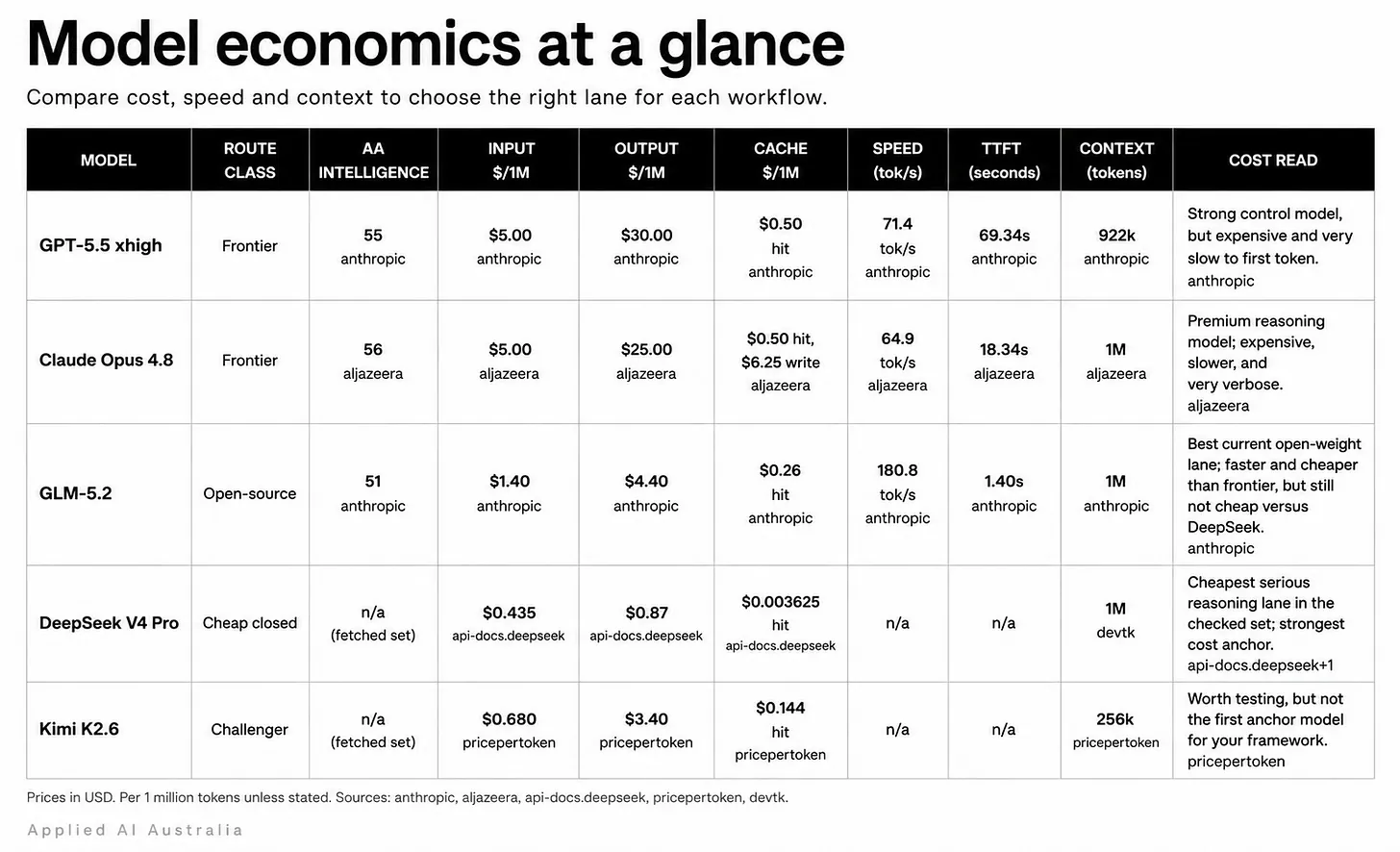
One caveat: I run these on non-sensitive work. If a workflow touches customer, regulated or confidential data, run it through the gate below before you route anything offshore.
Standardising still works below the threshold
Optionality adds hidden costs. Routing across several models requires an abstraction layer, continuous evaluation, model-specific tuning, extra monitoring, and dedicated QA.
Cheaper models can also create rework; a single bad extraction can erase any initial savings. Ultimately, a cheaper token price does not always translate to a lower total business cost.
While a single, dedicated supplier can offer better support, higher rate limits, a clearer product roadmap, and stronger security or data-residency commitments.
Also tokens do not represent the entire cost. Once you factor in human review, tooling, hosting, and development, a massive saving on model usage barely moves the needle on the overall business case.
This is why vendor independence only pays off above a certain threshold. Below a specific volume and risk level, sticking with one strong supplier is often the better call. Above that threshold - or in scenarios where losing a supplier would completely stop the workflow - implementing a fallback system easily justifies the extra development cost.
Governance note
I covered the broader APP 1.7 disclosure issue in issue 29 and this week's episode, The AI Decision Deadline Executives Can't Ignore.Spotify or Apple Podcasts.
APP 1.7 commences on 10 December. In my experience, mapping your automated decisions properly takes anywhere from 8 to 16 weeks for internal teams. The stakes are high, with serious privacy breaches attracting penalties of up to $50 million.
If getting compliant before December is on your radar but the work hasn't been done, we can help. Acquire Intelligence is running a small number of dedicated APP 1.7 readiness sprints to get teams sorted.
We have very limited capacity for these, so if you need to get this off your plate, reply directly to this email with "APP 1.7" and we'll get right back to you
The routing gate: should this workflow be on the frontier?
Score each workflow 1 to 3 on five dimensions - add them up.
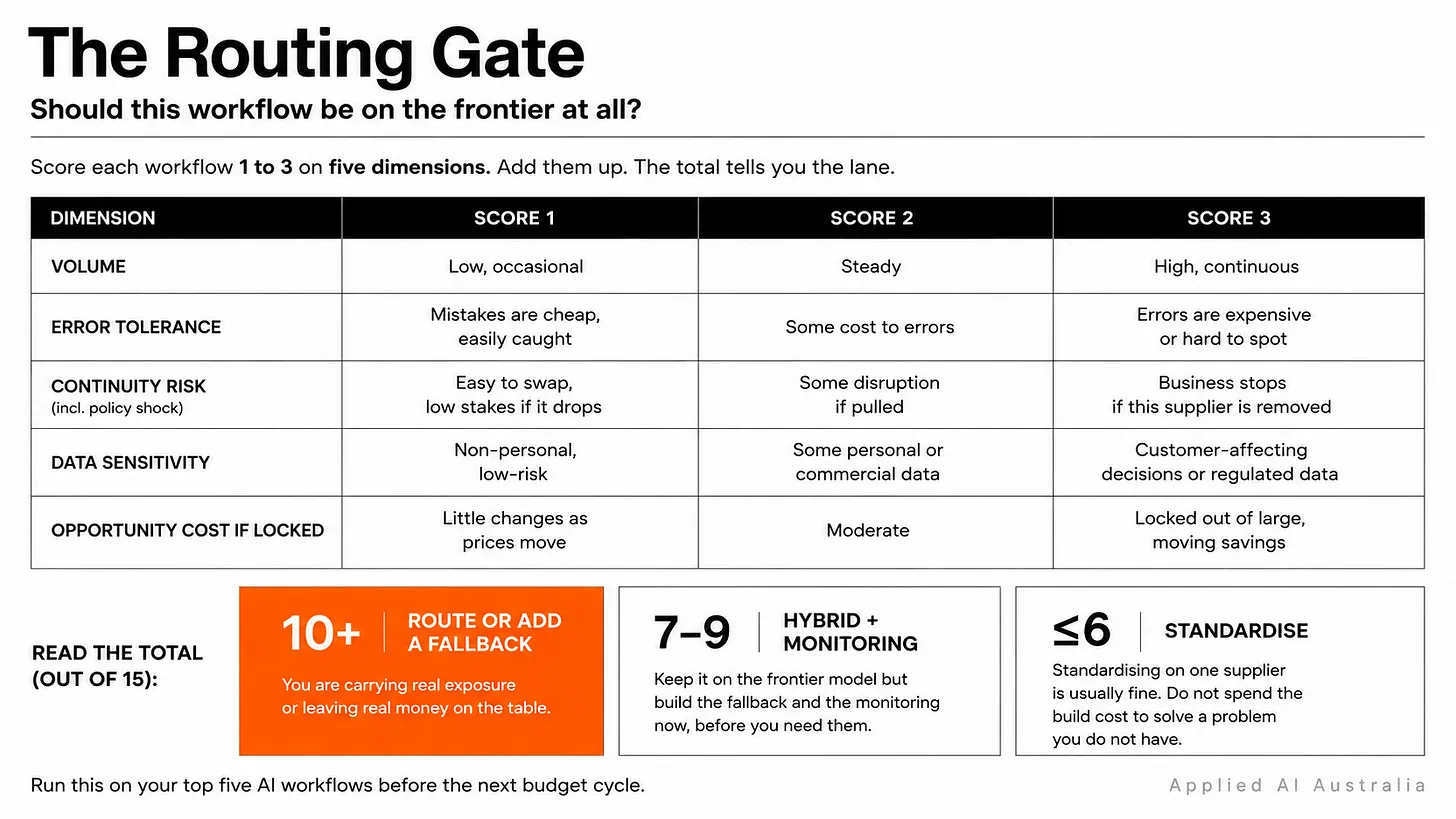
Read the total (out of 15):
10 or above: Route, or add a cheaper controlled fallback. You are carrying exposure or leaving real money on the table.
7 to 9: Hybrid. Keep it on the frontier model but build the fallback and the monitoring now, before you need them.
6 or below: Standardising on one supplier is usually fine. Do not spend the build cost to solve a problem you do not have.
This will not be the final answer...but It is a better starting point than putting high-volume, low-risk work on the most expensive model by default.
Worked examples, so you can copy and edit:
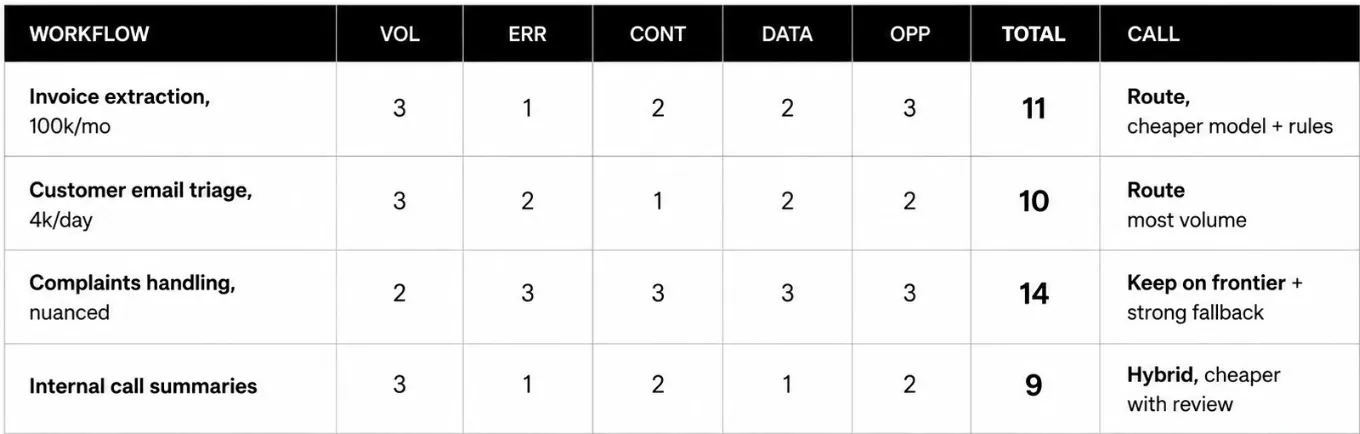
Let the model interview you - copy this into Claude or ChatGPT, no need to fill anything in the model will ask you what it needs.
You are helping me run a model-routing gate on my organisation's AI workflows.

Your job is to interview me, collect the missing information, then produce a scored routing table.

<context>
I want to assess which AI-assisted workflows should:
1. stay standardised on one supplier,
2. use a hybrid setup with fallback and monitoring, or
3. be routed dynamically or given a cheaper controlled fallback.

Do not ask me to fill in a template upfront. Interview me one question at a time, using plain business language.
</context>

<interview_rules>
Ask only one question at a time.

Start by collecting:
1. My organisation's industry
2. Approximate organisation size
3. Main regulated exposures or sensitive data types
4. The AI-assisted workflows we currently use or are considering

For each workflow, collect:
- What the workflow does
- Rough monthly volume
- Who uses or relies on the output
- What happens if the output is wrong
- Whether errors are usually caught before they matter
- Whether the workflow uses personal, customer, confidential or regulated data
- Whether the workflow would be hard to move away from if the AI supplier changed price, policy or availability

After each answer, decide whether you have enough information to score that workflow. If not, ask a targeted follow-up.
</interview_rules>

<scoring_method>
For each workflow, score 1 to 3 on five dimensions:

1. Volume
- 1 = low or occasional use
- 2 = regular but not operationally heavy
- 3 = high-volume or continuous use

2. Error tolerance
- 1 = errors are cheap, obvious or easily caught
- 2 = errors create moderate rework or reputational risk
- 3 = errors are expensive, hard to spot, customer-affecting or legally risky

3. Continuity risk
- 1 = easy to swap supplier or pause workflow
- 2 = disruption would be inconvenient but manageable
- 3 = business process stops, degrades materially or creates serious dependency risk if the supplier is removed

4. Data sensitivity
- 1 = non-personal, non-confidential data
- 2 = internal business data, mildly sensitive information or limited personal data
- 3 = customer-affecting, regulated, confidential, privileged, health, financial, legal or high-risk personal data

5. Opportunity cost if locked
- 1 = little financial or strategic impact if locked into one supplier
- 2 = some potential savings or flexibility lost
- 3 = likely locked out of large savings, better models, routing gains or resilience benefits

Total each workflow out of 15.
</scoring_method>

<lane_rules>
Recommend a lane using this logic:

- 10+ = route dynamically or add a cheaper controlled fallback
- 7-9 = hybrid setup with fallback and monitoring
- 6 or below = standardise on one supplier

If any workflow scores 3 on data sensitivity, flag it as needing a governance check before any routing change.
</lane_rules>

<task>
1. Interview me until you have enough information to score the workflows.
2. Briefly summarise your assumptions before scoring.
3. Score each workflow using the five dimensions.
4. Recommend the appropriate lane.
5. Identify the single biggest risk or saving for each workflow.
6. Flag governance checks where required.
7. If my answers are vague, make a conservative scoring assumption and mark it as an assumption rather than pretending certainty.
</task>

<output_format>
When the interview is complete, return:

1. Brief assumptions
2. Routing table with these columns:
   - Workflow
   - Volume
   - Error tolerance
   - Continuity risk
   - Data sensitivity
   - Opportunity cost if locked
   - Total / 15
   - Recommended lane
   - Biggest risk or saving
   - Governance check needed?

3. Final recommendation:
   - Workflows to route or add fallback first
   - Workflows to monitor
   - Workflows safe to standardise for now
   - The next practical step
</output_format>

<quality_bar>
A strong answer must:
- ask focused questions instead of dumping a long questionnaire
- avoid scoring before enough information is available
- use conservative assumptions where risk is unclear
- separate facts from assumptions
- make the routing recommendation obvious
- highlight governance-sensitive workflows clearly

A weak answer:
- asks me to fill in the whole template manually
- gives generic AI strategy advice
- ignores regulated data risk
- recommends routing purely based on cost
- fails to explain the biggest risk or saving per workflow
</quality_bar>

Begin by asking me the first question only.
What you own before your next budget cycle
This is not a decision for IT or a working group - it is a COO decision, with the CFO co-signing the investment.
Before your next budget or vendor review, run the gate on your top five to ten AI workflows. Produce a single page that outlines three things:
- Which workflows stay on the frontier model and the strategic reasoning why.
- Which workflows move to a controlled, cheaper option to optimise costs.
- One definitive dollar figure: either the annual run-cost you will stop leaking, or the continuity exposure you are choosing to carry deliberately.
That is the minimum useful output: a named list and a single, owned number, signed by the two executives who carry the risk.
Models will continue to grow more powerful, meaning governments will keep taking an interest and market prices will keep moving.
Run the gate. Own the number.
Forward this to your COO: if our main supplier were removed tomorrow, which workflow breaks first?
About Applied AI Australia
Applied AI Australia helps executives turn AI into measurable business outcomes. We filter every initiative through one question: Does this increase revenue or decrease costs? If not, it's noise.
Leaders do not need more AI hype. They need to know which decisions AI should change, what risk it creates, and how to get value without creating chaos.
I am not a career consultant. I am a leader with 15 years of P&L experience, most recently as an executive at News Corp.
Following our acquisition by Acquire Intelligence, we combine this approach with a 10,000-strong global team that delivers enterprise execution.
We publish a regular podcast and weekly newsletter to give busy executives the judgment they need in less than an hour a week.
Listen on Spotify or Apple Podcasts.
Disclaimer: Nothing in this newsletter is legal, financial, or professional advice. It is research, pattern recognition, and practical operating observations for Australian boards and executives. Before acting on any of it, speak with your own adviser.
Ready to deploy AI with confidence?
Get board-ready frameworks and strategic guidance for Australian executives navigating AI transformation.
Discuss your AI problem