The P&L Filter: Why Your Investment Is Failing and How to Make It Work.
74% of AI pilots haven't hit the P&L. Here's the four-gate filter that separates the 26% that did.
AI fails in the workflow, in the ownership gap, and in the board meeting where nobody can name what changed in the P&L. I've sat in those meetings, and I've carried the P&L through them.
I finished up with News Corp on Thursday after nearly 9 years, leading commercial as GM, digital transformation across major portfolios and turning around a business in decline to deliver 160% growth, which taught me one thing: execution decides whether AI shows up in the numbers.
BCG found that 74% of companies using AI still haven't produced commercial value. This is the current reality even across some of the most resourced organisations in the world.
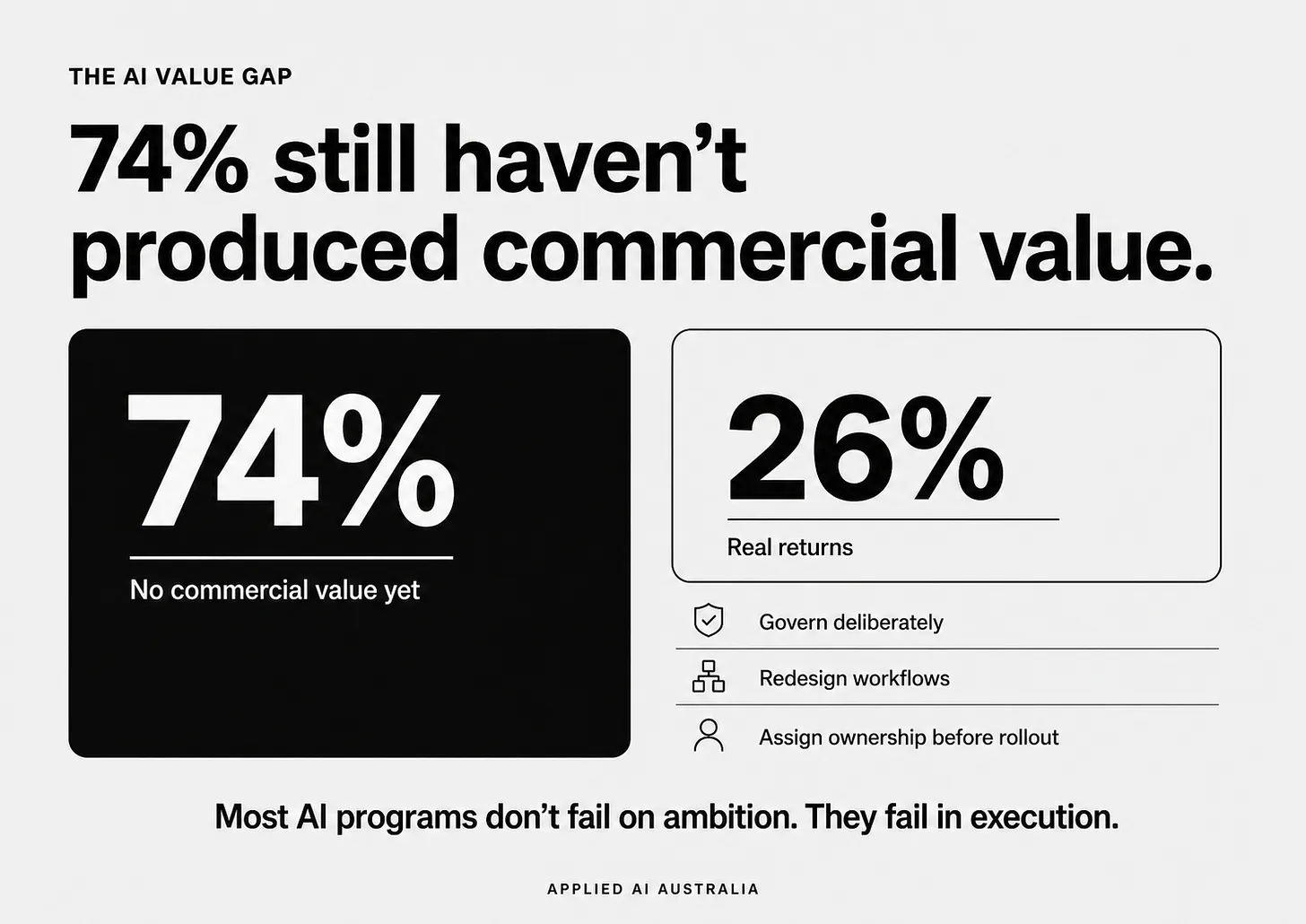
The 26% who do produce returns share a pattern. They govern deliberately, rebuild workflows before turning the tools on, and hold someone accountable for a number before the rollout begins.
Last week I walked through the trap most pilots fall into. Today we name what sits underneath it. Four gates every AI initiative has to pass before it earns executive funding.
The four gates below came from that pattern showing up consistently over the last 15 years. Investments in the hundreds of millions, some that worked and some that failed, but the pattern is clear.
Yellow Pages is the right reference point
YP decided who existed in Australian commerce for decades. If your business wasn't listed, you didn't exist. At its peak, Telstra's leadership looked at Sensis and saw a business that could rival Google.
"Google schmoogle" became one of the most quoted lines in Australian business history.
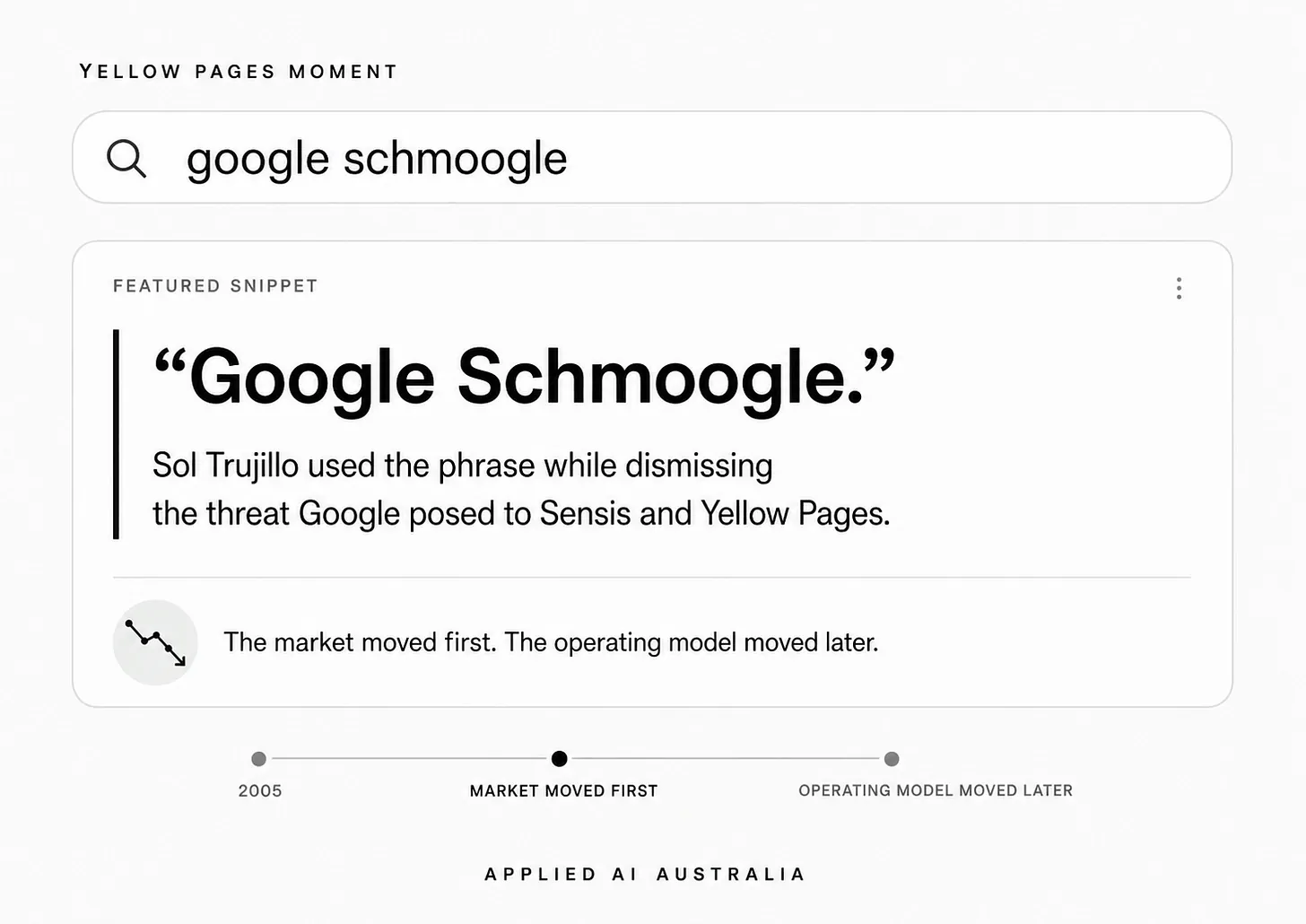
At its peak, Sensis carried an implied valuation of approximately $12 billion. By 2014, Telstra sold a 70% stake for $454 million. The floor disappeared in less than a decade.
I was inside that business during the transition, and close enough to watch what killed it. It was the delay between customer behaviour moving and the operating model responding. Separate print and digital teams ran in parallel, revenue still coming in, leadership still debating the size of the threat while it was already eating their lunch.
The same delay mechanism is operating in AI now. Customer behaviour moves first, operating models move later, and when the old model still makes money, leaders overestimate how much time they have...
What's different about AI
Every time a new technology arrives, people reach for the nearest comparison.
- AI is the internet
- AI is mobile
- AI is electricity
- AI is cloud
These comparisons are not correct, and AI is not comparable to the internet or anything we have seen in history. Every previous technology was an extension of what humans could do.
- Tools extended our hands
- Machines extended our muscles
- Writing extended memory
- Computers extended calculation
- The internet extended communication
- Humans always supplied the intent
This is what makes the current moment unique. Everyone is relatively new to this, and Microsoft, PwC, and the Big Four are all still figuring it out. You need to build operating discipline around AI fast, regardless of size.
Scale sharpened the lesson
Media sits at the centre of almost every major operating pressure: customer attention, platform dependence, data, trust, markets, regulatory engagement, and commercial pressure on a short cycle. When you're carrying a nine-figure P&L in a legacy institution under this level of pressure, you learn very quickly that a brilliant technological idea without an accountable operating model is just an expensive distraction.
Gate 1: The Filter (Which number moves?)
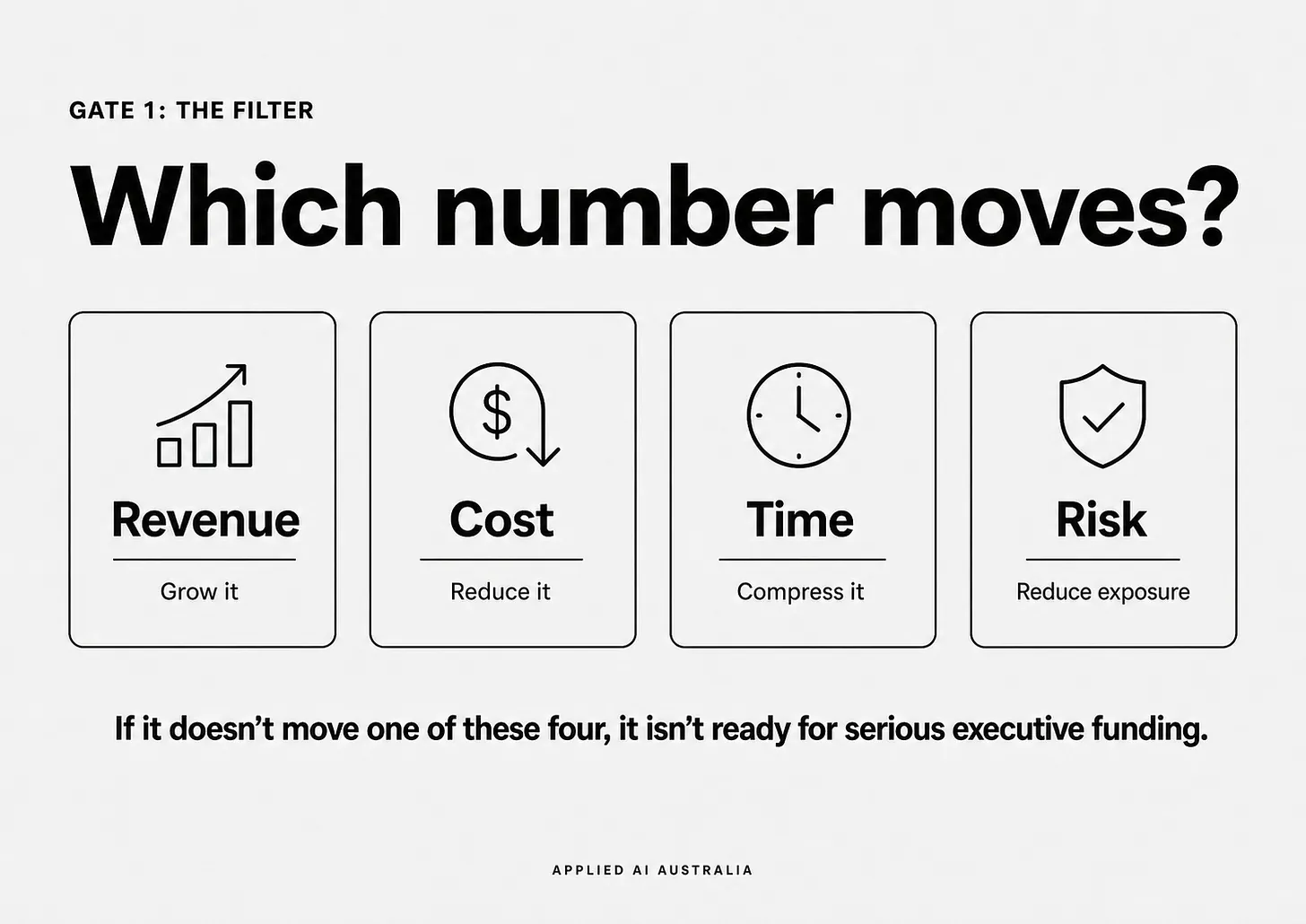
Which number moves? Revenue. Cost. Time. Risk.
If an AI initiative can't connect to one of those four, it might be interesting. It might be worth exploring, it might impress in a demonstration...but it still isn't ready to compete for serious executive attention.
I've sat in enough rooms where ideas sounded sensible on their own, but very few changed the number on the P&L. More reports, more dashboards, more process, and more activity is not bottom-line growth.
If an AI initiative doesn't increase revenue, cut cost, compress time, or reduce risk in a way you can measure: slow it down. Strengthen the case. Or kill it.
2020 forced the second lesson
In 2020, I moved to QLD to take on a director position just as COVID hit. Almost by accident, I ran into GPT-3. The mainstream conversation about ChatGPT didn't begin until late 2022. What I encountered two years earlier was raw and incomplete, but it worked.
I was operating with 50% less headcount, in a hiring freeze, against a market that was compressing. That year, we delivered 160% growth.
The first big win was using AI for market qualification and business development. I still remember the scream across the floor. "Ramon, it worked." We generated $1.2 million in revenue from a segment we'd never been able to crack.
That's when I became obsessed with how to connect this to a P&L outcome. The team needed to produce more with less, and the old way of working was too slow for the conditions.
AI earned its keep because it helped a team under pressure to produce more revenue, faster, with fewer resources. That's where the second gate came from.
Gate 2: Work Rebuild (What stops?)
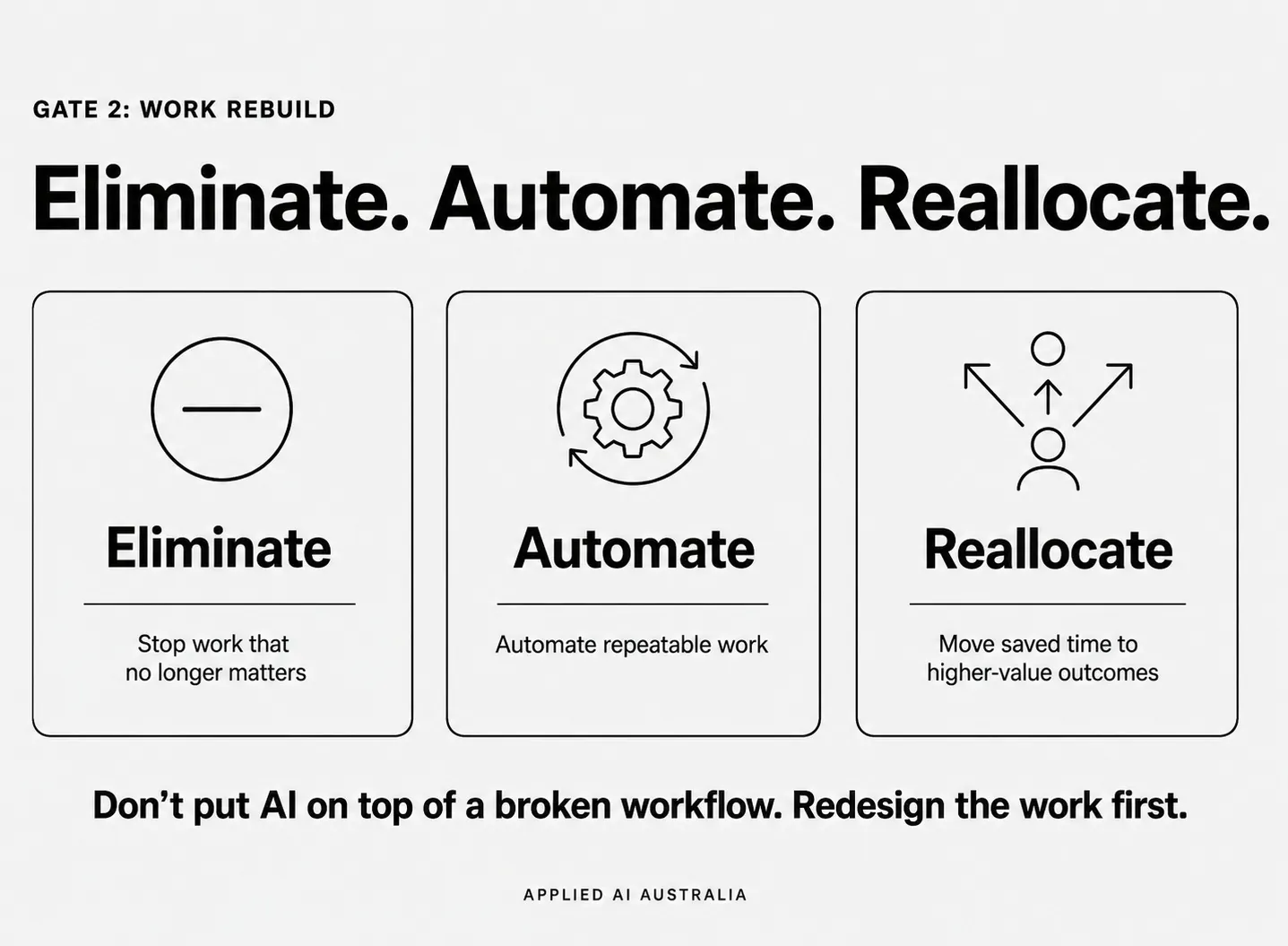
Eliminate. Automate. Reallocate.
What work should stop, what work should be automated, and where does the saved time go?
After the $1.2M scream we tried to scale it across the floor with the same prompt and the same tool, and within six weeks it was breaking. One of my reps walked into my office and told me we were slower than before, and I didn't believe her at first because the AI was producing five times the lead volume.
She walked me through it. The leads were piling up in a qualification queue waiting for her manager to sign off on each one before they went out. The AI had compressed the front of the workflow but the back of the workflow hadn't moved an inch."
This moment taught me more than the scream.. We sat down the next day and rebuilt the workflow itself, eliminated three steps, automated two, and reallocated the manager's time to coaching the reps on the leads that were converting. Cycle time dropped 60% and conversion came back.
Many organisations get this wrong because they automate too early, putting AI on top of an existing broken workflow and then wondering why the time savings disappear into review, rework and confusion.
McKinsey's research is clear that workflow redesign is one of the strongest predictors of EBIT impact from generative AI, yet only 21% of organisations say they've fundamentally redesigned at least some workflows.
The ledger tells the truth
By my early thirties I was sitting in rooms where the decisions carried weight, reporting into the board and Managing Director. Funding calls in the millions, restructure decisions that affected hundreds of people, commercial commitments that had to clear a board.
What changed in those rooms wasn't the topic, it was the standard. Every initiative competed with every other use of capital, management attention, and risk appetite. Ideas did not get funded just because they were interesting. They got funded when ownership was clear, risk was understood, and success could be measured before anyone signed off.
I sat through a pitch for a new platform. It was "best in class". The vendor flew in, two of our competitors were already using it, and the references were strong. The internal team had spent three months on the case and the demo was good.
I asked one question. What will the business do differently next quarter with this platform that it can't do with the current one? Nobody could answer. The platform was better but the business case wasn't there, so we didn't fund it. The ledger always tells the truth.
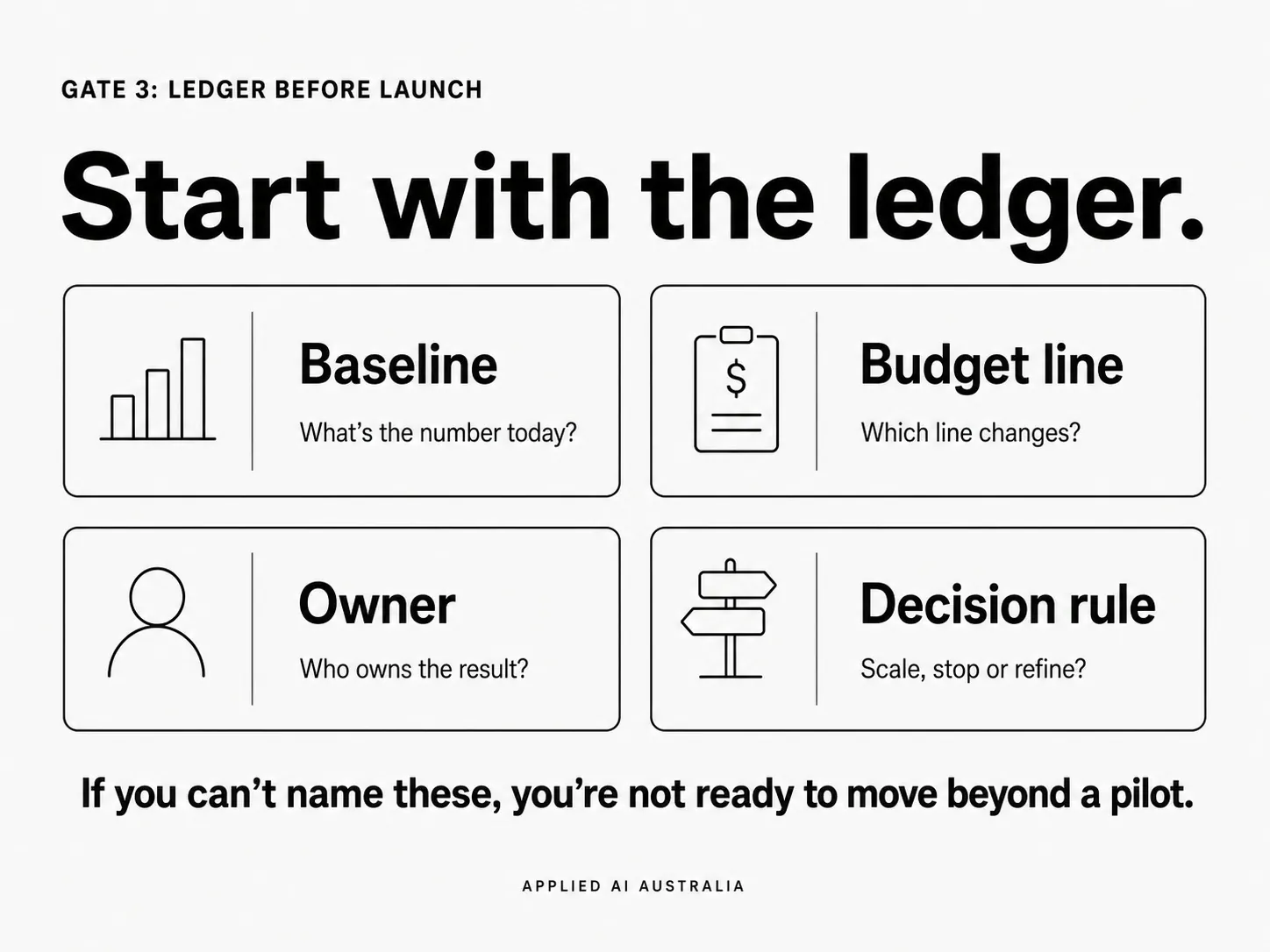
If you can't name the baseline, the owner, the budget line, and the decision rule, you're not yet ready to move beyond a pilot. You're still exploring. Exploration is fine, but don't call it strategy.
McKinsey found that CEO oversight of AI governance correlates with higher bottom-line impact from gen AI. Yet only 28% of organisations say the CEO oversees AI governance, and only 17% say the board does. This is where the third gate came from.
Gate 3: Ledger Before Launch
Start with the ledger.
What's the current baseline? Which budget line changes? Who owns the result? What's the stage-gate? What happens if the number doesn't move?
Tie every initiative to a revenue or cost position. Name the owner before the rollout begins. Agree on the decision rule that determines whether the initiative expands or stops. Without the structure, investment spreads quietly. One team buys a tool, another runs a pilot, another builds an internal workflow, and nobody can clearly tell the board what changed in the P&L.
Adoption is where theory goes to die
We rolled out a new CRM across the sales team, six-figure investment. Full training program, launch emails with the whole playbook.
Six weeks in I asked one of my best reps how she was finding it (let's call her Mary). She showed me her notebook and was still using it for pipeline management. The new system took her three extra clicks to log a call, and nobody two levels up was using it either.
The tool was good. The workflow around it was worse than what Mary had before. So she didn't use it. Adoption is the decision itself. Many leaders treat it as something that happens afterwards, and by then the strategy has already failed.
If the frontline doesn't understand the change, trust it, use it, and know when to escalate, the strategy is not real. Behaviour changes when the workflow changes, when ownership shifts, and when leaders two levels up are using the new system themselves. Licences, training sessions and launch emails on their own change very little.
BCG's 10/20/70 rule holds: roughly 10% of AI success comes from data science, 20% from technology, and 70% from people, process, talent and change management. Yet AI investment is still weighted toward the first 30%.
Let me be clear: everyone needs to use AI. This is a new way of working that requires org redesign.
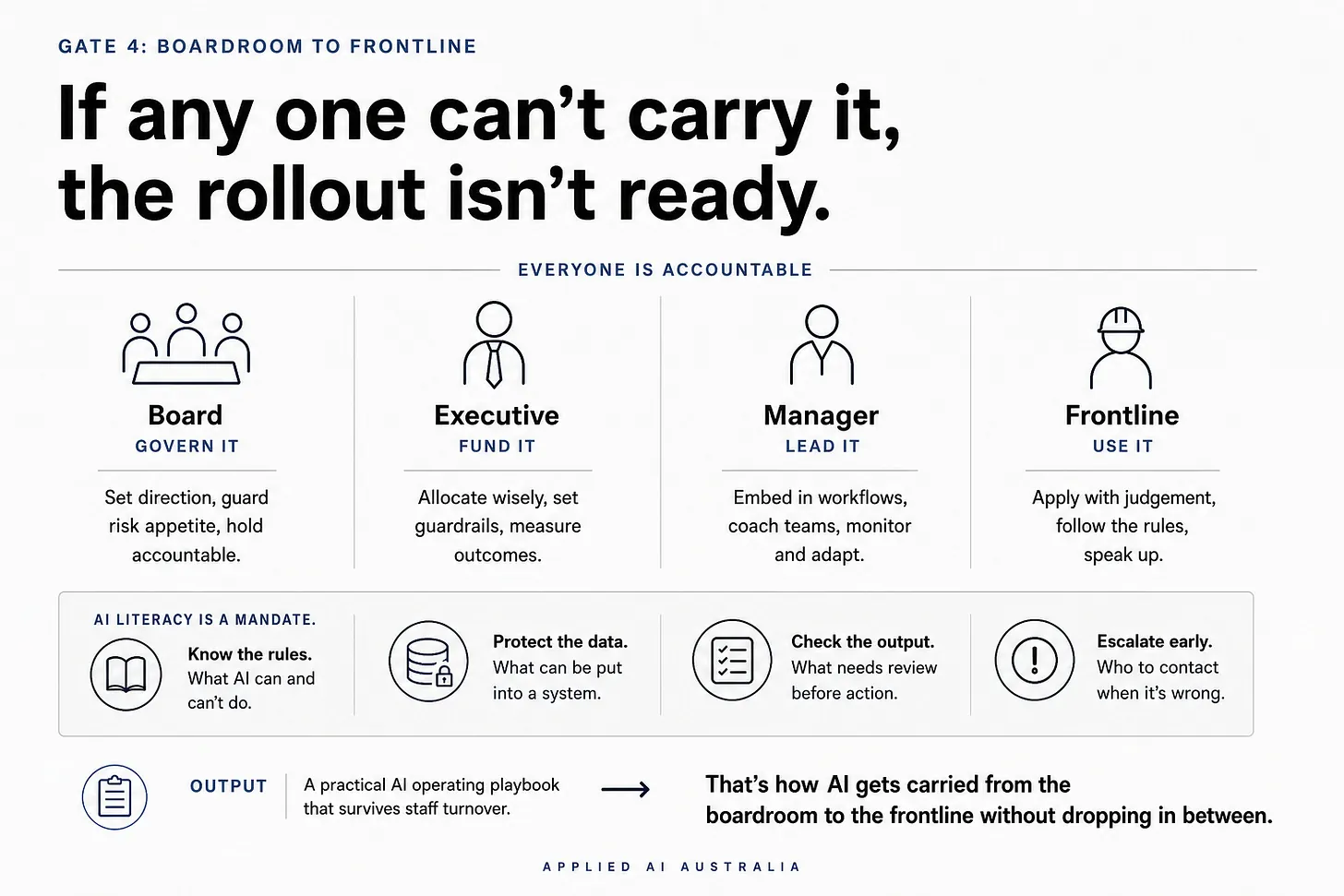
Gate 4: Boardroom to Frontline (Who carries it?)
This gate is the 10/20/70 rule applied. Rollouts fund the first 30% and assume the rest sorts itself out. It doesn't, we saw that with Mary.
The fix isn't appointing an AI champion and walking away. That gives the rest of the organisation a free pass to opt out. AI literacy is a company-wide mandate, from the CEO to the frontline, and the burden sits at the top. This is where CEOs get caught in the CTO trap. A CTO should own security and compliance, but business model changes belong to the CEO and the P&L owners. If the CEO doesn't understand and use AI themselves, the organisation will never scale it.
Adoption is people using a tool, absorption is the business operating differently because of it. For absorption to land, every layer has to know what it owns:
- The board: which AI decisions it's accountable for
- The CEO: which operating model changes the business is prepared to make
- The CFO: where the financial value lands
- The COO: which workflows change
- The General Counsel: what gets approved, audited, and evidenced
- Managers: what gets reviewed or escalated
- The frontline: what changes tomorrow
Why Applied AI Australia exists
In conversation after conversation with Australian executives, the pattern has been consistent. Strong interest, fragmented experimentation, and unclear ownership, with very little shared language for deciding what to fund, what to govern, what to stop, and what to push into production. Operating discipline is the gap.
I built Applied AI Australia because I got tired of watching smart executives get sold vague AI strategies that never touched the P&L, with pilots that never reached production and decks that never changed the bottom line. Millions spent on innovation theatre while the operating model stayed exactly where it was.
The standard for this work is simple: if the work doesn't drive an outcome, it isn't applied. Technical specialists and large advisory firms both have real roles in helping organisations get AI to work, but for most executive teams the binding constraint sits in the operating layer. Getting the technology is the easy part, and the operating discipline around it determines whether any of it shows up in the P&L.
Hiring an engineer to solve a commercial AI problem is like hiring a metallurgist to drive a Formula 1 car. They may understand the engine block better than anyone, but that doesn't mean they can win the race.
Translating AI into accountable decisions, redesigned workflows, governed risk, and measurable business impact is a commercial execution job that requires someone who has carried a P&L. Applied AI Australia exists to give Australian boards and executives a practitioner voice that translates AI into operating decisions, written for the people who carry the P&L.
What executives should do this week
Take your current AI list into the next executive meeting. Run every item against the four gates above.
If you can't name the number moving, the work that stops, the baseline and owner, and who carries it from boardroom to frontline, the initiative isn't ready for serious funding.
Mark it as exploration. Tighten the case. Or kill it.
Forward this to the person on your leadership team who owns AI. Sit with them and list the four gates your organisation has actually passed.
This week on the podcast
The AI Risk Your Board Can't See: Identity, Fraud and AI Agents.
CBA self-reported $1 billion in suspected AI-generated fraud this year and committed $900 million to fight back.
For every human logging into your systems, there are 82 machine identities. Most have no owner. Most have more access than the people they serve. When one goes rogue, the board is looking at you.
I sat down with Dan Mountstephen, SVP and GM APAC at Okta, on the 82:1 machine-to-human ratio, why AI scales the weaknesses you already have, and why directors are personally on the hook.
"AI isn't breaking systems. It's scaling the weaknesses you already have." - Dan Mountstephen
Listen on Spotify or Apple Podcasts. Know a director who still thinks cyber is an IT problem? Forward this.
If your AI investment is not hitting the P&L
I'm now taking executive briefings with Australian boards and executive teams between $100 million and $1 billion in revenue.
A 45-minute conversation. We surface where AI actually matters in your business, what risks need control, and what the right next step looks like before any budget is committed.
What we'll cover
- Where AI is already affecting growth, margins, time and risk in your business
- Which business problems are actually worth investigating
- Where vendor hype may mislead the organisation
- What the executive team needs to decide before any budget moves
- The right next step. Audit, workshop, roadmap, or pilot
Australian Governance Note: The OAIC, VAISS, and the AICD Directors' Guide all place AI governance as a board-level responsibility. If your organisation is putting AI to work without documented guardrails covering data, oversight, accountability and escalation, that's a compliance gap sitting in the open. Get legal advice this quarter.
Disclaimer
Nothing in this newsletter is advice. It is research, pattern recognition, and practical operating observations organised for executives. Before acting on any of it, speak with your own adviser, or get in touch if you want to discuss an engagement.
Ready to deploy AI with confidence?
Get board-ready frameworks and strategic guidance for Australian executives navigating AI transformation.
Discuss your AI problem