Your Security Budget Is Protecting You From Last Year's Risk.
The average Australian data breach costs $4.26 million. Ask your CISO this before the next board meeting.
Three weeks ago I walked out of a board meeting where no one could answer my question. I'll call the CFO David, which is not his name. David turned to the CISO. The CISO opened his laptop and started scrolling. Twelve minutes later, the same answer: "Ramon, we will need to come back to you on that."
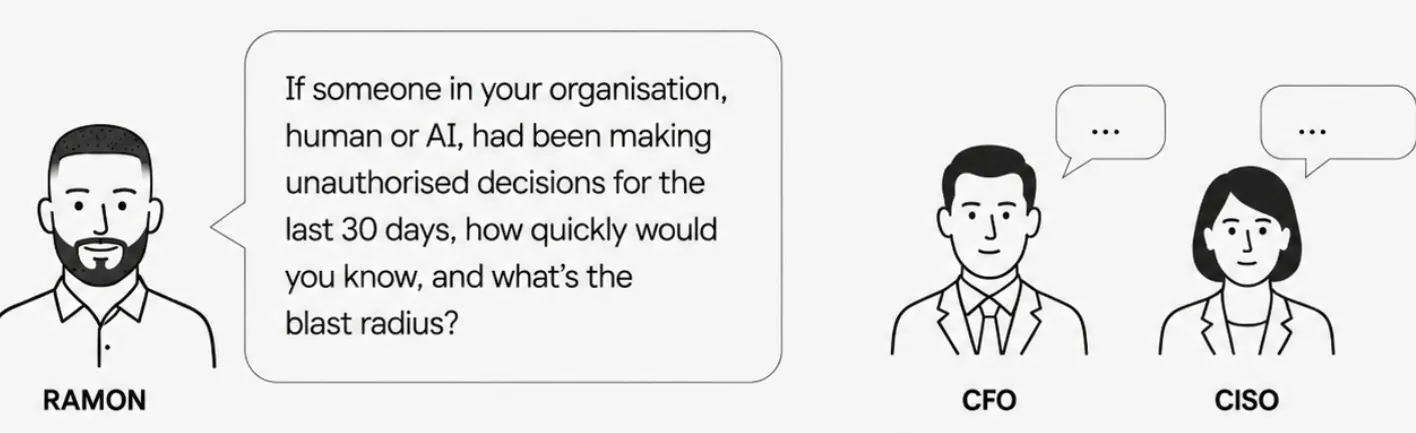
My question was: if someone in your organisation, human or AI, had been making unauthorised decisions for the last 30 days, how quickly would you know, and what is the blast radius? David's board had passed its last security audit four months earlier.
That board is not unusual. Australian enterprise cybercrime has surged 219% year on year. CBA committed $900 million in FY2025 to fraud, scams, financial crime, and cyber threats. In that same year, AI-generated loan documents moved through their systems for months before the issue reached public disclosure, despite internal concerns surfacing well before the bank acted. By the time the bank disclosed the breach publicly, investigators had found another billion dollars in fraudulent loans"across all five major Australian banks.
When I sat down with Dan Mountstephen, Okta's SVP and General Manager for APJ, the following week, he put it well- "AI is finding and scaling the weaknesses that were already inside the system".
Your CISO can answer every question your board asks. That's the problem.
The budget is a history book
Every line item in a security budget is a response to a previous incident, audit, or regulation. CBA's $900 million in FY2025 was built to defend against credential theft, phishing, and external breaches. Nobody built a line item for AI-generated loan documents from a model that did not exist three years ago.
Boards ask their CISOs: "Are we covered?" The CISO answers the question.
Yes to endpoint protection.
Yes to the last audit.
Yes to identity governance.
The board moves on.....
Nobody asks what "covered" means, when the attack changes frequently and the document being faked is indistinguishable from the real one.
Every investment must pass a filter. Revenue. Cost. Time. Risk. The filter is only as good as the threat you name. Name the wrong threat, fund the wrong defence.
What the conversation with Dan kept surfacing
Dan had been with a bank in Singapore the day before we spoke. Their CIO told him the bank was running on static API keys because they could not afford to slow operations by routing every system connection through a request process.
A static API key is a "standing privilege". It is the equivalent of a highly permissioned account running around the clock, attached to nothing visible in the directory, but owned by none.
For every human in a typical enterprise system, there are dozens of machine identities operating in parallel. Agents, service accounts, API connections, automated workflows. The majority have never been reviewed since they were created. Some carry permissions from projects that finished two years ago. Still active, still authenticated...
Where the budget is not looking
Firewalls matter. But they do nothing when the attacker logs in with valid access. Australian organisations now face an average data breach cost of $4.26 million, before you factor the inquiry, downtime, and the executive attention; it absorbs for months.
Take Sarah in accounts payable, pasting a supplier invoice into a free AI assistant before month close. Or Mark in procurement, feeding a tender document into a summariser that stores inputs for model training. Or the HR manager querying employee records through a tool, that hasn't been approved by legal.
Every use of unsanctioned AI can create an unapproved data handling event, especially when staff paste in personal, commercial, or regulated information.
Most Australian organisations still cannot see what their employees are sending to unsanctioned AI tools. Dan's position: banning shadow AI does not work. People find workarounds every time. The only approach that holds is to lean into it, make the sanctioned tools visible and governed, and to build policy around them.
The Badge Goes Back. The Access Stays.
Dan raised a point in our conversation that I want every executive reading this to take note.
When an employee leaves an organisation, the physical badge goes back. The cloud instances they spun up, the API tokens they created, the service accounts attached to their projects: most of those stay active. Nobody killed them.
The same accountability applies to AI agents. If your organisation deploys an agent, that agent needs a named human owner, recorded in the directory, accountable for everything it accesses. We need to apply the same rigour here as we do with any external vendor. You don't need to know every technician on a contractor's payroll, but you do require a single point of accountability who is on the hook for their conduct. AI agents are no different; if there isn't a human 'manager' tied to the identity, there is no one to be held responsible when things go wrong.
Ask your CISO this week.
"Can you give me a complete list of every service account, API key, dormant account, and AI tool that has access to our customer data? Who is the named human owner of each one? When was each last reviewed?"
Put this on the next board agenda
How quickly would we detect unauthorised decisions made by a human, bot, or agent using valid access?
What is the blast radius if a service account, API key, or AI tool is over-permissioned?
Can management produce a complete inventory of service accounts, dormant accounts, API keys, and AI tools touching customer data, with a named human owner for each?
How to use this newsletter before your next board meeting
Paste this newsletter into Claude or ChatGPT and ask it to map the three questions above to your specific industry and regulatory context. Takes four minutes. The output is board-ready language your CISO can take into the next session. Screenshot the deliverable question and send it to your board chair today with one line: "This should be on our standing agenda."
Australian governance
The ASD and AICD have made the board expectation clear for 2025-26: cyber risk should be a standing Board conversation, with specific questions asked and documented regularly. If your board is not doing that, you are behind published Australian Board guidance. The OAIC's enforcement posture under the Privacy Act has sharpened. Unmanaged AI tool usage, particularly where data is processed by offshore providers without documented oversight, which is a live privacy risk.
Under APP 8, if your employees are sending personal information to external AI tools and you cannot account for where that data is processed, you may already have privacy exposure.
If someone forwarded this email, subscribe to the newsletter: Here.
If this newsletter belongs in front of your Board Chair or your General Counsel, forward it with one line: "Can our CISO produce this list in 48 hours?"
Until next time,
Ramon.
If your AI investment is not hitting the P&L
I'm now taking executive briefings with Australian Boards and executive teams between $100 million and $1 billion in revenue.
We surface where AI matters in your business, what risks need control, and what the right next step looks like before any budget is committed.
What we'll cover
- Where AI is already affecting growth, margins, time and risk in your business
- Which business problems are actually worth investigating
- Where vendor hype may mislead the organisation
- What the executive team needs to decide before any budget moves
- The right next step. Audit, workshop, roadmap, or pilot
About Applied AI Australia
AI and privacy law in Australia are moving faster than Boards and ELTs can track in the time they have. APP 1.7, higher penalty caps, and OAIC privacy sweeps mean automated decisions are now a front-of-house topic for growth, risk, people, and technology.
We help Australian companies with turnover between $100M - $1B turn AI into revenue, margin, time, and better governance.
One podcast, one newsletter, every week, built so you can brief a board in under an hour.
Listen now and subscribe: Available on Apple and Spotify
Catch the full episode today.
Disclaimer: Nothing in this newsletter is advice. It's research, pattern recognition, and publicly available information organised for executives who don't have five hours a day to read court filings. Before you act on any of this, talk to your own advisor.
Primary sources: Cyber security priorities for boards of directors 2025-26 (ASD/AICD); ASD Cyber Threat Report 2024-25; Privacy and Other Legislation Amendment Act 2024 (Cth); CBA FY2025 Annual Report; IBM Cost of a Data Breach Report 2024; Okta State of Identity Security 2026; Dan Mountstephen, Applied AI Australia S2E9 (April 2026).
Ready to deploy AI with confidence?
Get board-ready frameworks and strategic guidance for Australian executives navigating AI transformation.
Discuss your AI problem