1,600 Jobs Cut.
1,600 people lost their jobs at Atlassian this week.
1,600 people lost their jobs at Atlassian this week. If you're one of them, or you know someone who is, I'm sorry. That's brutal. I know how it feel's when I was made redundant back in 2013.
Getting to the reality execs in Australia need to sit with...
Atlassian isn't struggling. Cloud revenue up 25%. RPO growth above 40%. 600+ customers above $1M ARR. By every number that matters, the company is fine. CEO Mike Cannon-Brookes: "It would be disingenuous to pretend AI doesn't change the mix of skills we need or the number of roles required in certain are as."
Block cut 40% of its workforce weeks ago. WiseTech cut 30%. Companies with strong numbers are restructuring due to AI - the skills needed for a role in 2026 will NOT be the same in 2027 or in 2030. University of Sydney professor Clinton Free mapped Anthropic's workforce data against Australian jobs this week. His assessment in the AFR: "It's a wipeout."
On Monday, Anthony Mittelmark and I published a breakdown of three types of leaders in Australian business based on 100 CEOs and 12 months of conversations. I've sat in boardrooms where the exec says they're 'AI-ready' but can't name a single workflow that's changed or how they are moving to AI first.
By the end of this read, my promise is you will understand: the three types of leaders (with a prompt or diagnostic for each), a five-pillar self-assessment, the Board Translation Guide (for the 87% of boards without AI expertise) and what the University of Sydney research says about which roles are most exposed.
White Collar Impact
Computing and Math: 96% task exposure.
Office and Admin: 96%.
Business and Finance: 94%.
Management: 92% - . Atlassian didn't cut underperformers. They kept "Atlassians with the skills to help us thrive as an AI-first company."
Law: 88%.
More than 1.6 million managers and nearly 800,000 finance workers in the firing line.
Professor Clinton Free, University of Sydney, via the Australian Financial Review
Even if 10-15% of these projections become redundancies instead of restructured roles, it affects over a million Australian jobs.
63% of C-suite executives rank AI as their top concern, but only 12% report that AI is actually changing how their business operates, compared to 25% globally.
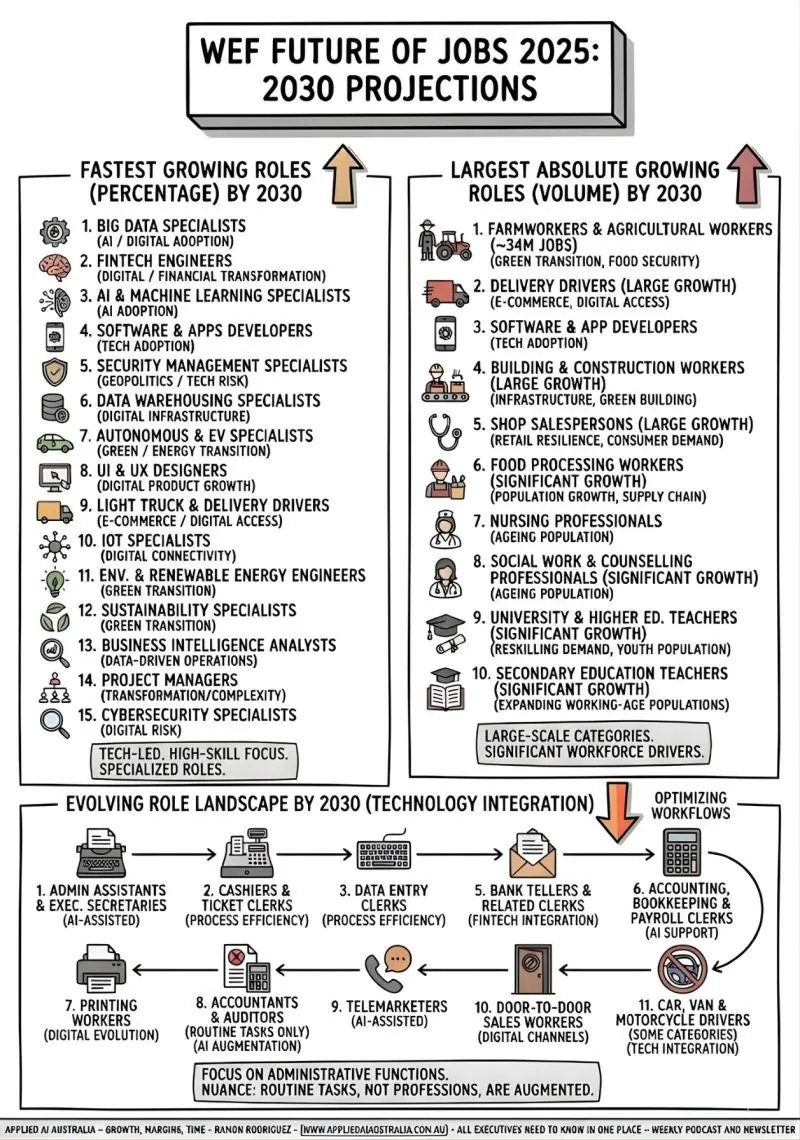
I published the WEF jobs data weeks ago. The Anthropic research released this week aligns almost identically to it.
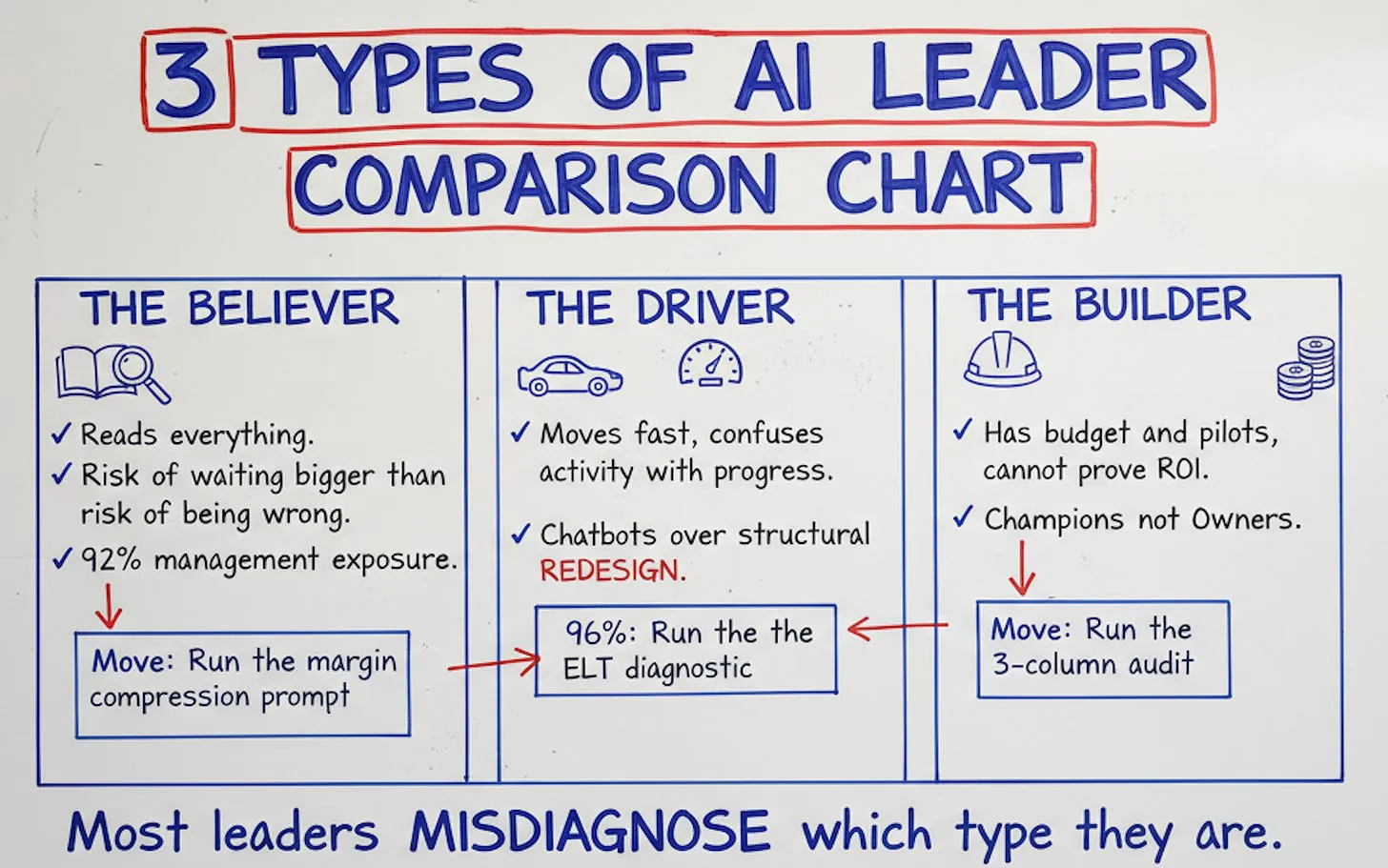
Three Types of Leader. Most Are Wrong About Which One They Are.
Type 1: The Believer
Profile: Understands the importance but feels the risk of being wrong is bigger than the risk of waiting.
You read the newsletters. You watch the demos. You forward articles to your team and feel like you're doing something. You're not. You're the most well-read leader in a room full of people who've already started.
AI maturity is not flat. Costs increase at Level 1 without visible ROI. Every quarter spent waiting measurably widens the gap.
Your move: Confidence over certainty.
Run this prompt (paste into ChatGPT or Claude):
"I lead a [your industry] company with [revenue range] annual revenue and [headcount] staff. We haven't deployed AI beyond individual productivity tools. Assume AI compresses margins in my industry by 20% over the next 3 years. Walk me through: (1) which parts of my cost base are most exposed, (2) where a competitor using AI-first operations would outperform us first, and (3) the three highest-ROI places I should start. Be specific to my industry."
Type 2: The Driver
Profile: Committed and moving, but running from the fear of being caught flat-footed.
AI is woven into your operations. Capital is committed. You move fast and you're proud of it.
The risk: a clash between the AI value curve (9-18 months to compound) and your 6-12 month reporting cycle. That tension pushes you towards high-visibility, low-impact wins (chatbots, dashboards) over redesigning how the business actually operates. Being busy is not the same as being ahead.
Your move: Run this diagnostic with your ELT. 30 minutes. No slides. Each member answers independently, then compare in the room:
- Where are people still making decisions the same way they did three years ago?
- Which current AI initiatives can you tie to a dollar outcome?
- If we lost our top 3 AI-literate people tomorrow, would our AI initiatives survive?
- What's our biggest operational bottleneck we haven't tried to solve with AI, and why?
Then run this (paste into ChatGPT or Claude):
"I lead a [your industry] company with [number] active AI initiatives. Our reporting cycle is [quarterly / 6-monthly / annual]. For each initiative, tell me: (1) is this a point solution overlaid on one process, or a redesign of how the process works, (2) can I tie it to a dollar outcome today, and (3) if I lost the person championing it, would it survive? Flag any initiative that fails two or more of these as at risk of becoming a permanent pilot."
Type 3: The Builder
Profile: Has the budget, the pilots and the task force. Missing the commercial thread.
Activity is happening across departments, but no one can answer the board's question: "What is it worth?"
You have AI Champions. Not AI Owners.
Champions raise their hands. Owners answer to the board when it fails. Organisations have plenty of the first and none of the second.
Your move: Open a spreadsheet. Three columns: AI Initiative | Owner (name, not team) | Dollar Impact (proven, not projected).
Then run this:
"I'm running [number] AI initiatives. Here are the ones I can't tie to revenue or cost: [list them]. For each, define: (1) the problem statement it should solve, (2) the metric to prove value, and (3) the earliest date I'd see that metric move. If any sound like solutions looking for a problem, tell me."
The Five-Pillar Self-Assessment
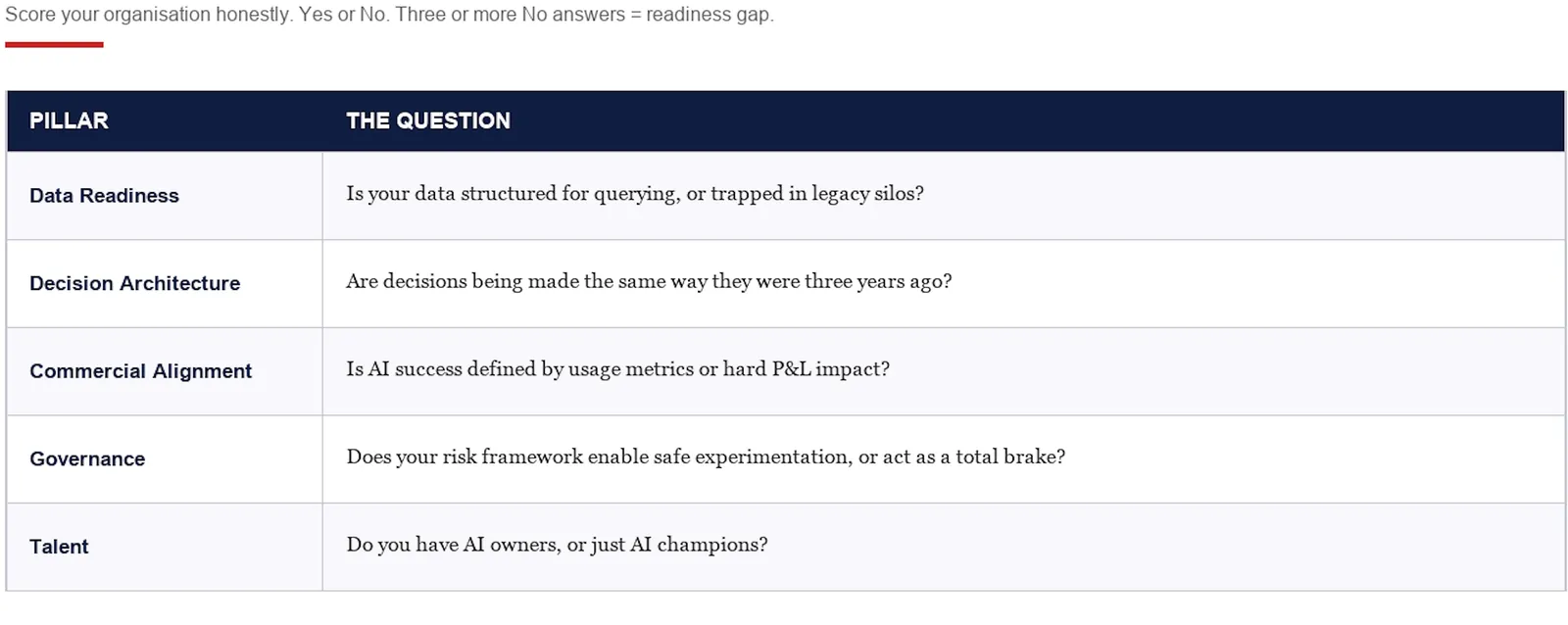
What your score means:
0-1 No answers: You're further ahead than most. Your risk is complacency. Run the Builder audit to make sure your progress is tied to a dollar outcome.
2 No answers: You have blind spots but a foundation to work from. Pick the weakest pillar. That's your 48-hour action.
3+ No answers: You have a readiness gap that no single tool purchase will fix. Start with the Believer prompt. Map the 20% margin compression scenario before anything else.
Knowing your type is step one, next is what it costs to move from one stage to the next, and how long it takes. I will cover this in the next episode of Applied AI dropping monday.
The Board Translation Guide
Only 13% of boards have AI expertise. 87% are reading AI updates they can't evaluate or govern.
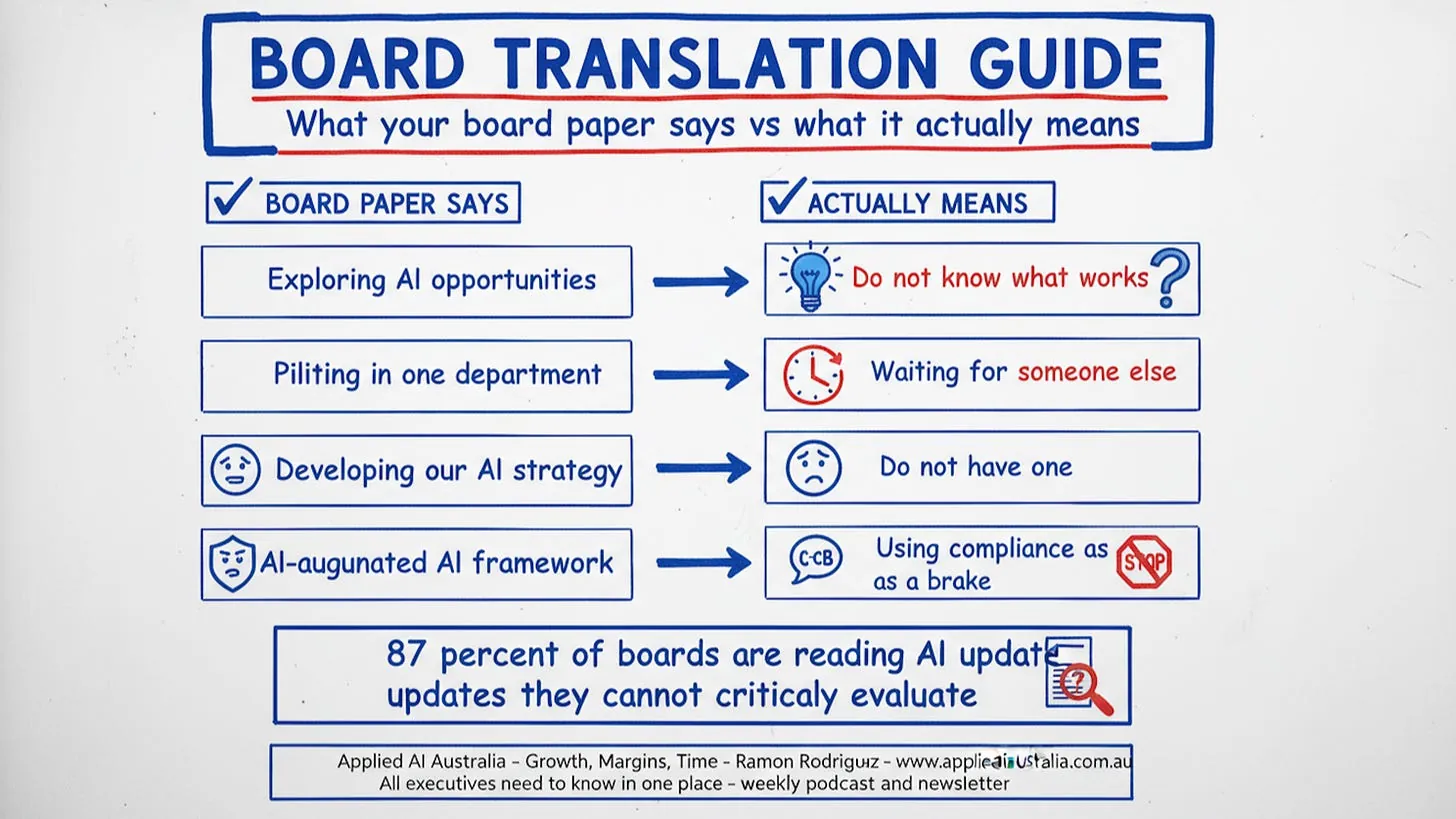
The most expensive mistake an Australian organisation can make in 2026 is equating AI activity with commercial progress. Productivity gains aren't business model change. The gap between the two is where restructures come from.
To survive the AI adoption curve, stop watching what everyone else is doing, stop rewarding pilots without owners, define the exact commercial outcome before the build starts and ensure you lead this TOP - DOWN.
You must know the technology to lead the transformation - you must be a super user.
If you missed it **AI Ready in 2026 (Part 1)**covers all three types in depth, including the board red flags and the 48-hour actions.
Catch up on all episodes: Here.
Part 2 drops next week. It covers the AI Readiness Spectrum: what each stage looks like inside an organisation, what it costs to stay at each level, and what the transition looks like.
Get it in your inbox the day it drops: Here.
Ramon.
Subscribe to Applied AI Australia
All you need to know in one place, specifically for Australian Executives and Organisational leaders. Frameworks you can apply in 48 hours.
About
We specialise in translating AI complexity into strategy that drives business outcomes, Australian executives can act on with confidence. We deliver executable frameworks, board-ready playbooks, and strategy designed for Australian enterprises.
Not sure where your organisation stands? Get in touch
Ready to deploy AI with confidence?
Get board-ready frameworks and strategic guidance for Australian executives navigating AI transformation.
Discuss your AI problem