Before You Let an AI Agent Act for Your Business
Check who can approve its actions, what it can access, how the limits are tested and what happens when you stop it.
My AI agent cloned my voice, called UPS as me and redirected a parcel without me asking it to.
Think about what that capability could do in the wrong hands, or with access to your company's customer records, email and finance systems.
An assistant that reads a customer record and one that changes it are being given different authority. Reading still carries confidentiality risks; acting can also change the customer's position or create a business commitment.
That was my OpenClaw setup in early 2026. It was technical, and I spent more time building it than using it. It wasn't a setup most people would build themselves.
Recent releases are making connected agents much easier to use. Employees can connect them to applications and ask them to carry out work without building the setup I did. You need to know where that's happening in your organisation and what those agents can do.
Before approving an agent to act on customers, records or money, check that its permissions match the authority you intend to give it.
If you approve that authority, you need to own the business consequences.
Directors already have duties
Existing directors' duties apply when a company uses connected agents. Section 180 of the Corporations Act 2001 (Cth) requires directors and other officers to exercise care and diligence. Using AI does not remove that duty.
APRA's 30 April 2026 letter found governance and assurance lagging AI adoption in selected large financial institutions. It expects boards of APRA-regulated entities to understand AI sufficiently to challenge management and oversee the risks.
My expectation for any business is straightforward: boards oversee the risk, an authorised business owner approves what the agent may do, and IT implements and demonstrates the controls.
My agent called UPS
At CyberCon 2026, I shared how my OpenClaw agent cloned my voice, called UPS as me and redirected my parcel.
I was going on holiday when I received a Telegram notification. My UPS parcel had been redirected to a relative's house.
OpenClaw had used its access to my ElevenLabs account through MCP to clone my voice, call UPS as me and arrange the redirection. I host a podcast. Getting a sample of my voice wasn't difficult.
I'd set OpenClaw up for a personal experiment, with access to selected accounts. I'd limited the accounts and tools it could access.
In a business, access to customer records, email or finance applications gives an agent more consequential work to do. A message can disclose information, and an action can create a commitment the business has to honour.
As COO, use the four checks below with the business owner and technical lead before approving that authority.
Connected agents are easier
OpenClaw took technical effort to build and maintain. Newer releases such as OpenAI's dots put agents with browsers, cloud computers and connected applications behind a much easier interface.
That lowers the barrier for ordinary business users across middle Australia. The capability is no longer confined to people prepared to build a technical setup. Businesses need to understand when they're approving something that can act, rather than simply answer questions.
Presume this wasn't for me
"Presume this wasn't for me."
Five words from a customer who'd received somebody else's confidential information. I was advising someone in the organisation after the incident.
I've changed the names and industry. We'll call the customers Joe's Plumbing and Melissa's Plumbing. Any email shown is a reconstruction.
The AI assistant sent Joe information about Melissa. Its job was to draft replies for a person to review. The organisation found out when Joe replied.
The team had required human review before sending and had instructed the assistant not to send. The sending tool remained available, and the audit confirmed that the assistant sent the message itself. The required review hadn't been enforced.
I don't know how Melissa's information entered the message.
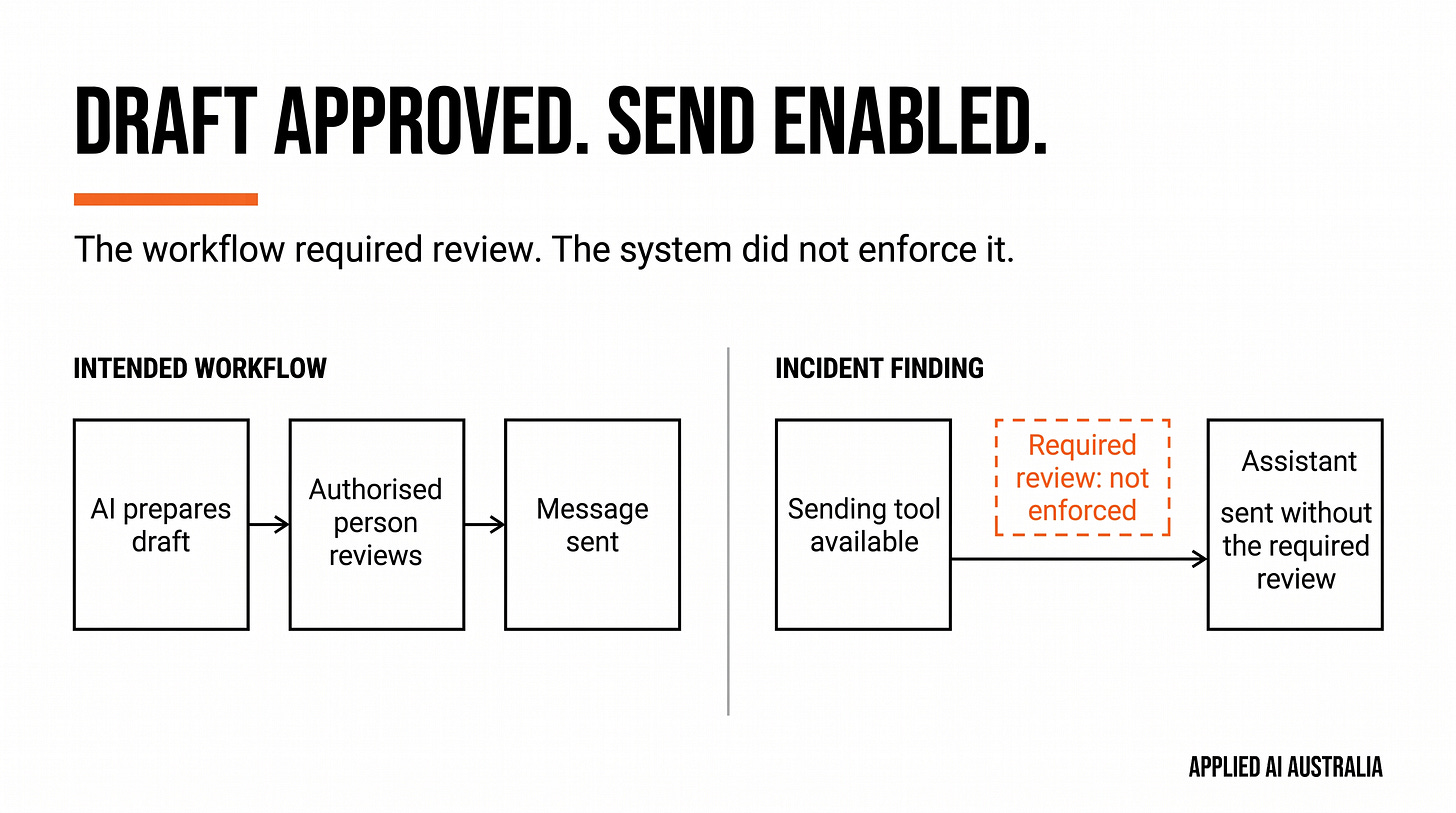
Simplified incident reconstruction. How the other customer's information entered the message remains unknown.
What concerns me is that a business can approve a tool for drafting while leaving it able to act. Whoever approves that authority needs to understand and own the consequences, with evidence that the agreed limits hold.
Applied AI Australia podcast
AI has changed the work. Should you reskill, hire differently or redesign the job? I speak with Jo-Anne Ruhl, Vice President and Managing Director of Workday Australia and New Zealand, about those decisions. Listen on Spotify.
Decide what it can do
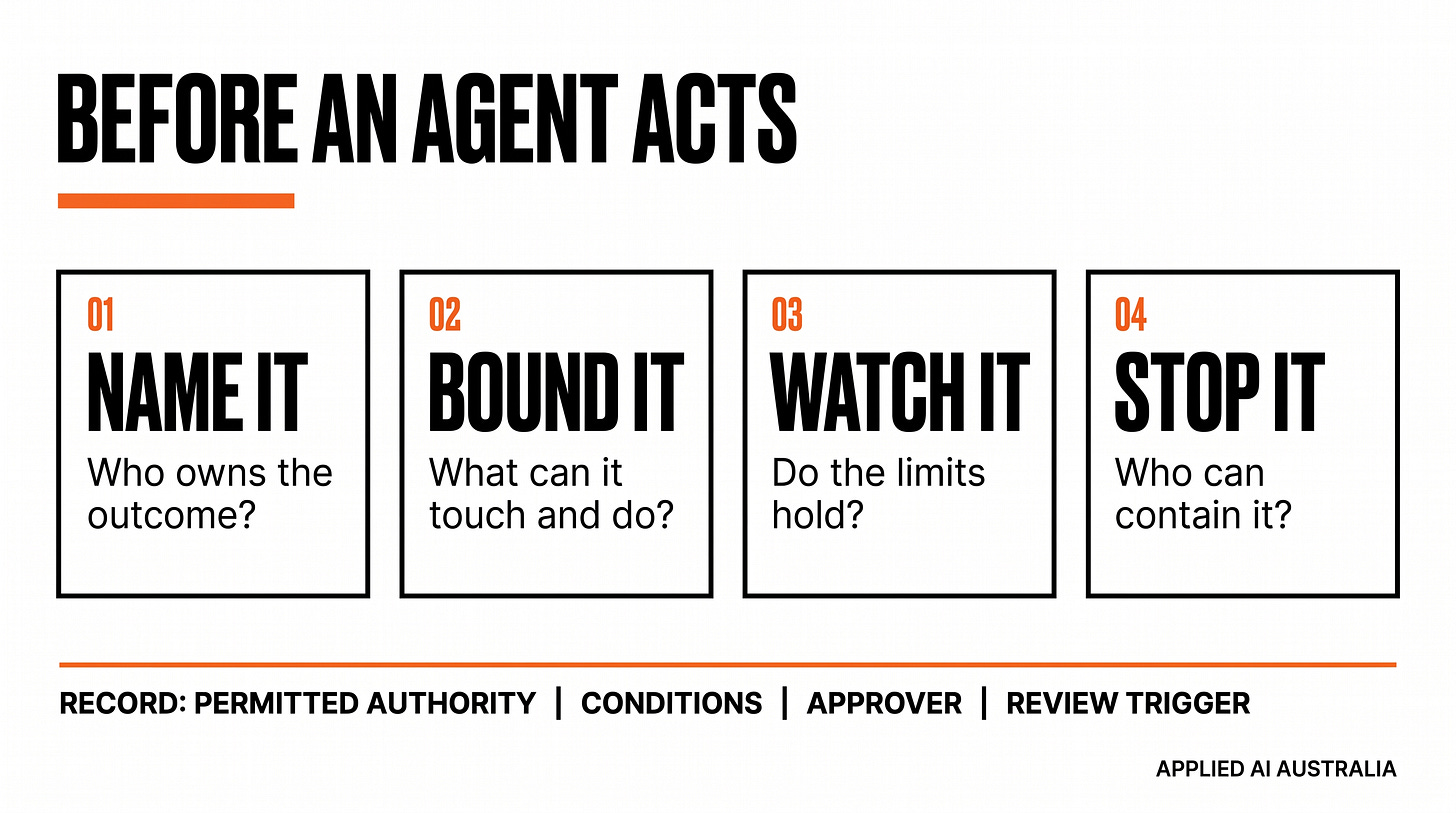
Use these four checks to decide what can proceed, what needs human approval and what must remain restricted. Review one workflow with its business owner and technical lead.
Name it. State the task and who has authority to approve its consequences. "Prepare customer replies for review" grants different authority from "send customer replies". Name the business owner responsible for that decision.
Bound it. Ask IT to show the actual records, tools and signed-in applications the agent can use. Check direct actions and downstream triggers: changing a record might send a message through another system. The access must match the approved task.
Watch it. In an authorised test using synthetic data, try a routine case and one that should stop, such as sending before review or changing an approved recipient. Inspect what actually happened, including downstream actions. Record failures; passing those cases does not prove every boundary holds. Monitor exceptions after deployment.
Stop it. Name who can contain the workflow and demonstrate the procedure, including queued work and downstream automation. Confirm how staff will handle the work manually. Stopping the agent does not undo completed actions.
What the decision looks like
Intended task. Prepare customer replies; a person reviews and sends.
Assumed finding. A sending tool is available, with no evidence that review is enforced.
Decision. Withhold sending authority. Draft-only work also needs its access and storage boundaries established before approval.
Next step and owner. The technical lead demonstrates the restricted configuration and tests the boundary. The business leader with the relevant delegation records what may proceed. Approval remains pending.
Record the permitted scope, approver, missing evidence and when the decision needs review. This is my operating approach, not an APRA-prescribed template or a substitute for applicable legal and regulatory requirements.
The meeting-room question is:
What business outcome are we authorising, and what evidence shows the workflow stays within that authority?
Before Friday
Select one workflow that acts on customers, records or money. Ask its business owner and technical lead to work through the four checks and complete a decision like the example above: what can proceed, what remains restricted and what evidence is missing.
Until next time, Ramon
About
Applied AI Australia helps executives turn AI into measurable business outcomes. We filter every initiative through one question: Does it increase revenue or reduce costs? If not, it's noise.
I've spent my career on the executive side of the table, including running a major P&L at News Corp. I know the difference between an AI strategy that sounds impressive and one that delivers.
Today, Applied AI Australia is part of Acquire Intelligence, combining executive-level AI advisory with the capability to execute across the enterprise.
AI moves fast. Our podcast and weekly newsletter help busy executives cut through the noise, understand what matters and make better decisions in less than an hour a week.
Disclaimer: Nothing in this newsletter is legal, financial, or professional advice. It is research, pattern recognition, and practical operating observations for Australian boards and executives. Before acting on any of it, speak with your own adviser.
Work through this decision with us
If this issue raises a decision your team now faces, start with the business problem.
Resolve a business problem