Can Your CFO Defend This AI Time Saving?
A five-minute CFO test to turn AI hours saved into a defensible business benefit.
A five-minute CFO test to turn AI hours saved into a defensible business benefit.
What this document is: A practical CFO test for separating AI time savings from financial benefit. It gives you the questions, evidence standard and copy-paste prompt required to determine whether an AI initiative has created released capacity, an expected financial benefit, or a realised result.
Save it. Use it before the next AI productivity claim reaches a board pack. Forward it to the CFO, COO or initiative owner responsible for turning released capacity into a measurable business outcome.
What you'll walk away with in five minutes:
- A six-question test to distinguish released capacity from a real financial benefit
- A simple way to identify the owner, destination and business metric behind any AI time-saving claim
- A copy-paste prompt that turns a live AI business case or pilot result into a one-page CFO Benefit-Realisation Brief
When Compare Club CEO Emma Fawcett sat down with me on the podcast, she explained how the business reduced a monthly finance reconciliation from 39 hours to 25 minutes.
One person used to lose nearly a week each month matching insurer payments. An AI model now matches the data and a person checks the result.
That gives the business back around 38 hours a month. The tool took two days to build and handed back the equivalent of 12 weeks of capacity a year.
Compare Club asks the person losing the week what they would spend the time on before anything gets built, and then checks with the commercial leaders whether they need those hours.
Can the CFO defend that AI benefit in the board pack?
The business needs to show what work stopped, where the released capacity went, who owns that allocation and which metric moved.
Until then, the board pack should classify the result as released capacity.
More output can still make the business slower
I learned this back in 2020.
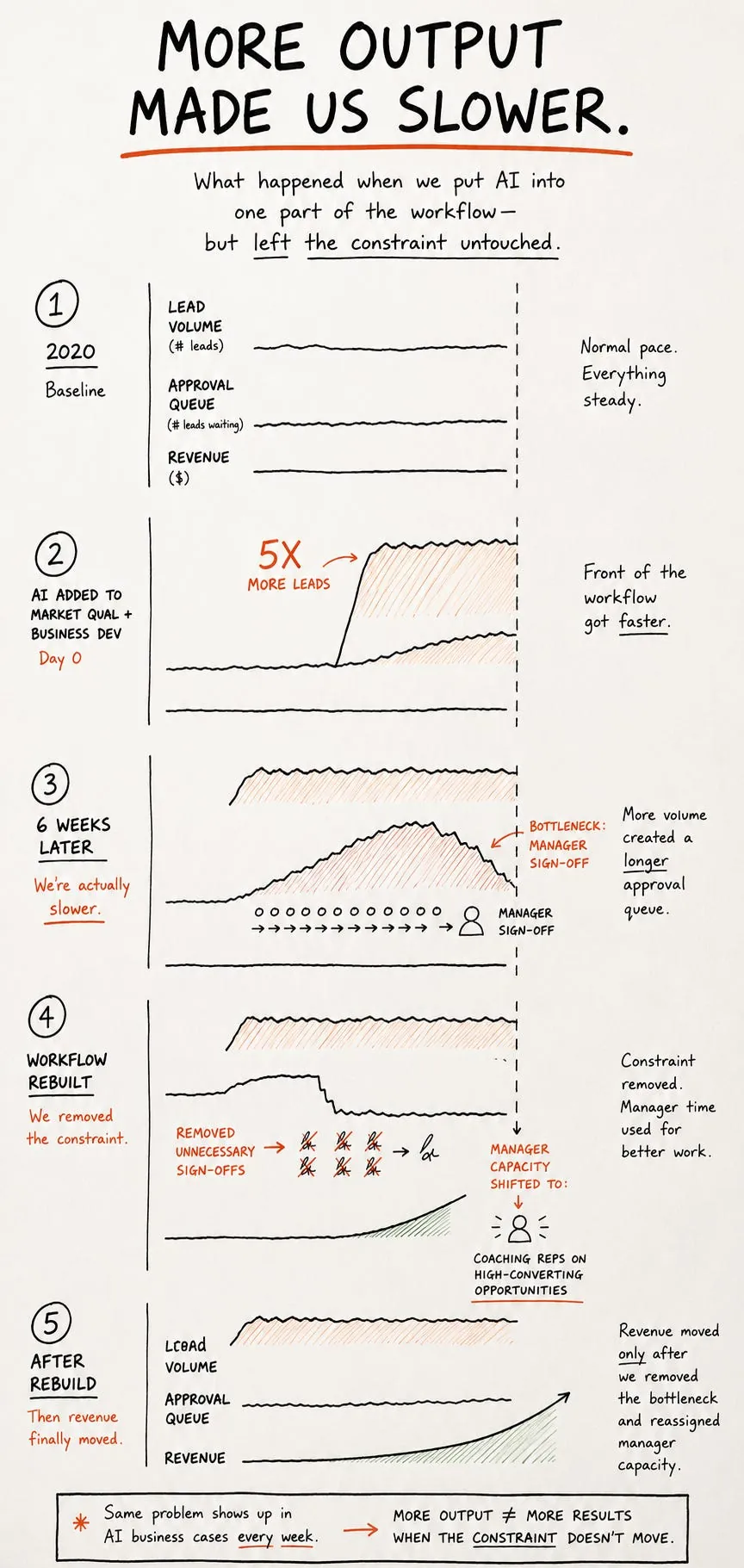
We used AI in market qualification and business development. The front of the workflow sped up and lead volume rose to five times its previous baseline.
Six weeks later, a rep told me the team was slower. She was right.
Every lead still needed a manager's signature. More volume created a longer approval queue.
We rebuilt the workflow, removed unnecessary sign-offs and shifted manager capacity into coaching reps on high-converting opportunities.
Revenue improved only after we removed the approval bottleneck and assigned the manager's time to better work.
The same problem appears in AI business cases every week.
McKinsey found that, across 25 practices it tested, workflow redesign had the biggest effect on whether organisations saw EBIT impact from generative AI. Yet only 21% of organisations using generative AI said they had fundamentally redesigned at least some workflows.
The tool works faster and the business counts the hours, but nobody decides what happens next.
The Capacity Destination Test
Before an AI time saving reaches the board pack, the CFO needs six answers.
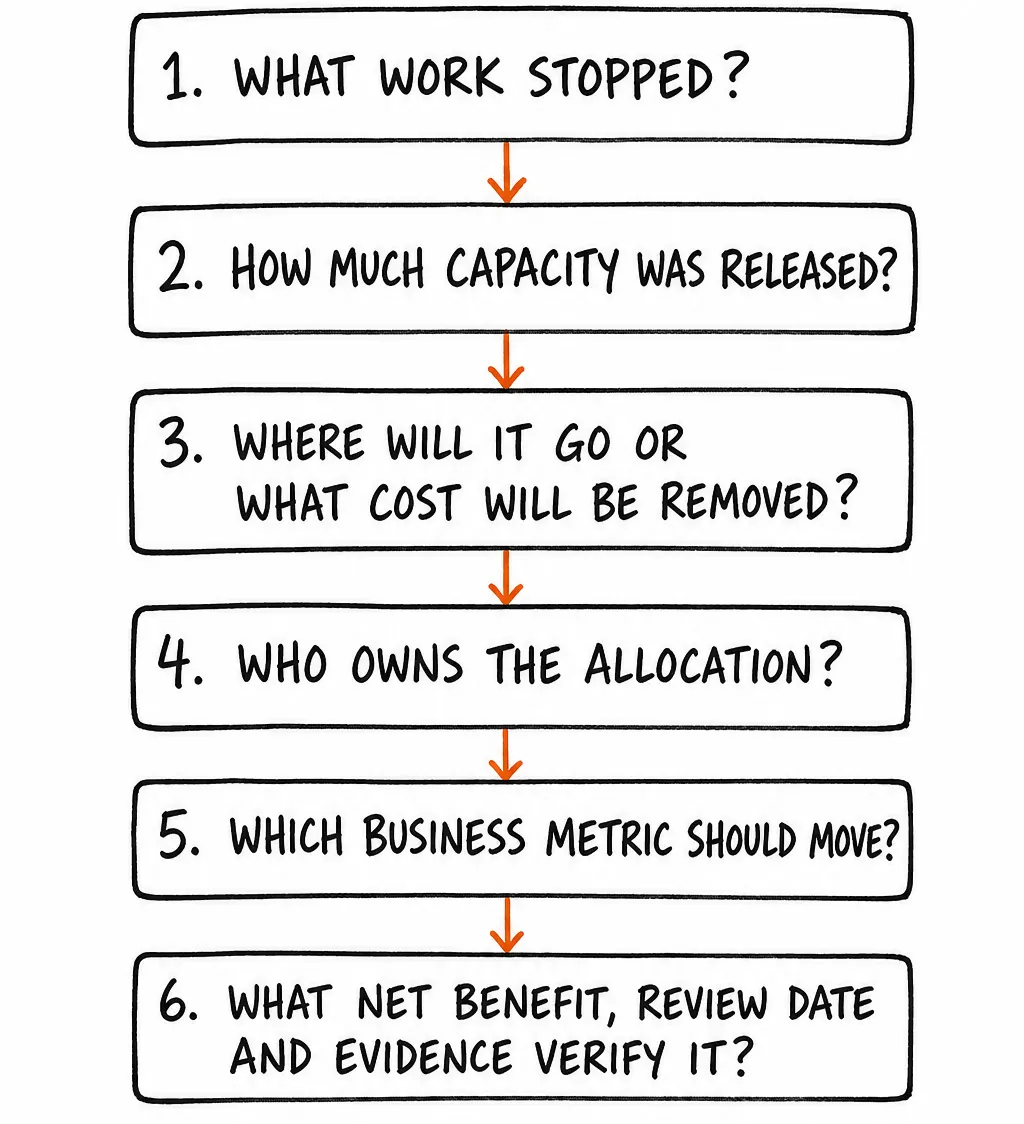
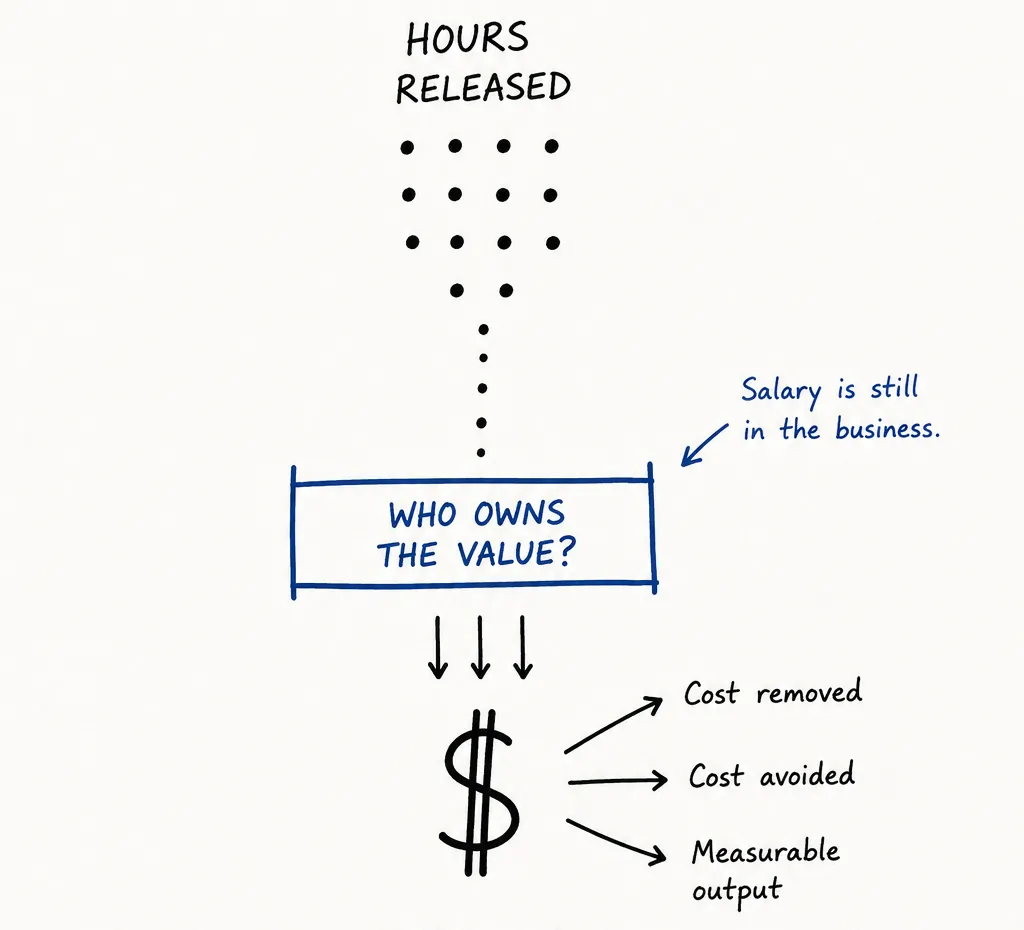
A dollar calculation estimates the value of released capacity. The financial benefit comes from the commercial mechanism: lower cost, avoided cost, higher-value output, improved service or reduced risk.
Include the cost to build, run and govern the solution, not only the hours released.
Set a baseline, name the benefit owner and revisit the result after implementation.
The salary remains in the business unless the organisation removes a cost, avoids a future hire or assigns that capacity to work that produces a measurable result.
The person doing the original work may not have the authority to make that allocation. Someone needs to own the workflow, the approval changes and the destination for the released capacity.
Until those decisions are named and evidenced, report the result as released capacity.
Use this with your approved AI tool:
<context>
AI initiatives often report "hours saved" as if time automatically becomes financial value. It does not.

Your job is to apply the Capacity Destination Test:

"Are we reporting time saved, or can we show the business result it created?"
</context>

<input>
[PASTE THE AI INITIATIVE, BUSINESS CASE, PILOT RESULTS OR PRODUCTIVITY CLAIM HERE]
</input>

<task>
Assess the claim and identify:

1. What work actually stopped, reduced or was avoided.

2. Capacity released, expressed in hours/FTE where evidence allows.

3. The destination of that capacity:
   - cost removed or avoided
   - additional productive work
   - revenue or margin impact
   - service improvement
   - risk reduction
   - no defined destination

4. Who owns the decision to redeploy or remove that capacity.

5. Which measurable business metric should move as a result.

6. One-off and ongoing costs required to achieve the benefit.

7. Net expected benefit, review date and evidence needed to verify whether it occurred.
</task>

<constraints>
- Do not treat "time saved" as a financial saving by itself.
- Report a financial benefit only when there is a specific mechanism linking released capacity to cost removal or avoidance, revenue, margin, service or risk.
- Do not invent missing numbers or assumptions.
- Flag unsupported assumptions explicitly.
- Distinguish forecasts from verified outcomes.
- If capacity has no defined destination or accountable owner, say so.
</constraints>

<output_format>
Produce a concise, one-page CFO Benefit-Realisation Brief with:

**Initiative**
One-sentence description.

**Capacity Destination Test**
- Work stopped:
- Capacity released:
- Capacity destination:
- Decision owner:
- Business metric:
- One-off cost:
- Ongoing cost:
- Net expected benefit:
- Review date:
- Evidence required:

**Benefit classification**
Choose the highest level supported by the evidence:

1. Released capacity: time/capacity has been freed, but no business result is yet demonstrated.
2. Expected financial benefit: a credible mechanism and owner exist, but the result has not yet been verified.
3. Realised financial benefit: the business result has occurred and is supported by evidence.

**Missing assumptions / evidence**
List only material gaps.

**CFO verdict**
In two to three sentences, answer:
"Are we reporting time saved, or can we show the business result it created?"
</output_format>

<quality_bar>
Be financially conservative. Trace every claimed benefit from:
activity → released capacity → destination → business metric → evidence.

Never upgrade a productivity estimate into a financial saving without evidence of the mechanism that converts one into the other.
</quality_bar>
Listen: Does AI Always Mean Fewer People?
Emma Fawcett and I get into how to redesign a process properly: the workflow, capacity constraints, changing roles, and why speeding up a broken system can make the problem bigger.
Listen on Spotify | Listen on Apple Podcasts
Before Friday
Pick one AI initiative claiming a productivity gain.
Run the Capacity Destination Test with the workflow owner.
Report it as released capacity until the team can answer all six questions.
Until next time,
Ramon.
About Applied AI Australia
Applied AI Australia helps executives turn AI into measurable business outcomes. We filter every initiative through one question: Does this increase revenue or decrease costs? If not, it's noise.
Leaders do not need more AI hype. They need to know which decisions AI should change, what risk it creates, and how to get value without creating chaos.
I am not a career consultant. I am a leader with 15 years of P&L experience, most recently as an executive at News Corp.
Following our acquisition by Acquire Intelligence, we combine this approach with a 10,000-strong global team that delivers enterprise execution.
We publish a regular podcast and weekly newsletter to give busy executives the judgment they need in less than an hour a week.
Listen on Spotify or Apple Podcasts.
Disclaimer: Nothing in this newsletter is legal, financial, or professional advice. It is research, pattern recognition, and practical operating observations for Australian boards and executives. Before acting on any of it, speak with your own adviser.
Ready to deploy AI with confidence?
Get board-ready frameworks and strategic guidance for Australian executives navigating AI transformation.
Discuss your AI problem