Five Roles. 70% Automated. $427K Nobody Checked.
The vacancy playbook your CFO needs before signing the next req. This is the HOW.
Part 2 of the vacancy redesign series |
Listen now and subscribe: Available on Apple and Spotify
What this document is: A role-by-role audit playbook with exact tech stacks, cost models, and a scoring system you can run on any position in your organisation. Save it. Upload it into Claude. Forward it to your CFO before the next req gets signed.
What you'll walk away with:
- A 1-3 scoring system you can apply to any role in 20 minutes
- Five complete role teardowns with the exact Australian tool stack for every task
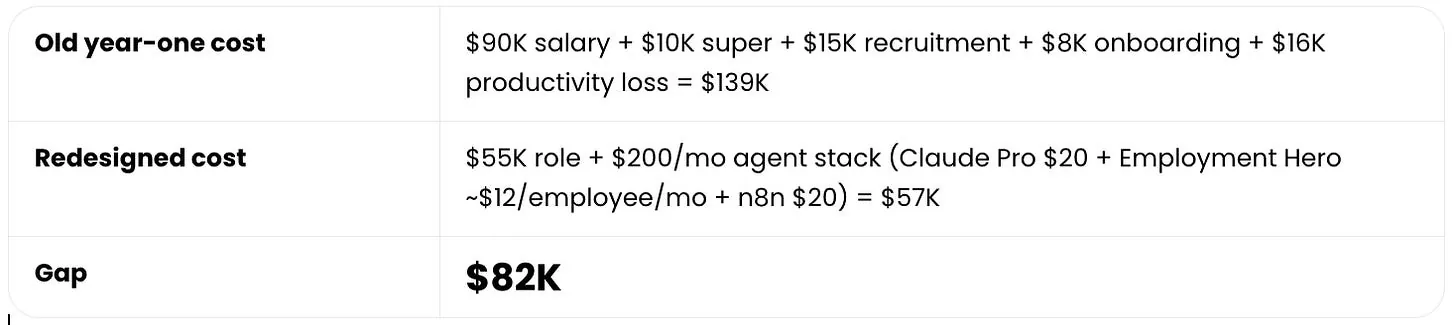
- A cost model showing old year-one cost vs redesigned cost for each role
- A copy-paste prompt that runs the audit on any role you haven't listed here
- A "where this breaks" section so you know the limits before you start
- A prompt to upload this document into Claude and run it against your own org
Skip to what you need:
- The scoring system and cost formula → start here if it's your first read
- Role 1: Management Accountant → Xero + Claude Projects + n8n
- Role 2: HR Advisor → Employment Hero + Claude Projects + NotebookLM
- Role 3: Marketing Coordinator → Buffer + Claude Projects + Supermetrics
- Role 4: Executive Assistant → Lindy AI + Claude Projects + Otter.ai
- Role 5: Business Development Manager → LinkedIn Sales Nav + Apollo + Claude Projects
- The aggregate → the $427K summary table
- The audit method → the copy-paste prompt for any role
- Where this breaks → what went wrong when I tested these stacks
- How to use this as an AI input → the prompt that turns this document into a working tool
The vacancy problem in one number
337,900 unfilled vacancies across professional and administrative categories in Australia at the time of writing this. Jobs & Skills Australia, February 2026. Goldman Sachs Global Investment Research, March 2026: 46% of administrative and support tasks are directly exposed to AI automation.
Two forces on the same spreadsheet. Roles you can't fill, and tasks inside those roles that no longer need a person.....
I ran a task audit on five common mid-market roles across four client portfolios. The pattern repeats: 6 or 7 out of 10 tasks scored as work an agent can handle today. This is the aggregate gap between what you're paying and what the redesigned version costs: $427,000 across five positions. This is modelled from Robert Half and Hays 2026 salary benchmarks, real tool costs, and the recruitment/onboarding overhead that we forget to mention in the business case.
I approved a backfill last year without reviewing the workflow. $160K, straight to market. Took six weeks to fill, three months to ramp. By month four, the person was doing work a scoped agent now handles. I wrote about it last week. This article is the playbook I wish I'd had before I signed the req.
Why the ratio is higher than you expect
Most I've run this with guess their own ratio at 1 or 2 tasks out of 10. It's usually about 3 or 4. I audited my own week earlier this year. Three of my ten tasks were pattern recognition that an agent now does.
For mid-market operational roles, the ratio jumps to 6 or 7 out of 10. The reason is structural. An executive's week is weighted toward judgement, relationships, and accountability (score 3 tasks). An operational role's week is weighted toward data processing, report formatting, template drafting, and system updates (score 1 tasks). The person in the role isn't less valuable. The job description is overloaded with work that doesn't need a human brain anymore.
The scoring system
Start with the person's calendar, inbox, CRM or HRIS, finance system, ticketing tools, project board. Watch what they actually do for a week. List actual actions using verbs: pulls, reconciles, drafts, schedules, updates, reviews, responds, formats, tracks, advises.
Then score each task:
Score 1 (Agent) if the work is rule-based pattern recognition or data processing that an agent handles start to finish. Bank reconciliation. Report formatting. Data entry. Template-based drafting. Contract generation from templates. Scheduled report distribution.
Score 2 (Hybrid / Human In The Loop) if an agent does the groundwork but a human decides, approves, or interprets. Policy drafts that need legal review. Cash flow models where a human sets assumptions. Board packs where the narrative requires board-level framing. Recruitment screening where a human makes the final call.
Score 3 (Human) if the core of the task is relationships, accountability, negotiation, sensitive judgement, or physical presence. Grievance management. Client trust. Team coaching. Strategy calls. Anything where being wrong has legal, reputational, or relationship consequences.
If 6 or 7 out of 10 score 1 or 2, you're looking at a redesign.
The cost formula
Every role comparison in this document uses the same model. "Full first-year hiring cost" means everything you actually spend to get a new person productive, not just salary.
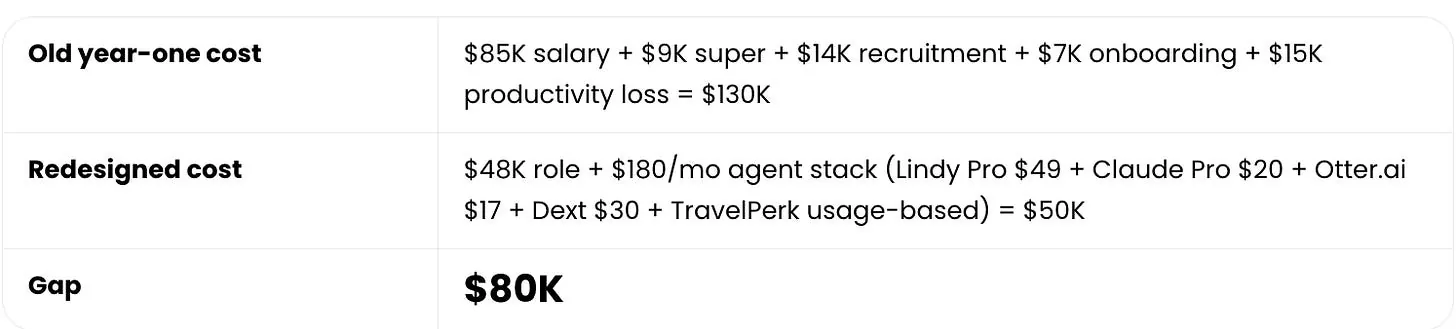
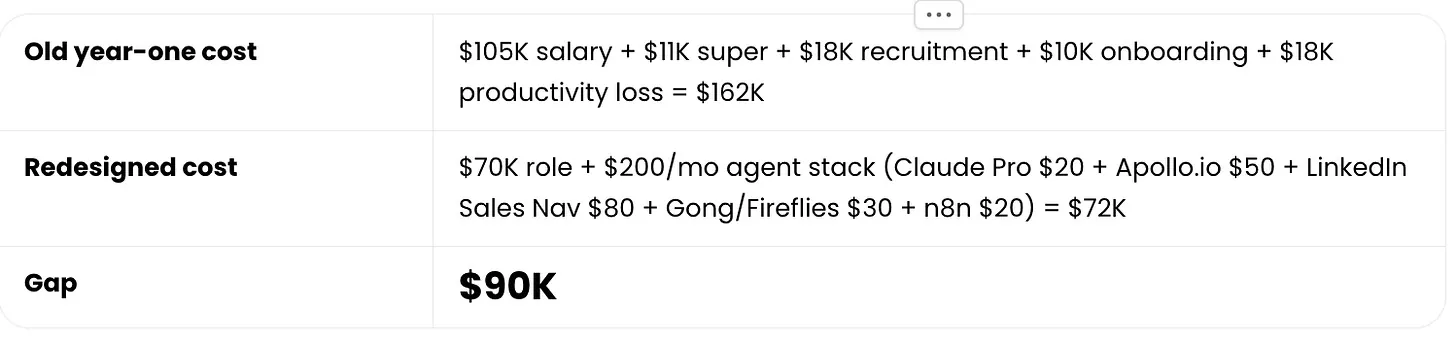
Old year-one cost(i.e. the full first-year hiring cost) = salary + super + recruitment (typically 15% of salary) + onboarding (typically 10%) + productivity loss (first 90 days at ~50% output).
Redesigned cost = compressed salary for the redesigned role + annual agent/tool stack cost.
Gap= old year-one cost minus redesigned cost
These are modelled examples. The savings shrink if the current person is already operating mostly at score 3 tasks. They grow if the role is heavier on process work than the benchmarks suggest.
Role 1: Management Accountant ($100-120K + super)
Salary benchmark: Robert Half 2026 Salary Guide, Australia. Midpoint in Melbourne and Sydney: $105-115K. MIT and Stanford researchers, published through NBER in 2025, found that accountants using AI tools closed books 7.5 days faster on average and took on additional clients without additional headcount.
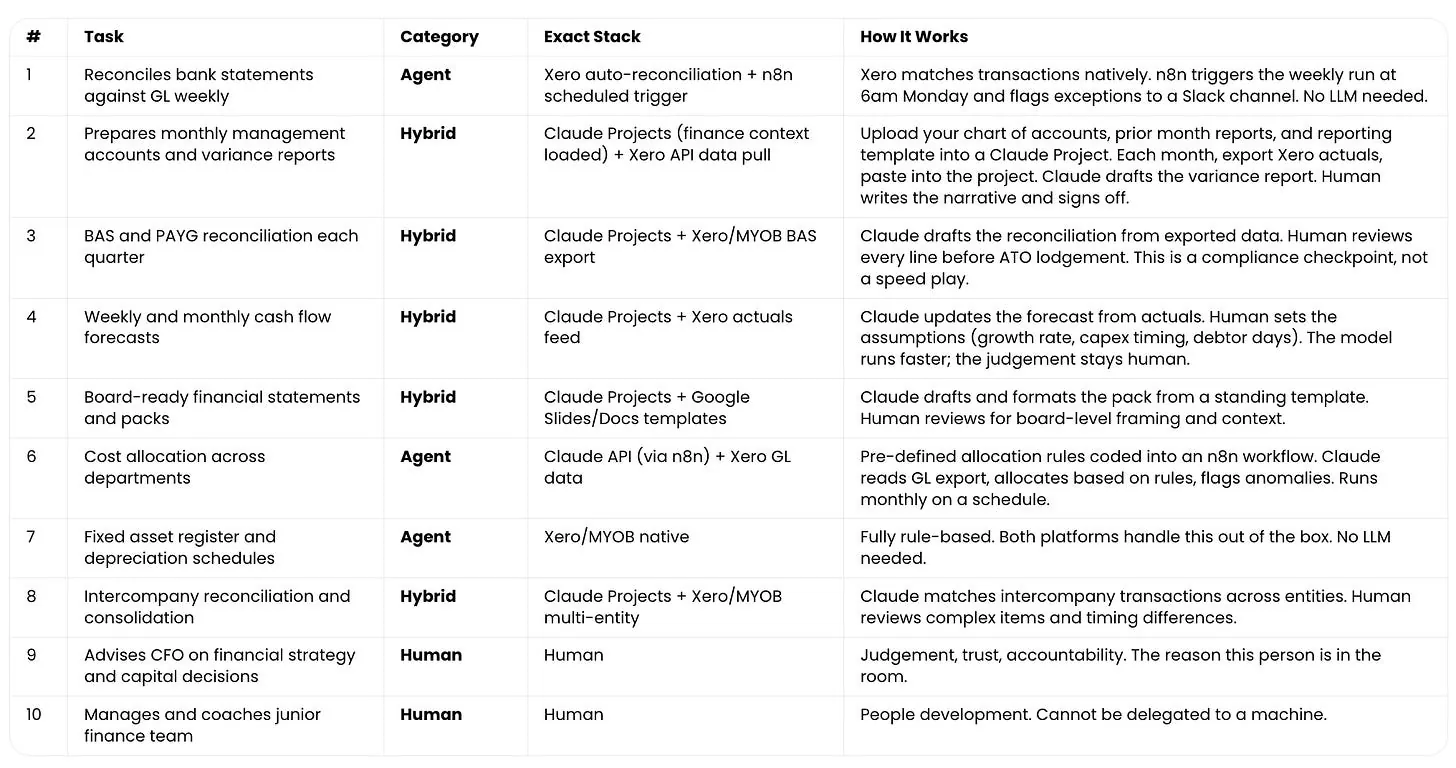
**Redesigned:**The data-heavy prep work compresses. CFO advisory, assumption-setting, and coaching. The agent stack handles reconciliation, register maintenance, and the data-heavy prep work that used to eat three days a week. This only works if your MA is spending three days a week on tasks 1, 6, and 7. If they're already operating at the advisory end, the compression is smaller.

Role 2: HR Advisor ($85-100K + super)
Salary benchmark: Robert Half 2026 Salary Guide, Australia.
Deloitte's Global Human Capital Trends, the number Australian HR leaders keep citing back to me: 57% of HR professionals' time is spent on administrative tasks. That stat matters here because it means the average HR Advisor is spending three days doing agent-grade work and two days doing the job they were actually hired for.
Task-by-task audit
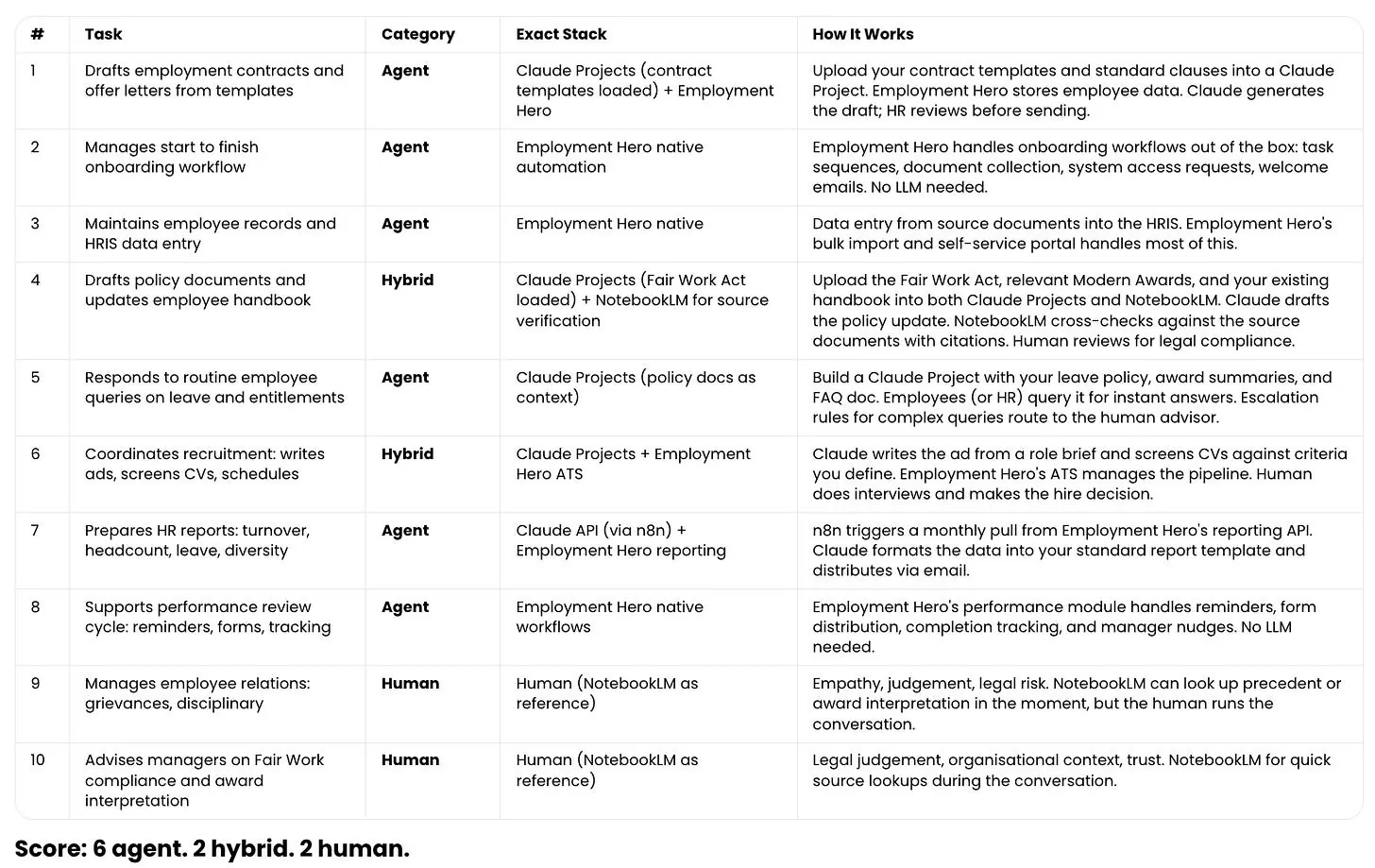
**Redesigned:**Six of ten tasks can be fully automated, with tools already deployed in Australian enterprise. Yale SOM's study on AI-human hybrid recruitment found that hybrid approaches improved workforce quality by 67% compared to random selection. The human judgement on tasks 9 and 10 matters more when the routine work is gone. You want your HR advisor spending their week on grievances and Fair Work interpretation, not updating spreadsheets.
Role 3: Marketing Coordinator ($70-90K + super)
Salary benchmark: Hays Australia 2026. Validated by Diego Mogollon's VentureCrowd case study (6 people to 1).
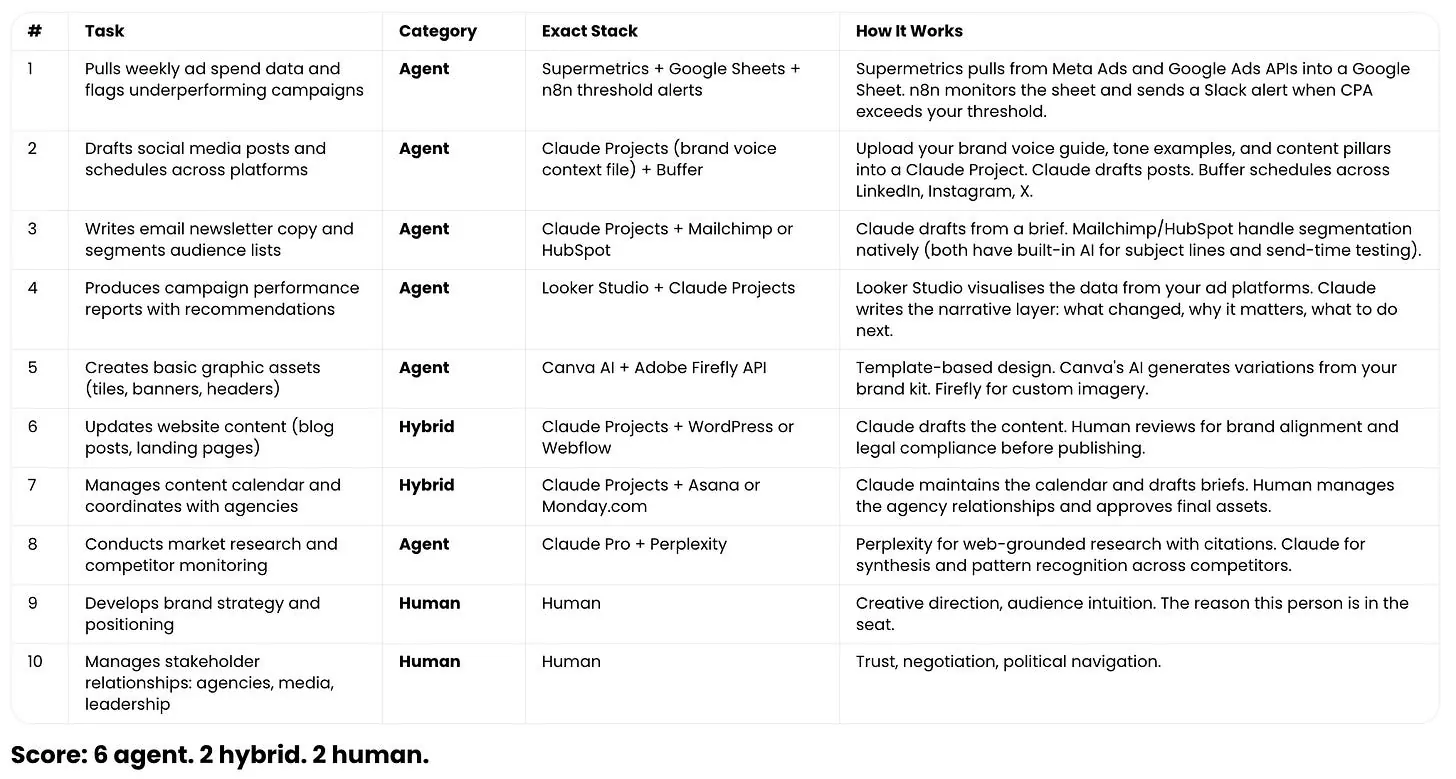
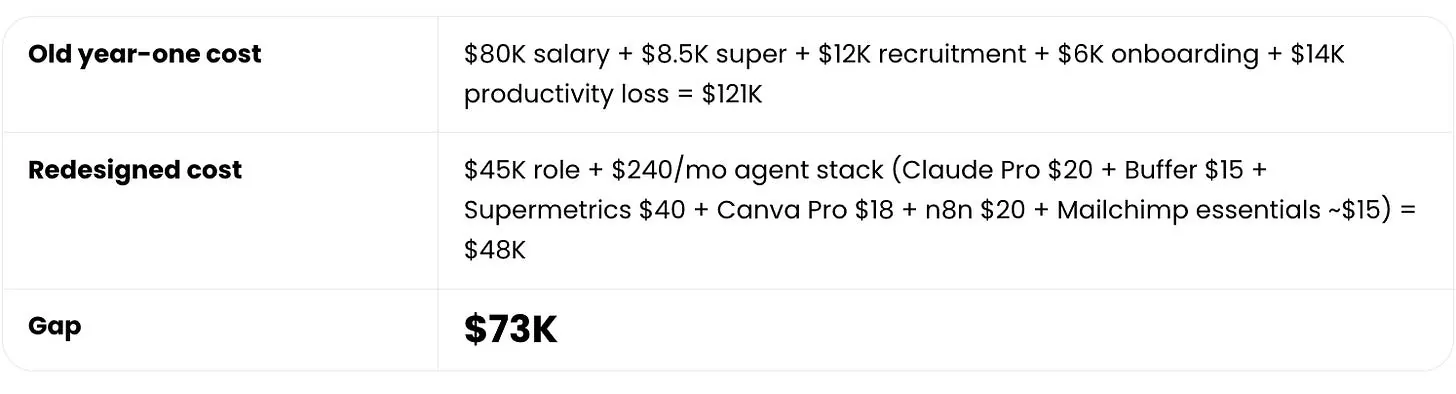
Three months ago I sat with a Melbourne CFO who'd budgeted $110K for a marketing manager. We listed every task. Ten tasks. Took 20 minutes. Seven were pattern recognition. She didn't cancel the hire, but did refine it. Salary dropped to $55K. Agents handle the other seven for $240 a month. Output hasn't changed.
Task-by-task audit
Role 4: Executive Assistant ($70-100K + super)
Salary benchmark: Hays Australia 2026.
This is the role that gets personal....The EA sits next to the executive who's reading this.
Task-by-task audit
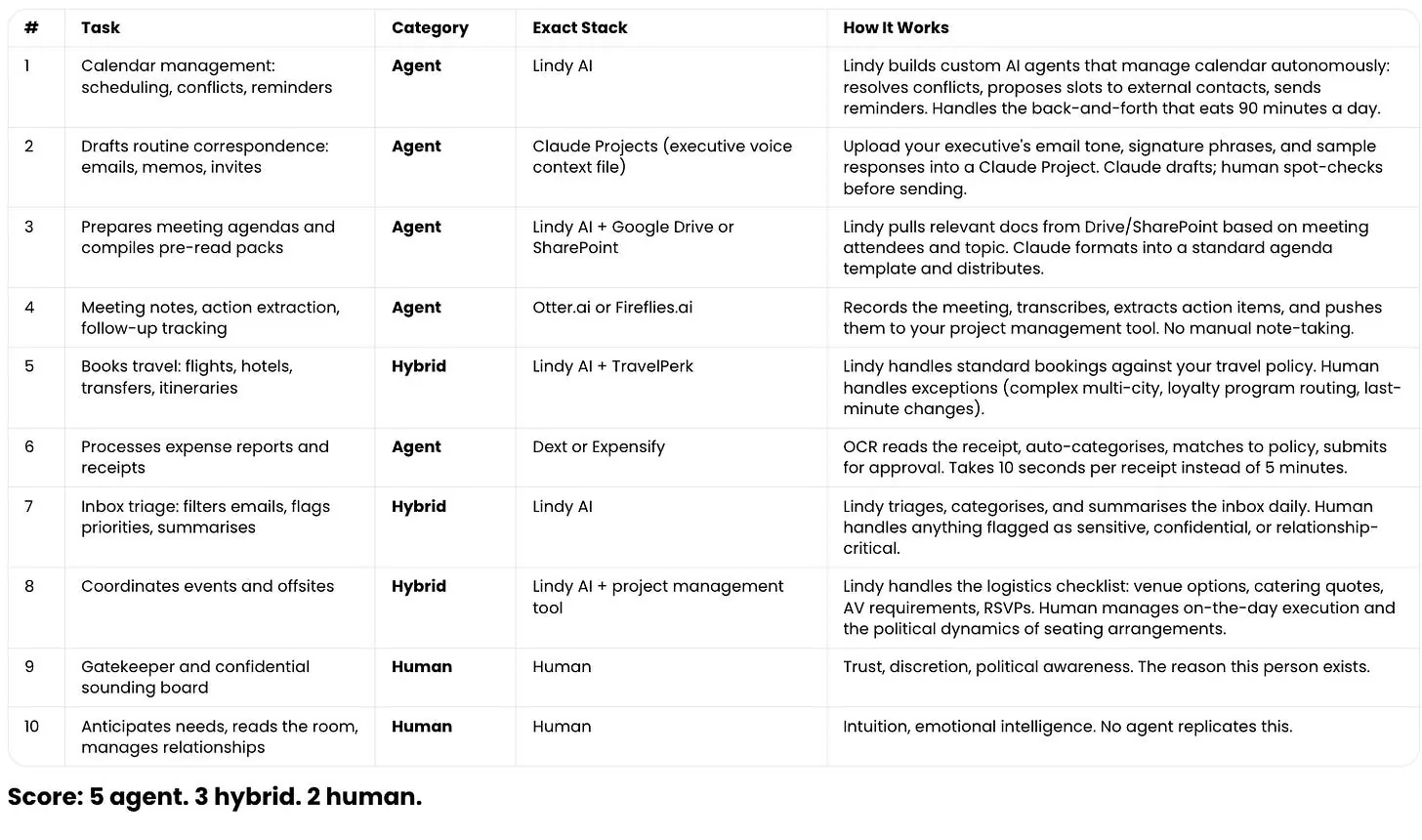
**Redesigned:**This frees the EA to spend their week on tasks 9 and 10 instead of three hours a day on scheduling conflicts. Most good EAs already want this. They're stuck in process work because nobody rebuilt the workflow around them. This only works if your EA is spending most of their week on process tasks. If they're already operating as the executive's gatekeeper, the compression is smaller.
Role 5: Business Development Manager ($90-120K + super + commission)
Salary benchmark: Hays Australia 2026. Commission noted separately.
This is where I started my career. Fourteen years in commercial leadership. I know what BDMs do with their days because I've managed hundreds of them.
Task-by-task audit
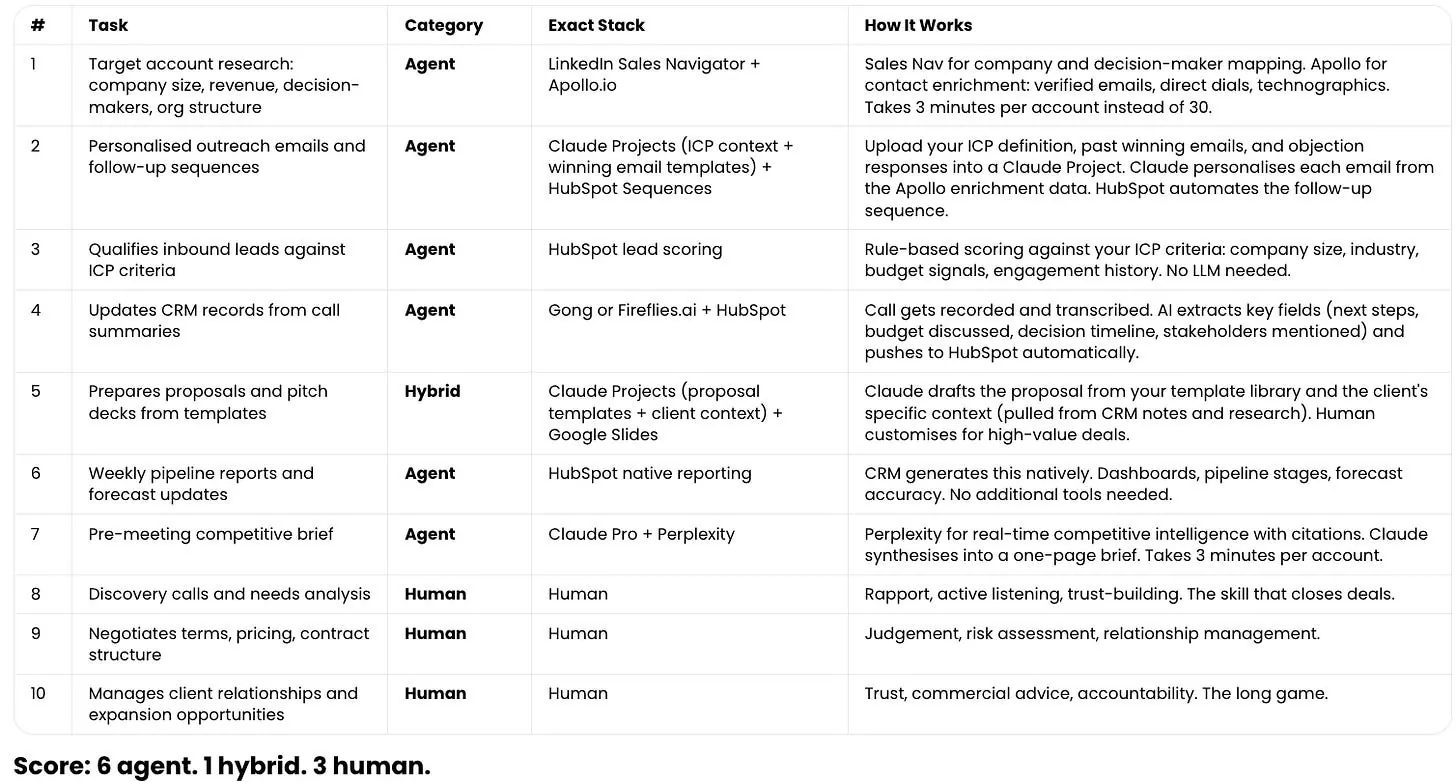
**Redesigned:**Highest human-task count in the set. Sales relationships, deal negotiation, and client trust are the last things to automate, but the prep work is six tasks eating 60% of the week.
The aggregate numbers
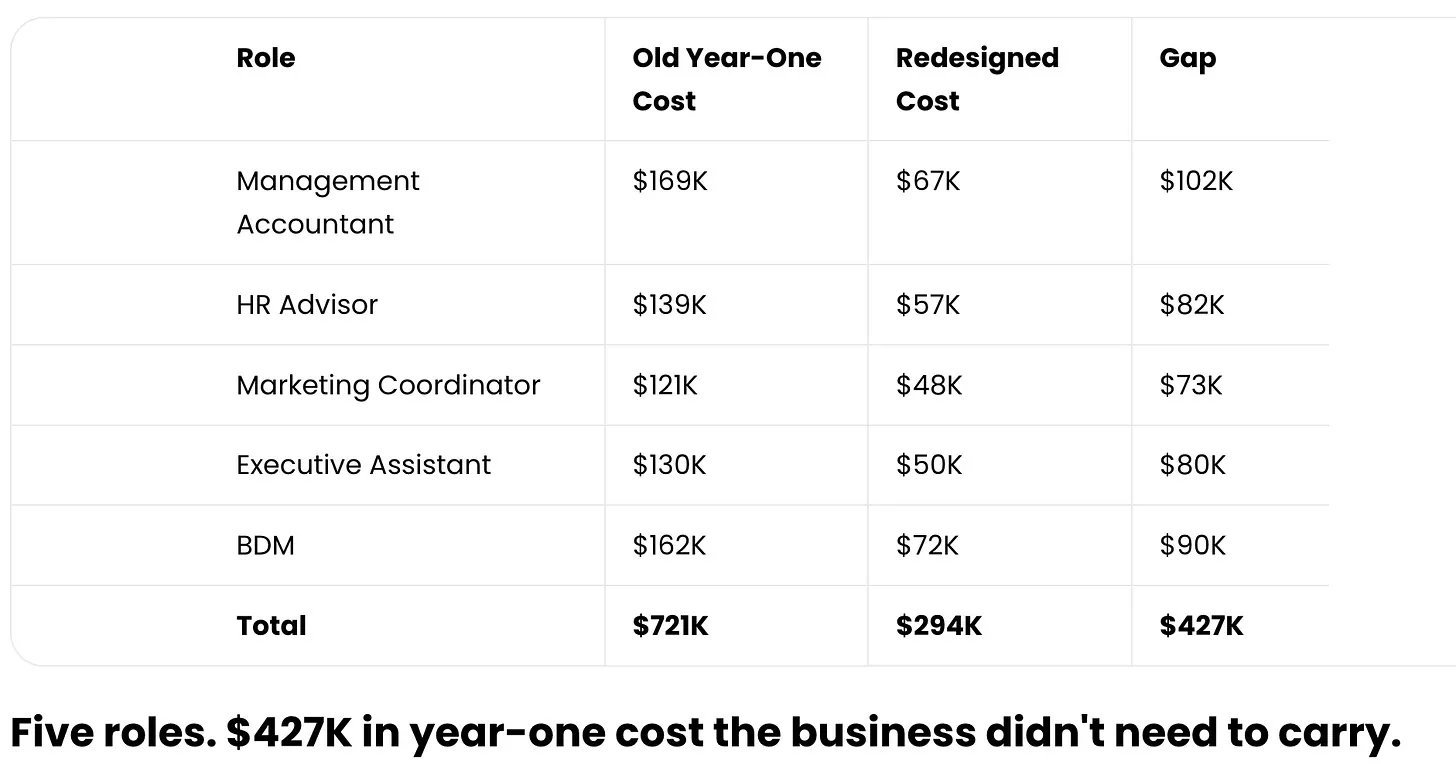
Multiply by your turnover rate. A 600-person organisation at 20% turnover makes 120 vacancy decisions a year. If a third should have been redesigns, that's 40 roles at an average gap of $80K. $3.2 million that nobody audited. At 2,000 people, it's north of $10 million. Do your own numbers.
The agent stack architecture
Redesigns use the same four layers. The tools change by role, but the architecture is consistent.
LLM layer: Claude Pro ($20/mo) or Claude Teams ($25/user/mo) for reasoning, drafting, and extraction. Claude Projects for persistent context (finance data, policy docs, brand voice, proposal templates). Claude API via n8n for scheduled automated workflows.
Workflow and orchestration layer: n8n ($20/mo self-hosted or cloud) for connecting systems and triggering actions. Alternatives: Zapier, Make. n8n wins on flexibility and cost for mid-market.
System-of-record layer: Xero/MYOB (finance), Employment Hero (HR), HubSpot (CRM/marketing), Google Workspace or Microsoft 365. The agent stack reads from and writes to these systems.
Human approval and governance layer: Every workflow has a point where a human reviews, approves, or escalates. Score 2 tasks always land here. Score 1 tasks run autonomously but with exception handling routed to a human.
The typical cost: $150-250 per month per role, depending on tool complexity. That's the number used in the cost models above.
The audit method (for any role)
Copy and paste this into Claude or ChatGPT. The output is a first-pass redesign brief you can bring to your next vacancy meeting.

I'm evaluating [role title] at [salary] in [industry] for potential redesign. List the 10-12 specific tasks this role performs weekly. Use action-level language: not "manages reporting" but "pulls data from [system], builds variance report, emails to [stakeholder] by [day]." For each task, score:

1 = Pattern recognition or data processing (agent handles start to finish)
2 = Requires judgement but includes repetitive steps (human + agent)
3 = Requires relationships, accountability, or physical presence (stays human)

For each task scored 1 or 2, name the exact tool stack (specific software, not categories) that handles it in an Australian mid-market context. Then show:

Which tasks to automate first (score 1)
Which to run as hybrid in months 1-3 (score 2)
Which to protect from automation entirely (score 3)
The redesigned job description (score 2 + 3 tasks only)
Cost comparison: old role (salary + super + recruitment 15% + onboarding 10% + productivity loss 90 days at 50%) vs redesigned role + agent stack at $200/mo
Role: [insert] Industry: [insert] Current salary: $[insert]
Now run it on yourself.
Where this breaks
I've tested every stack in this article. What went wrong is below:
Claude Projects hallucinated a Fair Work clause that doesn't exist. I'd uploaded the actual Act, but when the query crossed two different Modern Awards, Claude blended provisions from both and cited a section number that was plausible but fabricated. NotebookLM caught it because it only answers from uploaded sources. That's why the HR stack uses both: Claude drafts, NotebookLM verifies.
Employment Hero's onboarding automation missed a Modern Award edge case for a part-time employee transitioning to full-time. The workflow treated it as a new hire - it was a contract variation. Took me 10 minutes to catch, but if it had gone through unreviewed, the contract would have been wrong.
Xero's auto-reconciliation matched a supplier payment to the wrong invoice because the amounts were identical and the references were one digit apart. Exception handling flagged it, but only because the n8n workflow was configured to hold anything above $5K for manual review. Without the threshold, it would have posted clean.
Lindy AI booked a meeting across two time zones and got the offset wrong by one hour - damn daylight savings!
You need a human in the loop on score 2 tasks and to build exception thresholds into score 1 workflows. The stacks are 80-90% there. The remaining 10-20% is the judgement calls that justify the redesigned salary. Note: I wrote this conservatively. There's much more that can be done, and after going through it again today, I'd be more aggressive, but this is a good place to start.
How to use this document as an AI input
Upload this entire newsletter into Claude or ChatGPT Enterprise. Use the output as your first-pass redesign brief before the next req gets signed.
Based on this vacancy audit playbook, review [role title] at [salary] in [industry]. List the 10 weekly tasks for this role using action-level language. Score each task 1-3 using the scoring system in this document. For each task scored 1 or 2, name the exact tool stack. Show the cost comparison: old year-one cost vs redesigned cost + agent stack. Flag any task where the tool recommendation may not apply to my industry.
Governance note: If an agent processes personal information or influences decisions about individuals, the Privacy Act 1988 (Cth) and OAIC guidance apply. APP 1.7 (effective 10 December 2026) requires disclosure of automated decision-making. One question per workflow: "Does this process personal information and influence a decision about a person?" If yes, run a privacy impact assessment before deployment.
Before Friday: Open your next req. List the ten tasks. Score them. If more than five score 1 or 2, reply with AUDIT and I'll send you the full 20-minute vacancy audit template.
Forward this to the person who signs your reqs.
Ramon.
About Applied AI Australia
AI moves fast. Unless you want to spend five hours a day reading research papers, sitting through vendor briefings, and speaking to 100+ CEOs and boards, the way I've spent the last 90 days, you need a filter.
That's what Applied AI Australia is. One podcast. One newsletter. Every week. Built for Australian executives at companies between $50M and $2B. We only cover what matters: growth, margins, time, and risk. Less than one hour of your week to stay on the right side of history.
Listen now and subscribe: Available on Apple and Spotify
Disclaimer: Nothing in this newsletter is advice. It's research, pattern recognition, and publicly available information organised for executives who don't have five hours a day to read court filings. Before you act on any of this, talk to your own advisor. Or get in touch to book in an engagement.
Sources: Robert Half 2026 Salary Guide, Australia (Finance & Accounting; Human Resources) | Hays 2026 Salary Guide, Australia | MIT/Stanford study on AI in accounting (2025), via CFO Dive and NBER | Goldman Sachs Global Investment Research (March 2026) | Deloitte Global Human Capital Trends | Yale SOM: AI-human hybrid recruitment screening | Jobs & Skills Australia: Recruitment Insights Report, February 2026 | AHRI / Bentleys / Josh Bersin Institute: replacement cost benchmark (1.5x annual salary)
Ready to deploy AI with confidence?
Get board-ready frameworks and strategic guidance for Australian executives navigating AI transformation.
Discuss your AI problem