I Got Early Access to Astra | Where Mid-Market Businesses Lose 500+ Hours: 5 Agentic Workflows to Automate First.
A practical guide for $50M-$100M leadership teams on eliminating cross-system friction, protecting margins, and freeing senior capacity
I got early access to Astra and gave it three jobs I had already tried with Sol.
If a human can do it with a mouse, keyboard, or spoken direction, Astra can execute it.
Here is my experience testing it across three real tasks:
- A job-to-cash workflow
- A messy month-end pack
- A small internal tool we had discussed for months and never built
The job-to-cash workflow was the one that really surprised me - I had to run it three times to check it was right. It was.
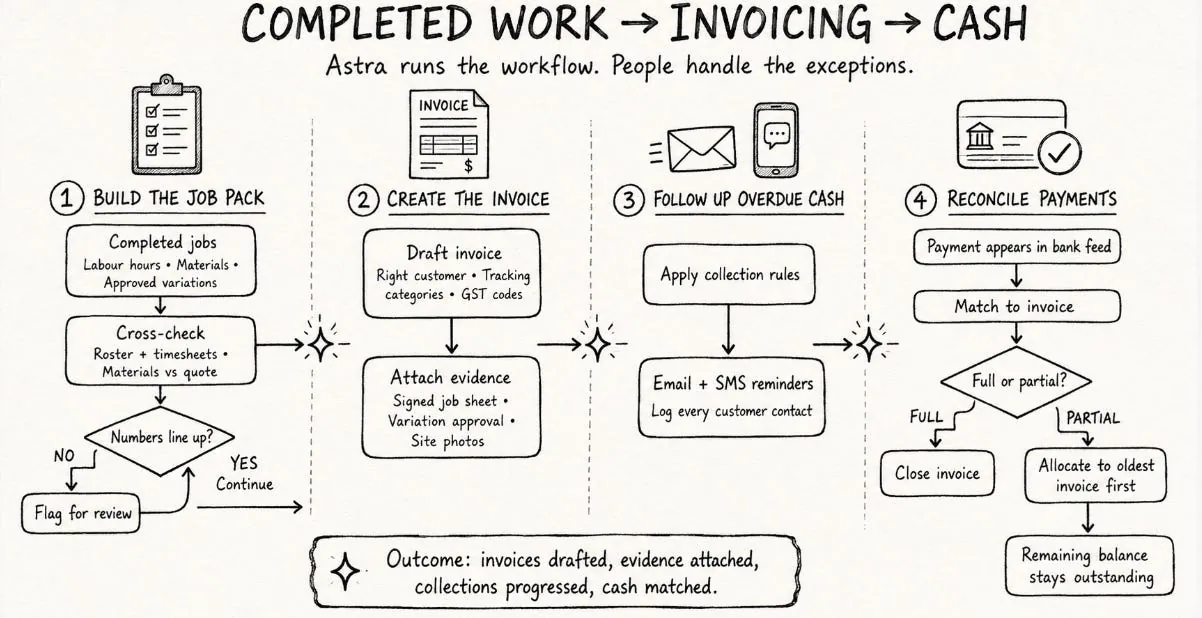
I used Astra's voice mode to tell it what I needed: get us from completed work through to invoicing and partially collected cash.
That meant going into the job management system and pulling the week's completed jobs, including labour hours, materials and approved variations.
It checked the hours against rostering and timesheets, then flagged jobs where the numbers did not line up or materials looked wrong against the quote.
It moved into accounting and created the draft invoices against the right customers, tracking categories and GST codes. It attached the signed job sheets, variation approvals and site photos from the job folders.
I then gave it a small group of overdue invoices and some simple collection rules. It ran the email and SMS reminders and logged the communication against each customer.
When payments appeared in the bank feed, it matched them back to the invoices. One was a partial payment, so it followed the rule I had given it and allocated the money against the oldest invoice first.
I had explained the outcome once, then watched Astra work through six parts of the process. It used the same screens a person would use and carried the information between them.
I have tried this kind of work with previous models.
Sol could handle the individual steps well. Once the work stretched across several applications and 12 dependent steps, I usually had to keep it moving: open this system, click that field, check the result, now continue.
Astra needed much less input from me. I could speak the instructions while it worked through the screens. It recovered when the interface changed, kept track of where it was and carried the job across each system. I only stepped in when a judgement call came back to me.
These are the five jobs I would test first.
1. Work between systems
Start with work where a person is moving information between applications.
A job closes in one system. Someone exports the data, checks a spreadsheet, opens another platform, corrects something, finds the supporting PDF, enters the result into finance, sends the email and updates the first system.
These steps seem small and insignificant, but add them up across a week and the labour becomes material.
The problem I often see in the mid-market is system fragmentation: CRM, finance, payroll, rostering, job management, project software, and a few spreadsheets that somehow became permanent.
Some of those systems should ideally be connected, but many never justify a large technology project because the workflow is too small.
That is where I would test Astra.
The value in my job-to-cash test did not come from one difficult task. It came from carrying the context across the joins and continuing the work.
I would look at:
- completed jobs moving into invoicing
- CRM administration that requires updates in finance
- supplier onboarding across several platforms
- payroll and rostering checks
- customer cases that require someone to open several systems
- recurring compliance administration
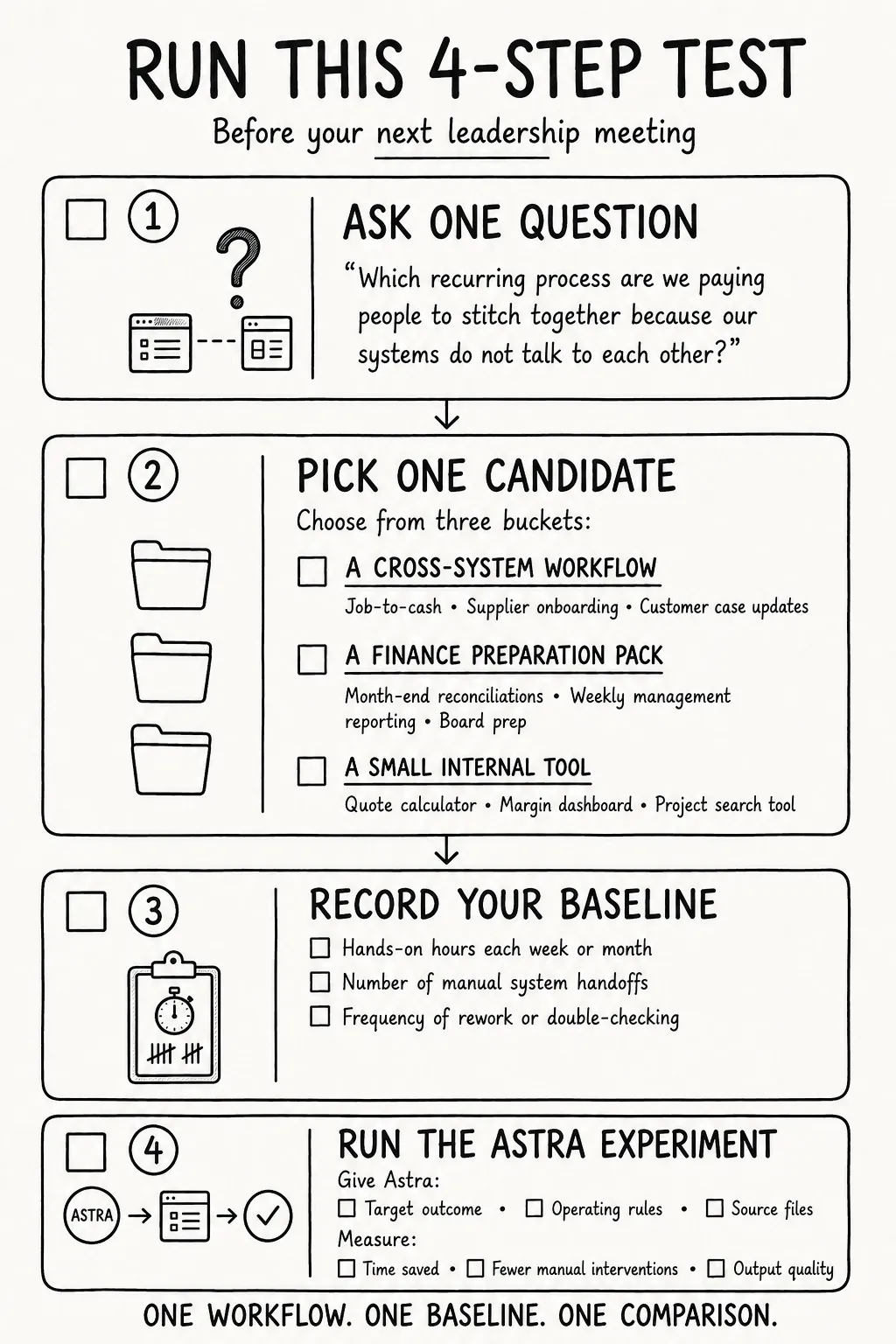
Take one workflow and measure it before touching Astra.
How many hours does it take each week? How many times does a person move information manually? How much gets checked twice? Where does rework occur?
A process using 10 hands-on hours a week is 520 hours a year before you count errors, delays or management review.
2. Finance preparation
The second job I gave Astra was a month-end financial pack.
I provided:
- trial balances by entity
- AR and AP ageing reports
- payroll accrual schedules
- prior-period figures and working notes
I used voice again to talk Astra through the brief: cross-check the pack, reconcile the working tabs and trace inconsistencies. Explain any movements exceeding my percentage and dollar thresholds, then send anything requiring human judgement back to the finance lead.
Astra worked through the workbook, moved between tabs, checked formulas against the source schedules and wrote the reconciliations back into the file. It delivered draft variance commentary and a concise exception list. When I wanted a number checked again, I said so and it went back.
The value for me was delegating the mind numbing work.
Take a finance lead, they are paid to understand margin shifts, cash flow constraints, forecast validity, and strategic next steps. Not spending time on low value work such as:
- pulling reports and matching schedules
- comparing periods and tracing variances
- checking formulas and drafting preliminary commentary
Where to test Astra in finance:
- month-end packs
- weekly management reporting
- reconciliations and variance investigations
- working-paper preparation
- first-pass board materials
The finance lead still owns the numbers and signs off on the final output, so the key metric is preparation time saved.
If the team can shift from hours of manual reconciliation to reviewing a short exception list and applying strategic judgement, the ROI is immediate.
3. Recurring operational work
The third place I would look is recurring operational work:
- invoice runs
- collections
- weekly sales reporting
- project updates
- customer onboarding
- supplier administration
A 15-minute step repeated across customers, jobs, or invoices turns into new headcount surprisingly quickly.
Another approval gets added. Another system gets introduced. Another check becomes permanent....
Three years later, nobody can quite explain why the process takes half a day.
Astra performed better in my testing when I gave it the outcome and the operating rules, rather than feeding it one task at a time.
Take a weekly management report. I would give Astra responsibility for pulling the defined inputs, checking the data, reconciling differences covered by an agreed rule, preparing the pack, and sending exceptions to the owner. The owner still makes the management call.
The same approach applies to collections. Define which accounts qualify, what communication is allowed, when the process stops, and which customers come back to a human.
This is where the quality of the workflow matters. If your team cannot agree on the rules, sort that out before asking Astra to run it.
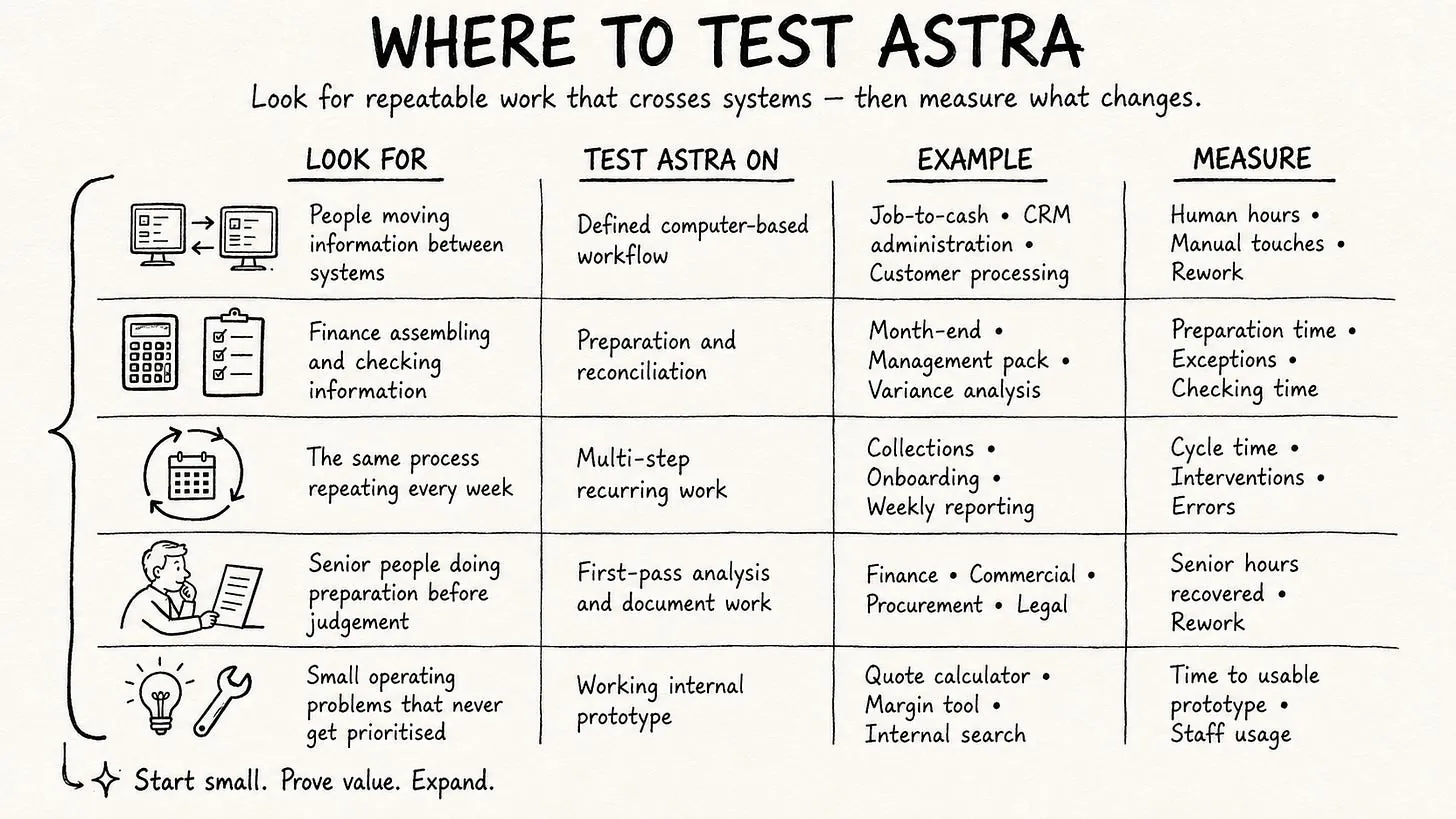
I would take this table into your next management meeting.
Pick the row costing you the most time.
Then pick one workflow inside it and put a baseline against the current process.
That is a better starting point than asking every department to come back with AI ideas.
I test new AI capability against operating work like this so executives can spend less time working out what is worth paying attention to.
Rudi Khoury (CDO, Fisher & Paykel) breaks down the AI build-versus-buy trade-off. Listen on Apple Podcasts or Spotify.
4. Senior preparation
Look at your highest-paid people and the prep work they perform before applying their actual experience:
- A commercial director reads the tender pack before positioning a bid.
- Finance assembles and reconciles data before explaining monthly results.
- Procurement compares supplier material before negotiating.
- Legal organises and reviews documents before giving advice.
- A general manager pulls together the operating pack before diagnosing an issue.
Preparation is necessary, but it does not have to be done by the person making the decision.
Give Astra the source material, operating rules, and a clear definition of what needs human review. Then measure the entire process.
If a 4-hour prep task drops to 3 hours because the senior leader still has to re-check most of the work, leave it alone or redesign the test. If that same leader can review exceptions in 40 minutes and spend the rest of the time on the commercial decision, the economics change completely.
Measure what happened to the person's time and how they used the newly freed capacity.
5. Small internal tools
The fifth job to test is building small internal tools - which was the third thing I tested personally.
A quote-versus-actual margin calculator had been discussed for months. People wanted it, though it never became important enough to turn into a proper software project.
I used voice again to talk Astra through the logic, gave it sample data and asked for the first version. It opened the tool in the browser, ran the sample data and showed me the result. I talked through the changes while looking at the screen, and Astra rebuilt and tested it again.
A couple of iterations later, I had something usable.
I think this matters for businesses below $100M because there are plenty of internal problems that fall into this gap.
- A quoting calculator would help sales.
- Operations wants a simple dashboard.
- Finance wants a better margin view.
- Someone wants to search old job folders without opening files individually.
The idea never becomes important enough to compete with the larger technology work, so the spreadsheet survives.
I would test Astra on:
- quote calculators
- margin dashboards
- internal search across project or customer files
- supplier lookup tools
- small workflow tools
- simple operational dashboards
Build enough to put the idea in front of the person who has the problem.
Then watch whether they use it.
If it solves something real, decide what proper engineering, security, support and controls are required before it goes further.
If nobody uses it, stop.
You have answered the question without funding a full project...
Where I'd leave it alone
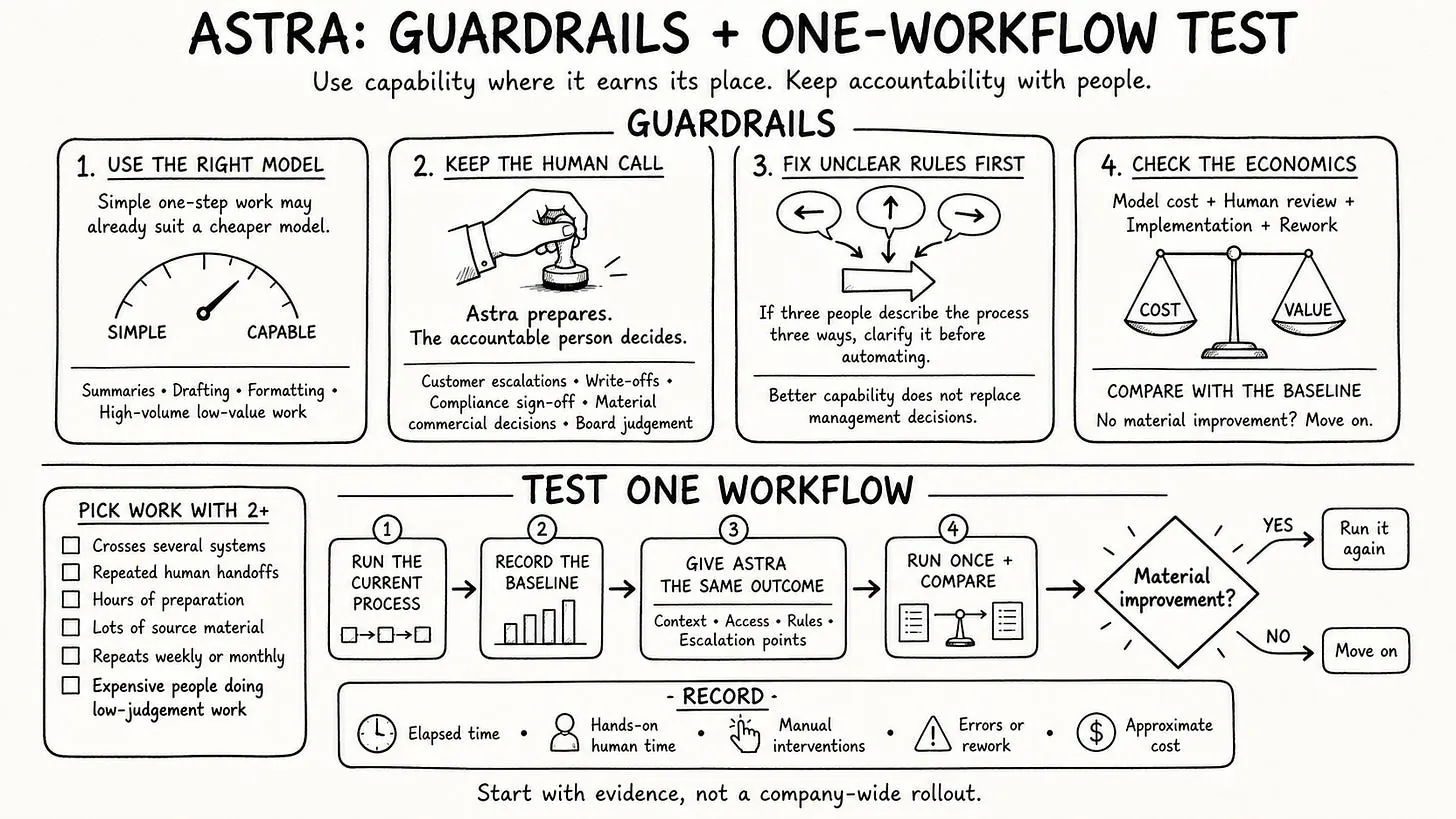
I would not move simple one-step work onto Astra when a cheaper model already handles it well.
Basic summaries, simple drafting, formatting and high-volume low-value work do not automatically need your most capable model.
I would also keep final human ownership around consequential decisions.
Until next time,
Ramon.
Before Friday
Continue the conversation
Should your business build its own AI tools, or just buy what's already on the market?
For growing and mid-sized businesses, making the wrong call here is incredibly costly - it can easily tie up your lean development team for months or drain cash on software you could have bought off the shelf.
On this week's podcast, Rudi Khoury (Chief Digital Officer at Fisher & Paykel) joins me, to break down the math behind the build-vs-buy equation.
While he operates at a large enterprise, the core principles he shares about preserving focus, avoiding custom code debt, and partnering smart apply directly to smaller, more agile teams.
Listen on Apple Podcasts or Spotify.
About Applied AI Australia
Applied AI Australia helps businesses turn AI into measurable bottom-line outcomes. We filter every initiative through a single question: Does this increase revenue or decrease costs?
After carrying the P&L at News Corp, I built Applied AI Australia because I kept seeing smart leadership teams sold vague AI strategies that never touched the balance sheet.
Following our acquisition by Acquire Intelligence, we now back this with the execution power of a 9,500-person delivery team.
Need help? Just reply to this newsletter - I read every response and will get back to you within 48 hours.
Disclaimer: Nothing in this newsletter is legal, financial, or professional advice. It is research, pattern recognition, and practical operating observations for Australian boards and executives. Before acting on any of it, speak with your own adviser.
Ready to deploy AI with confidence?
Get board-ready frameworks and strategic guidance for Australian executives navigating AI transformation.
Discuss your AI problem