Loop Engineering: The AI Skill Executives Need Next
Why the best leaders are replacing reactive management with systems that drive continuous improvement. Here's how you start.
How to use this issue: pick one high-value activity and try one full loop cycle. Upload this newsletter into AI and watch it happen.
The gap between how your people work and how you lead keeps widening
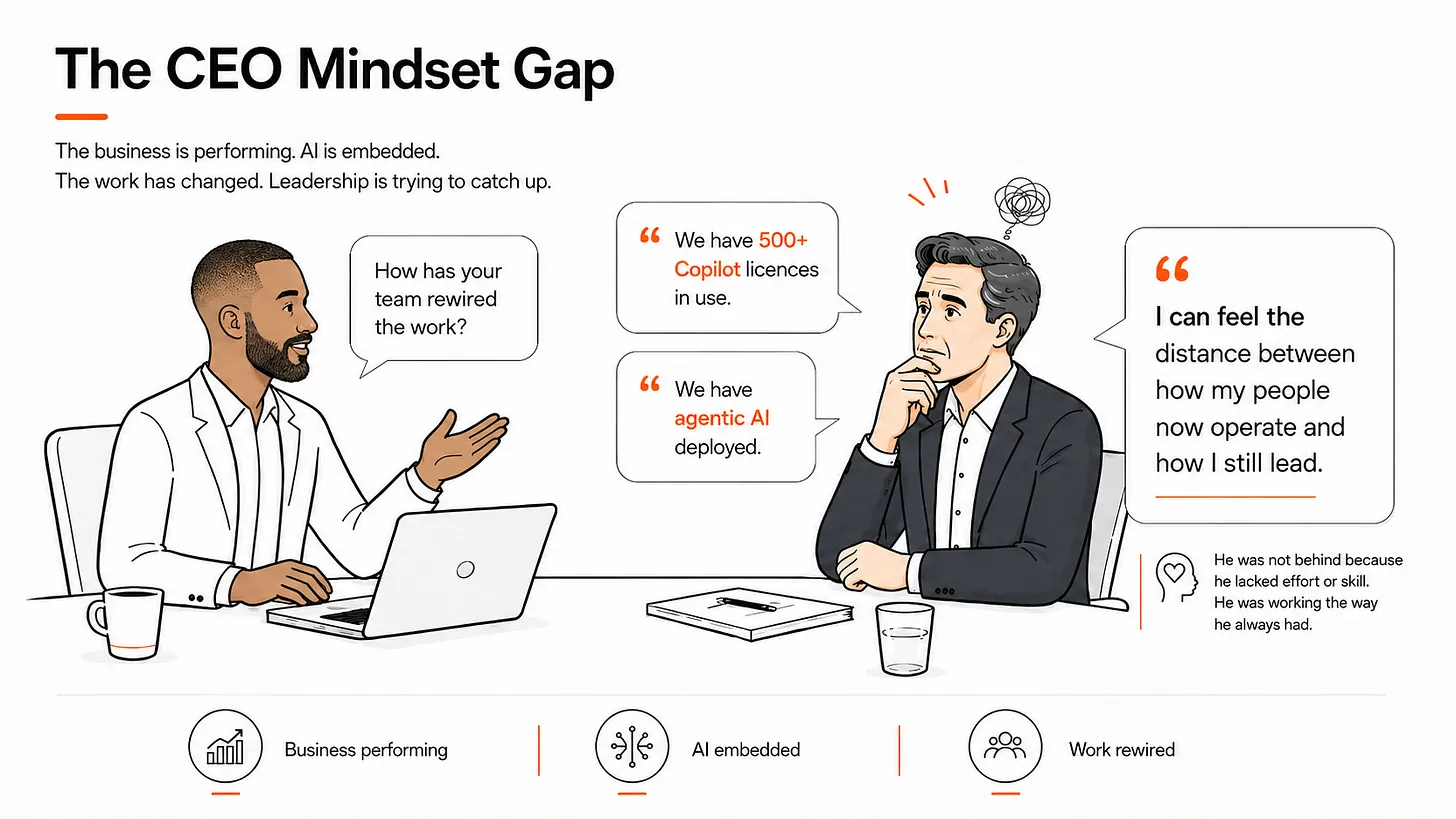
Last month a CEO, let's call him Mark, walked me through his month. He said his team had rewired how work gets done. Work was moving faster, the business was performing well, and AI was now part of the operating rhythm.
I said, "That is good to hear. How has your team rewired the work?"
He said, "We have more than 500 Copilot licences in use, and we have agentic AI deployed."
The more I probed, the more overwhelmed he became.
Finally he said, "I can feel the distance between how my people now operate and how I still lead. It seems to be widening every month. How do I get on top of this AI stuff?"
Mark was not behind because he lacked effort or skill. He was working the way he always had. He wanted to know whether his traditional methods were still the best way to move the needle. He also questioned whether he was still leading at the level the job now demands.
Catching up is the wrong instinct
I hear this from leaders constantly. The instinct is to catch up: read more, attend more events, buy more tools. That instinct is mostly wrong.
What got you here will not get you there.
**The change starts with a decision:**put the old way of working to one side and approach every task through an AI-first lens. Ask yourself constantly how AI can augment the work in front of you.
- Sometimes it automates the task completely.
- Sometimes it makes you faster.
- Sometimes it adds nothing, at least not yet.
Apply AI to your highest-value work
When I started working with AI in 2020, I tried everything to connect it to my work:
- every task
- every hour mapped
- every workflow
- flowcharts
- mind maps
- week-by-week notes
Over time I stopped needing the log. What became clear was simple: apply it to your highest-value work. That is where AI generates the most value.
What if every important business problem had an intelligent loop around it, one that could search wider, test faster, diagnose issues earlier, improve the work, and only escalate the decisions that actually require leadership attention?
I call it Loop Engineering, and the rest of this read will tell you how to build one.
The unit of work has changed from task to cycle
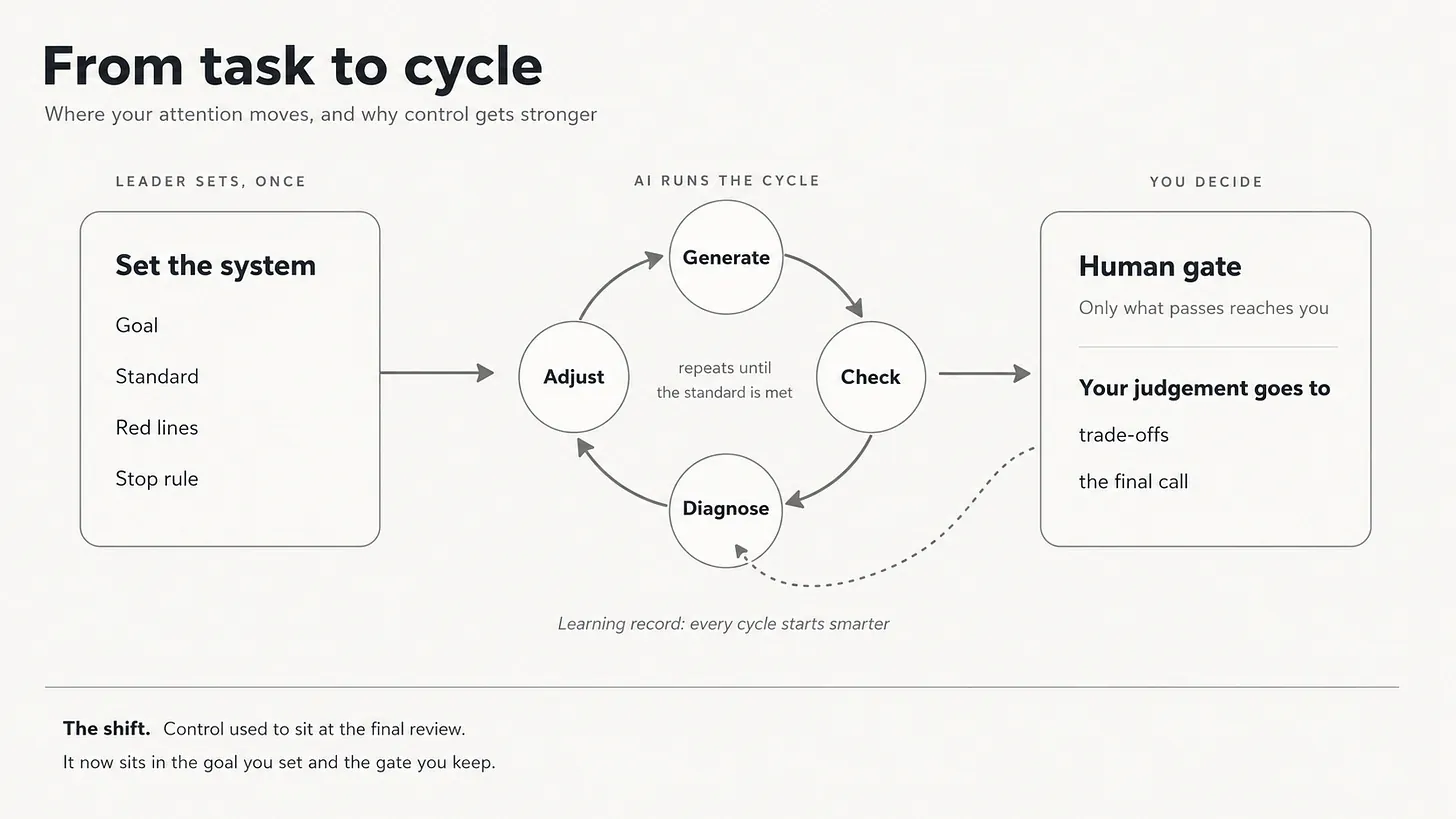
A prompt gives AI an instruction. A loop gives it a governed job.
Five steps that run on repeat:
- Goal: the outcome you are improving. Every pass is measured against it.
- Generate: the system produces the work.
- Check: it scores that work against the standard.
- Diagnose: when the work falls short, it finds the specific cause.
- Adjust: it changes one lever, then runs again. This is where it self-corrects.
You set four rules around the loop:
- Standard: what good looks like, specific enough to score against.
- Red lines: what gets rejected on sight.
- Human gate: the call that still needs you, the trade-off and the final yes.
- Stop rule: when to stop, escalate, or kill it.
Don't lead tomorrow's business with yesterday's playbook.
Applied AI Australia → Listen to the latest episode on Apple Podcasts or Spotify.
Reactive functions become self-improving engines
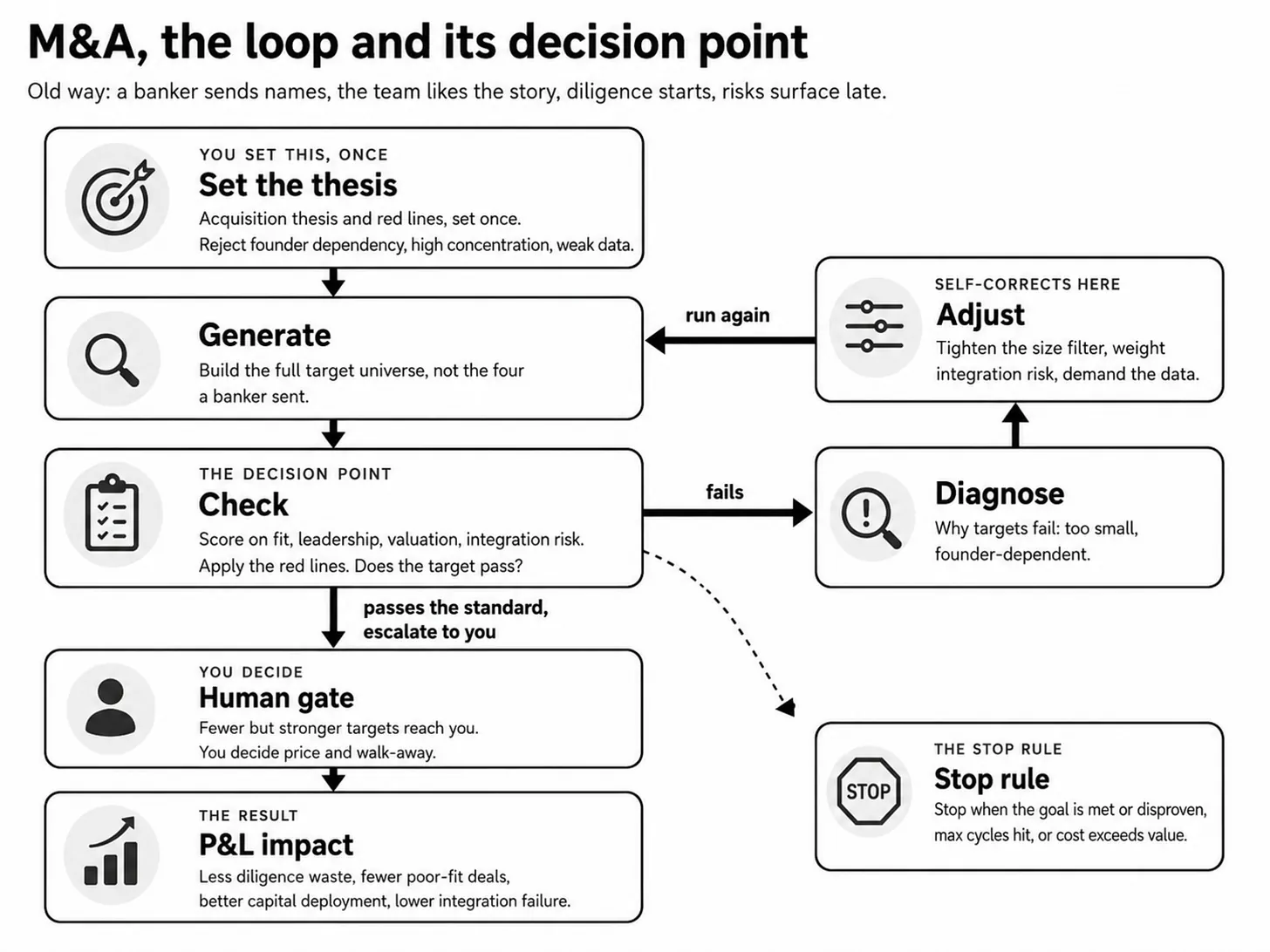
Loop Engineering changes where leadership attention goes
You stop controlling individual outputs by hand. You start defining the standard, setting the measures, deciding the exceptions, and improving the system itself.
"AI becomes a commercial asset when it stops answering isolated requests and starts improving the way the business works. Which process should we put a loop around first, and who owns the goal?"
Where it breaks
Loops break in predictable places:
- Poor goal: the system works toward the wrong thing.
- Weak standard: the system cannot tell good from bad.
- Bad context: the output looks sharp and rests on nothing.
- Cosmetic checking: the system reviews itself without real verification.
- Shallow diagnosis: the system names a failure it cannot explain.
- Wrong adjustment: the system tightens the wrong lever.
- No stop condition: the loop becomes sunk cost with better language.
- No human gate: the system crosses into decisions it should not own.
- No memory: the learning disappears and every cycle starts cold.
- Wrong environment: a chat window cannot run a fully governed cycle without tools, logs, and permissions.
Run it in one step
Upload this newsletter and get started in 2 ways.
- Terminal / CLI (Claude Code or Codex): The real way to implement
- Standard Chat (ChatGPT, Claude, Gemini, etc.): Best for a quick start-simply upload or paste the text straight into your web browser.
💡 Looking for the setup? Whether you want the step-by-step terminal installation lines or prefer to copy-paste the individual prompts by hand, the complete toolkit and step-by-step guide are waiting for you in the Appendix at the end of this issue.
I have uploaded the Applied AI Australia Loop Engineering issue. Use the goal interrogator prompt inside it to run me through the goal protocol now, one question at a time, and do not move on until I have a locked goal block. Then use the loop prompt inside it to run the cycle on my problem: [describe your business problem in one sentence]. If the loop stalls, use the recovery prompt, then carry on. Treat the three prompts as one sequence and take me through it end to end.
It will grill you on the goal, lock it, then run the loop and come back only when it needs your call.
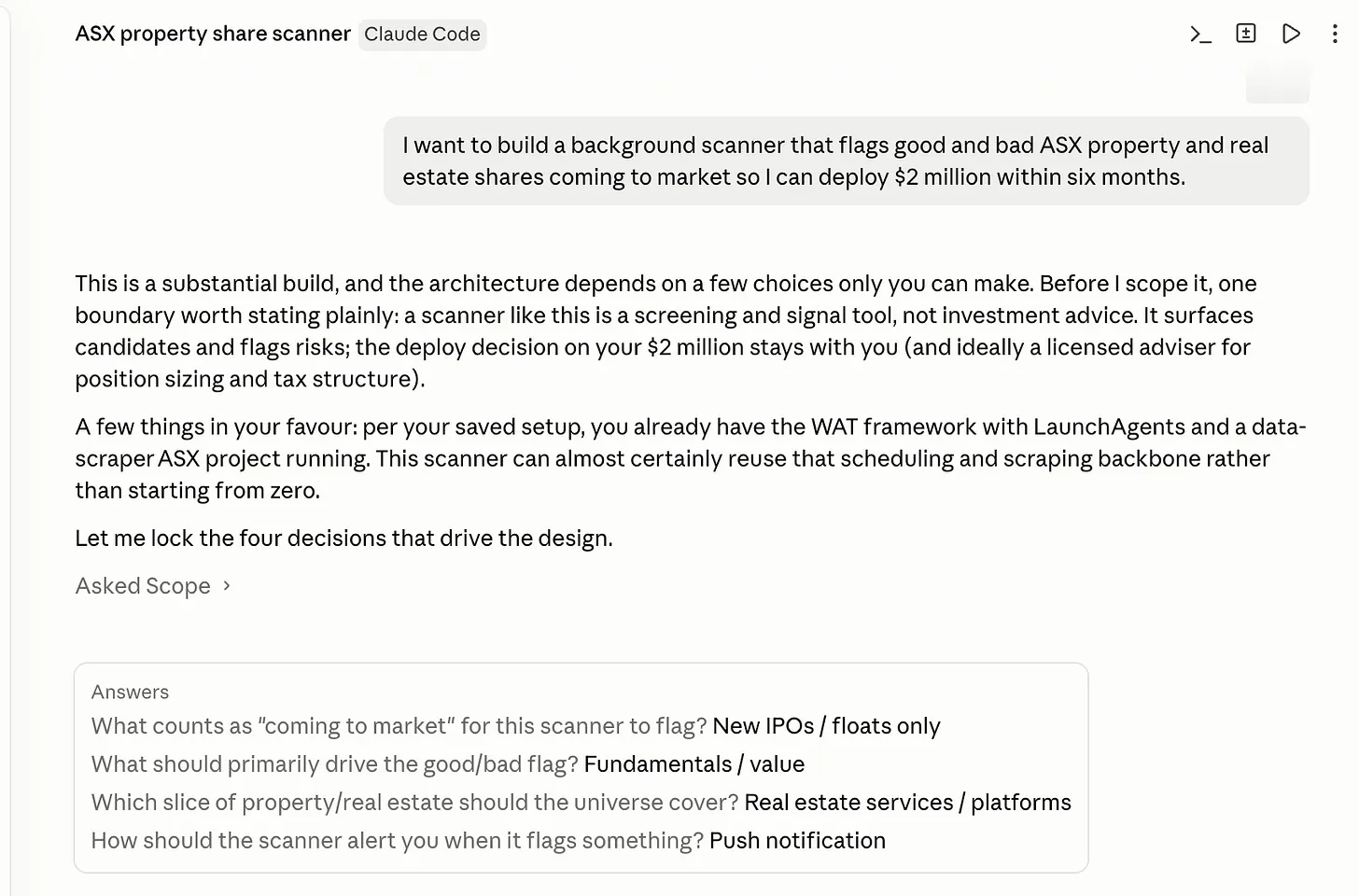
Run your first loop in the next 48 hours
Before Friday, select one high-value process where you need better visibility and run a single loop on it.
Forward this to whoever owns operating performance, with one question: "Which of our recurring decisions are we still reviewing manually, and which should already be a self-improving loop?"
Until next time, Ramon.
About Applied AI Australia
Applied AI Australia helps executives turn AI into measurable business outcomes. We filter every initiative through one question:
Does this increase revenue or decrease costs? If not, it's noise.
I am not a career consultant. I am a leader with 15 years of P&L experience, recently an executive at News Corp. I've seen what works and what doesn't at scale.
Following our recent acquisition by Acquire Intelligence, we combine this approach with a 10,000-strong global team that delivers enterprise execution.
Right now, many leaders are asking:
- Where is AI already affecting growth, margin, time and risk, and where do we have exposure we have not properly mapped yet?
- Which AI opportunities are actually worth funding, and which ones are just noise?
- What should we do next: audit, workshop, roadmap, governance review or pilot?
- How do I stay credible and competitive as AI changes my role, my team and my organisation?
Subscribe to the weekly podcast and newsletter for plain-English judgement and practical frameworks in under an hour a week.
Listen on Spotify or Apple Podcasts.
Need to move faster on governance, prioritisation or getting your business AI-ready before the next regulatory sprint?
Book a short call here.
Disclaimer: Nothing in this newsletter is legal, financial, or professional advice. It is research, pattern recognition, and practical operating observations for Australian boards and executives. Before acting on any of it, speak with your own adviser.
Appendix: run it yourself, the full toolkit (power users)
This appendix is for the two groups who want more control: terminal users who want to run it natively, and power users who want to drive each stage of the loop by hand.
⚠️ The fully autonomous version is not yet available out of the box in standard consumer apps like ChatGPT or the Claude desktop app. To run it at full potential you need a terminal or IDE such as Claude Code or Codex. Or I have the prompt pack below for those who rather not.
In a terminal (Claude Code or Codex): one command
First time, and nothing installed? It is one line. Open your terminal (Terminal on a Mac, PowerShell on Windows), paste one of these, then type claude or codex to start.
Claude Code, Mac or Linux:
curl -fsSL https://claude.ai/install.sh | bash
Claude Code, Windows PowerShell:
irm https://claude.ai/install.ps1 | iex
Codex, Mac or Linux:
curl -fsSL https://chatgpt.com/codex/install.sh | sh
Claude Code needs a paid Claude plan, Pro or above. Codex is included with ChatGPT Plus and up.
Once it is running, you do not need a heavy setup. Feed your objective and guardrails straight into the native /goal command in a single line. It handles the loop and the self-correction.
/goal Complete [business objective] without stopping until [verifiable end state]. Rules: 1. Always validate progress by running [test or build command]. 2. Never [insert absolute red line]. 3. Stop and ask me if [insert escalation trigger].
In a chat window, by hand: the three prompts in order
You paste a prompt, answer the AI's questions in plain English, and decide what to do with the output. The AI handles the protocols, the scoring, and the placeholders. Your job is simple: paste, answer honestly, and choose what comes next.
Run them in one chat, not three separate ones. If you uploaded this issue first, the AI already has all three prompts and will carry you from goal to loop to recovery without you pasting again. The three are laid out below so you can see and control each stage.
The three run as one sequence: the goal prompt locks the target, the loop prompt runs until the work passes or the path is killed, and the recovery prompt unsticks it if it stalls.
Step 1: lock the goal. Paste this into a fresh chat and answer its questions.
You are a goal interrogator. Your job is to stop me from working on the wrong thing.

Run me through this protocol. Do not skip steps. Do not let me past a step until I answer cleanly. Push back hard. Do not flatter me. Do not invent additional steps.

1. STATE THE GOAL IN ONE SENTENCE
   - Reject vague verbs: improve, enhance, drive, enable, optimise, leverage, support, explore, understand, look into.
   - Reject anything that cannot be observed externally by a third party who cannot ask me questions.
   - If the verb is vague, force a restate with a measurable outcome.

2. DEFINE "DONE"
   - What would a third party point to and say "this is the result"?
   - Name the metric, the delta, the deadline, and the artefact. One sentence each.

3. RED LINES (minimum three)
   - What automatically disqualifies any solution, regardless of how attractive?
   - Push back if I give fewer than three.

4. WALK-AWAY CONDITIONS
   a) Falsifying evidence: what would prove the goal itself is wrong, not just the method?
   b) Spend cap: the maximum I will spend in time, money, and attention before walking.
   c) Break-point: at what observable trigger does walking away beat pushing through?

5. NAME THE BIAS MOST LIKELY TO DISTORT THIS
   - Pick one from: sunk cost, sponsor pressure, ego, optimism, charisma, anchoring, FOMO, status, recency.
   - Explain in one line why it applies here, not in general.

6. PRESSURE TEST (you argue, I defend)
   a) Argue the strongest case the goal is the wrong target.
   b) Argue the strongest case the goal is right but the timing is wrong.
   c) Argue the strongest case someone else should own this, not me.
   I defend all three before you continue.

7. SCORE THE GOAL (0 to 1) on:
   - Clarity
   - Measurability
   - Falsifiability
   - Commercial fit
   GATE: all four scores at or above 0.80 AND average at or above 0.85. If either condition fails, send me back to step 1. Do not negotiate.

OUTPUT a single locked block I can paste into the loop:
   GOAL: <one sentence>
   SUCCESS: <metric, delta, deadline, artefact>
   RED LINES: <list>
   WALK-AWAY: <falsifying evidence | spend cap | break-point>
   BIAS WATCH: <named bias, one-line reason>
   CONFIDENCE: <four scores and the average>

If I am being lazy, emotionally committed, or moving fast to avoid the question, say so directly.

When the locked goal block is complete, do not wait for another prompt. If the loop prompt is available to you, for example because this issue is uploaded, continue straight into the loop on this goal. If it is not, tell me to paste the loop prompt next.
Step 2: run the loop. Paste this into a fresh chat, then replace the bracketed lines with the block from Step 1.
You are running a generate -> check -> stress test -> diagnose -> adjust cycle against a locked goal.

INPUT (replace each bracketed line with your own content before sending):
- Goal block from Step 1: [PASTE THE LOCKED GOAL BLOCK FROM STEP 1 HERE]
- Scoring rubric: [PASTE YOUR SCORING RUBRIC HERE, OR WRITE: USE THE FOUR CONFIDENCE CRITERIA FROM STEP 1]
- Red lines: [PASTE THE RED LINES FROM STEP 1 HERE]
- Walk-away conditions: [PASTE THE WALK-AWAY CONDITIONS FROM STEP 1 HERE]
- Max cycles: 5 (change this number if you want more or fewer)
- Stop conditions (any one fires the stop): standard met for two consecutive cycles with zero red-line breaches, goal disproven by evidence collected during the loop, max cycles hit, or expected value of next cycle below its cost.

EXPECTED VALUE CALC (use when invoking the EV stop):
   EV(next cycle) = P(material improvement this cycle) x value of that improvement
   STOP if EV(next cycle) < direct cost of running it. Show the numbers.

PROTOCOL, run every stage on every cycle. Same output structure every cycle so I can compare across.

A. GENERATE
   Produce the output: list, draft, recommendation, plan, or analysis.
   Show sources, assumptions, and confidence per claim.
   Flag anything resting on a single source or untested assumption.

B. CHECK
   Score the output against the rubric, criterion by criterion.
   Mark every red-line violation explicitly.
   Output pass or fail per criterion with one-line evidence.

C. STRESS TEST
   Run one adversarial pass: what would a hostile expert kill this on?
   List the top three ways this output fails when it reaches the human gate.
   Downgrade any claim resting on weak evidence after the stress test.

D. DIAGNOSE
   If the output fails, name the cause precisely. Pick exactly one:
   - Goal mis-specification
   - Missing or stale evidence
   - Wrong source or weak data quality
   - Faulty scoring weights
   - Structural mismatch (this option type was never going to work)
   - Bias contamination (optimism, sponsor pressure, anchoring, etc.)
   No "needs more work". Name the lever.

E. ADJUST
   Change exactly one lever based on the diagnosis. State what changed, why, and what the next cycle will test.
   Do not adjust multiple levers in one cycle. Ever.

F. REPEAT
   Re-run from A with the adjusted method.
   Maintain a learning log per cycle: number, lever changed, score before, score after, what was learned.

STALL TRIGGER:
   If the same diagnosis fires twice in a row OR the score does not move for two consecutive cycles, declare a stall. If the recovery prompt is available to you, run it yourself and then resume the loop with the patch applied. If it is not, tell me to paste it. Do not run a third cycle on the same diagnosis.

ESCALATE TO HUMAN GATE only when the output passes the standard AND survives the stress test for two consecutive cycles. Provide:
- Final output
- Score per criterion
- Stress-test summary: what could still kill this
- Learning log
- Recommended next decision: approve, adjust, kill, or expand scope

Do not produce filler cycles. Every cycle must move the score, change the diagnosis, or kill the path.
Step 3: recover when it stalls. Run this only when the loop stalls or contradicts itself.
You are the recovery layer. The loop has failed, stalled, or contradicted itself. Your job is to find the real break and patch it before the next cycle runs.

INPUT (replace each bracketed line with your own content before sending):
- Goal block: [PASTE THE LOCKED GOAL BLOCK FROM STEP 1 HERE]
- Last failed output: [PASTE THE LATEST FAILED OUTPUT FROM STEP 2 HERE]
- Loop log: [PASTE THE LEARNING LOG FROM STEP 2 HERE, OR DESCRIBE WHAT HAS BEEN TRIED]
- Failure mode observed: [DESCRIBE WHAT WENT WRONG IN ONE LINE: error, crash, repeated low score, contradiction, hallucination, red-line breach, plateau, or same diagnosis twice]

PROTOCOL:

1. CLASSIFY THE FAILURE, pick one and only one:
   a) Goal failure: the goal is wrong, fuzzy, or unmeasurable.
   b) Evidence failure: the data feeding the loop is stale, missing, or wrong.
   c) Method failure: generation or scoring cannot produce a valid output for this goal.
   d) Verification failure: the check stage lets bad output through or rejects good output.
   e) Execution failure: the system crashed, timed out, or hit a constraint.
   f) Bias failure: the loop is optimising toward an attractive but commercially wrong direction.

2. ROOT CAUSE
   Drill with "why" until you hit a single named, changeable lever. Maximum five whys. Output the full chain so I can audit your logic.

3. PATCH
   Propose exactly one minimum viable change that fixes the root cause without rewriting the loop.
   Removal is preferred over addition. If the patch adds scope, justify why no removal would work.
   State exactly what changes in: prompt, source, scoring weight, verification rule, sequencing, or stop condition.
   State the cost of the patch and the expected effect on the next cycle.

4. REGRESSION CHECK
   List what the patch could break that was working before.
   Add a guard, test, or assertion that catches the regression on the next cycle.

5. LEARNING RECORD
   Write one line in this format:
   [Cycle N | Failure class | Root cause | Patch | Expected effect | Regression risk]

6. REPEAT-PATCH GUARD
   If this root cause has appeared in any previous recovery entry for this loop, do not patch again. Tell me to escalate to a human. The loop has a deeper structural problem.

7. DECIDE, pick one:
   - Resume the loop with the patch applied.
   - Escalate to human gate to adjust the goal, the standard, or the kill criteria.
   - Kill the loop because the goal is disproven or expected value is below cost.

Do not retry the same approach hoping for a different result. Do not patch more than one thing at a time. If you cannot name the root cause in a single sentence, tell me to escalate to a human.
Pushback is the signal that the prompts are working. The AI will start saying things you did not want to hear. Your goal will get rewritten on the first pass. Ideas you arrived with will get killed inside the loop. Assumptions you treated as facts will get challenged. Run it this week on a decision you have been delaying, and watch how fast the goal interrogator finds the fuzzy bit you have been avoiding.
Ready to deploy AI with confidence?
Get board-ready frameworks and strategic guidance for Australian executives navigating AI transformation.
Discuss your AI problem