Find the P&L Line Before You Fund the Pilot
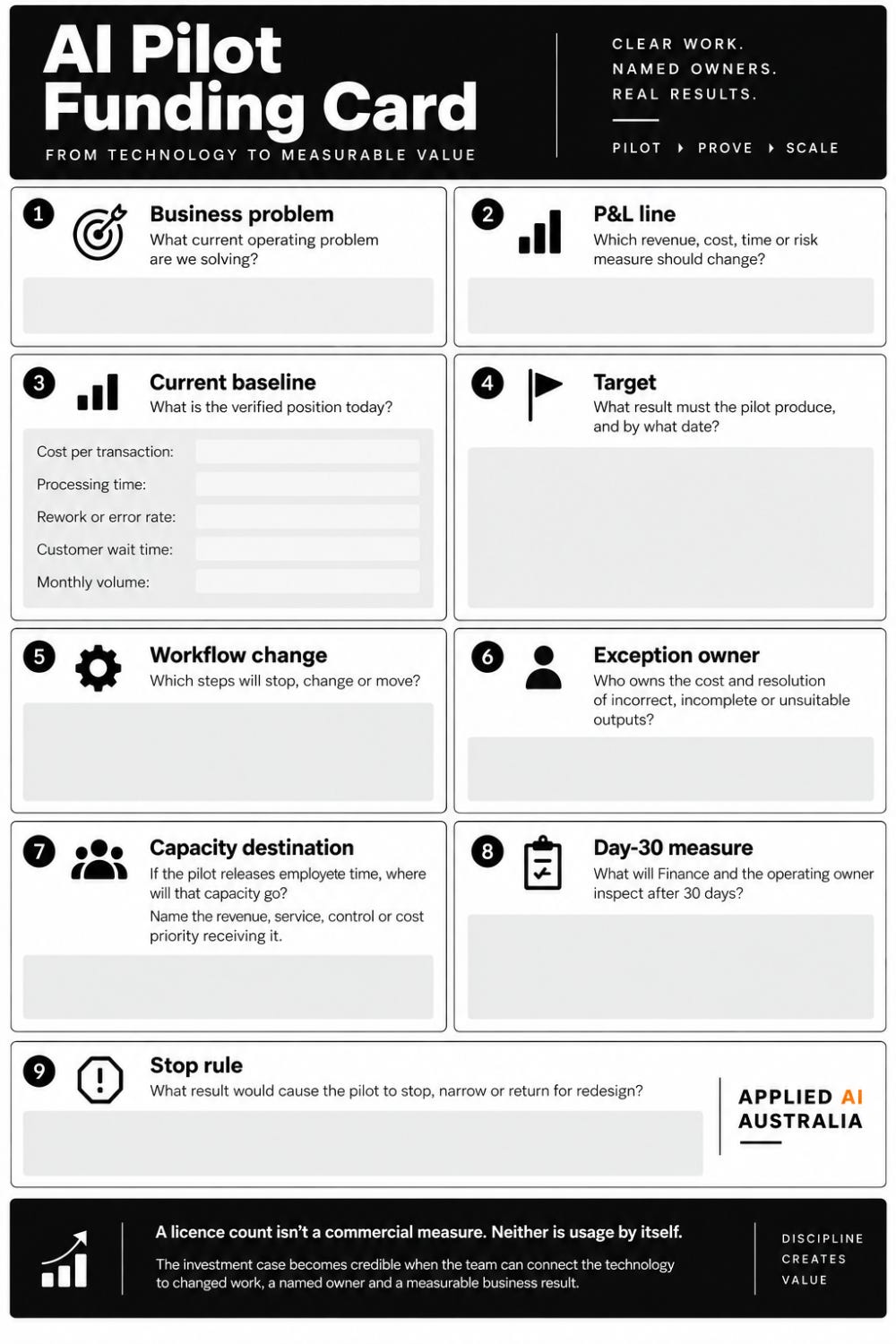
Before funding another AI pilot, require five operating conditions: a P&L line, verified baseline, exception owner, capacity destination, and Day-30 stop rule.
The funding decision
Across our operational audits of AI initiatives, more than 80% of project proposals lack at least one of three things: an exception owner, a destination for released capacity, or a defined stop rule.
Before approving another pilot, require five things:
- The P&L line expected to change.
- A verified operating baseline.
- A named exception owner.
- A destination for released capacity.
- A Day-30 measure and stop rule.
If the project lead cannot provide the evidence, hold the next allocation.
Task speed is the start
AI can remove six or seven hours from a fortnightly review and still leave the P&L unchanged. The result depends on what the team does with that saved time.
Proving a model can process documents, analyze data, or generate recommendations shows capability, but it doesn't establish a commercial result. The wider workflow still decides whether the investment reduces cost, releases capacity, increases revenue, or simply pushes the bottleneck elsewhere.
Whether a model speeds up analysis, a copilot drafts a document, or an agent generates recommendations, many AI business cases stop at the task level. Project teams convert saved minutes into annual productivity estimates and submit funding requests, bypassing the actual work surrounding the task.
Outputs still require human review, exceptions need handling, and approvals linger in queues-leaving released capacity to dissolve into extra reports, meetings, and administrative filler.
The correct test is end-to-end:
- What work stopped?
- Where did the constraint move?
- Who owns the exceptions?
- Where did the released capacity go?
- Which revenue, cost, time, or risk measure changed?
A faster task only matters when the operating model moves with it.
Fifty million combinations
The same operating discipline appears inside Coca-Cola Europacific Partners.
CCEP Australia serves roughly 100,000 customers across about 500 products. That creates approximately 50 million possible product-by-customer combinations.
Orlando Rodriguez , Managing Director of CCEP Australia (also my brother...), explained how the business applies AI inside that operating environment.
The commercial team must determine which products belong in which customer locations as demand, seasons, and locations shift. This review previously involved a manual process taking six or seven hours each fortnight.
CCEP now uses AI to generate these recommendations. The real impact comes from what the team does with those recommendations, not the volume produced. Teams shift hours away from manual diagnosis into setting priorities, allocating resources, and executing for customers.
Speeding up the task forced the surrounding operational model to adapt.
Answers reached the shift
The same principle appears inside CCEP's manufacturing operations.
Production lines run around the clock. When equipment performance dropped, teams previously analysed the operating data after the shift or after the equipment stopped. That review could take several hours.
CCEP now uses AI to run live diagnostics and give technicians a prioritised list of actions during the shift.
The information reaches the person who can act while the operating problem is still occurring. The technician receives a ranked set of issues rather than another report to interpret later.
The diagnostic capability is integrated into the way the team works. It doesn't sit beside the operation as an isolated test.
Solve the business problem.
"Doing something for the sake of it can be interesting, but in my experience and in my opinion, doesn't really give you traction and doesn't give you scale. You really have to apply it to a real, genuine business problem and opportunity."
To keep projects focused, CCEP evaluates initiatives against three criteria:
- Does the technology help team members spend more time on work requiring judgment, relationships, and execution?
- Does it remove friction for customers or make the organization faster and easier to work with?
- Does it build a platform the business can use to support sustainable growth?
CCEP looks for headroom to grow, material cost reduction, or a meaningful sustainability outcome. AI serves as a tool to pursue those outcomes- a discipline that prevents a large organization from funding every technically interesting use case at once.
Accountability stays visible
AI programs often lose accountability between the pilot and the operating business.
Technology owns the system, Finance owns the budget, Operations owns the workflow, and Risk owns the policy-yet no single owner accepts accountability for the complete commercial result.
Orlando's position was:
"Accountability stops with me, but individual functions have their accountability."
The chief executive remains accountable for the business outcome, while individual functions retain responsibility for the parts they control. A named executive owner connects these moving pieces, ensuring the initiative is measured against P&L results, not technology adoption.
The technical demo should never move into production before someone defines the P&L result and accepts ownership of the exceptions.
Use the capital gate
Before funding the next pilot, require the project lead to complete this card.
Before Friday
- Choose one AI pilot currently seeking more funding.
- Ask the project lead to complete the funding card using verified operating data.
- Have Finance confirm the baseline and the operating owner confirm where released capacity will go.
If the team cannot name the P&L line, exception owner, capacity destination, and Day-30 measure, hold the allocation until the investment case is ready.
Until next time, Ramon.
The Applied AI Australia Podcast
Practical AI Governance & Operational Decision-Making
If this commercial framing resonates, join our weekly executive discussions on how enterprise operators evaluate AI initiatives, manage risk, and align technology investments with P&L impact.
- This Week: Where do you start with AI at scale with Orlando Rodriguez, MD of Coca-Cola Europacific Partners Australia.
- Next Week: The agentic workforce and the executive augment role with Jo-Anne Ruhl, Vice President & Managing Director of Workday ANZ.
Watch or Listen to the Latest Episode
Coca Cola (CCEP) Managing Director - Orlando Rodriguez
About Applied AI Australia
Applied AI Australia provides board-level advisory, governance reviews, and diagnostic audits for executive teams. We evaluate every initiative against direct revenue growth or cost reduction.
We deliver structured frameworks to determine which decisions AI should change, where risk must be contained, and how freed capacity is reallocated to drive margin.
Founded by Ramon Rodriguez, a commercial leader with 15 years of P&L experience, including executive general management at News Corp Australia, Applied AI Australia operates as an independent strategic advisory front door.
Where enterprise engineering and execution capacity are required, implementation is separately scoped through our execution partner, Acquire Intelligence.
Next Steps for Your Leadership Team
Interested in evaluating your current AI proposals against a verified commercial baseline?
Book a 45-Minute Executive Briefing: A focused, peer-level working session on your AI governance and capital allocation.
Disclaimer: Content published by Applied AI Australia represents research, pattern recognition, and practical operating observations for executive teams and boards. It does not constitute formal legal, financial, or technical advice.
Work through this decision with us
If this issue raises a decision your team now faces, start with the business problem.
Resolve a business problem